
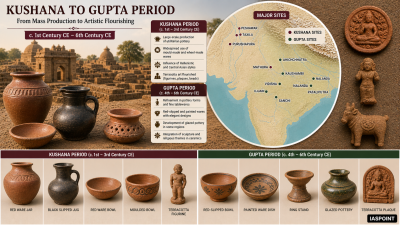
The transition from the Kushana period (c. 1st Century CE – 3rd Century CE) to the Gupta period (c. 4th Century CE – 6th Century CE) marks a significant shift in Indian ceramic traditions. While the preceding Mauryan era was defined by the technical perfection of NBPW, the Kushana and Gupta phases prioritized mass production, functional diversity, and the integration of sophisticated plastic arts (sculpture) into ceramic forms.
Kushana Pottery: The Red Polished Ware Era
Kushana pottery is characterized by its utilitarian robustness and the influence of Central Asian and Mediterranean styles due to the Silk Road trade.
Key Characteristics and Types
- Red Polished Ware (RPW): The hallmark of this period is a smooth, sturdy red ware with a bright red slip. It was fired in an oxidizing atmosphere.
- Sprinkler Form: One of the most diagnostic shapes of the Kushana period is the “sprinkler” (a vessel with a small neck and a perforated spout), used for both ritualistic and domestic purposes.
- Decorated Surfaces: Unlike the plain NBPW, Kushana pottery frequently features stamped, incised, or molded decorations. Common motifs include the Nandipada, Swastika, and floral scrolls.
- Foreign Influence: The presence of “Rouletted Ware” and “Amphorae” fragments at Kushana sites indicates strong trade links with the Roman Empire.
Major Kushana Sites
- Purushapura (Peshawar): Revealed high-quality Gandhara-influenced ceramics.
- Mathura: A major production center for both stone sculpture and red-slipped pottery.
- Sanghol (Punjab): Famous for yielding a wide variety of stamped Kushana bowls and jars.
Gupta Pottery: The Golden Age of Ceramic Art
The Gupta period, often called the “Golden Age” of Indian history, saw pottery evolve into a medium of fine art. The ceramics of this era are noted for their elegance, thin walls, and intricate relief work.
Technical and Aesthetic Advancements
- Molded Pottery: The Guptas perfected the use of molds to create pottery with elaborate relief scenes depicting mythological stories, animals, and floral patterns.
- Polychrome Pottery: Some rare specimens show the use of multiple colors, though the classic red-slipped ware remained dominant.
- Mica-mixed Ware: Potters often mixed mica with clay to give the vessels a glittering, “golden” appearance, known as Micaceous Red Ware.
- Evolution of Forms: The period saw the introduction of complex shapes like high-necked jars (Kalasas), spouted vessels with animal-shaped spouts (Makara-mukha), and multi-handled jars.
Terracotta Art in the Gupta Period
Pottery during the Gupta era was not limited to vessels. This period produced the finest terracotta plaques used in temple architecture (e.g., Bhitargaon Temple).
- Religious Themes: Figures of Vishnu, Shiva, and Buddha were common.
- Secular Themes: Scenes of daily life, court scenes, and amorous couples (Mithuna) were frequently depicted on terracotta panels.
Comparative Analysis: Kushana vs. Gupta Pottery
| Feature | Kushana Pottery | Gupta Pottery |
| Primary Style | Red Polished Ware (RPW) | Micaceous and Molded Red Ware |
| Key Shapes | Sprinklers, handled jugs, deep bowls | Kalasas, Makara-spouted jars, ornate lids |
| Decorative Technique | Stamping and Incision | High-relief molding and painting |
| Cultural Influence | Greco-Roman and Central Asian | Indigenous Classical (Puranic) themes |
| Texture | Generally thick and sturdy | Fine-grained, thin-walled, and elegant |
360° Archaeological Facts and Trivia
- The “Kushana Sprinkler”: This specific vessel is a “type-fossil” for archaeologists; finding it immediately identifies a layer as belonging to the 1st–3rd century CE.
- Ahichchhatra Stratigraphy: The excavations at Ahichchhatra (UP) provide the most comprehensive sequence of Indian pottery, clearly showing the transition from Kushana red ware to Gupta molded ware.
- The Golden Glitter: The Gupta use of mica wasn’t just for aesthetics; it also acted as a tempering agent, helping the clay withstand the stresses of firing.
- Secular to Religious: While Kushana pottery remained largely functional, Gupta pottery became an extension of the temple-building tradition, with many vessels used specifically for temple rituals and libations.
- Decline of Luster: By the Gupta period, the mirror-like finish of the Mauryan NBPW had completely disappeared, replaced by a preference for texture, relief, and color.
Summary of Functional Classes
- Ritualistic: Sprinklers (Kundi) and spouted vessels used in Buddhist and Hindu ceremonies.
- Domestic: Large storage jars for grain, cooking pots (Handis), and drinking bowls.
- Architectural: Terracotta bricks and ornamental tiles for temples and monasteries (Stupas).
- Commercial: Standardized jars for the transport of oil, wine, and honey across internal trade routes.