

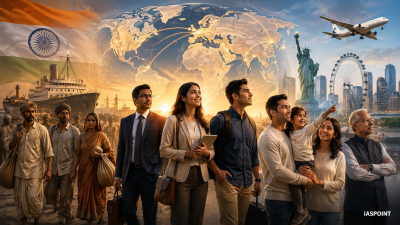
The Indian diaspora, currently the largest in the world according to the United Nations, is categorized into three distinct groups: Non-Resident Indians (NRIs), Persons of Indian Origin (PIOs), and Overseas Citizens of India (OCI). Their distribution is a result of diverse historical waves, including colonial-era labor migration, post-independence professional migration, and the modern IT-driven boom.
Major Diaspora Hubs: Demographic and Economic Profile
The following regions represent the most significant concentrations of the Indian community globally, contributing to India’s status as the top recipient of remittances.
| Region/Country | Estimated Population | Primary Composition | Economic/Political Significance |
| United Arab Emirates (UAE) | 3.5 Million | Blue-collar & Professionals | Largest source of remittances; vital for energy security. |
| United States of America | 4.4 Million | Highly skilled professionals | Significant political lobbying via “Samosa Caucus”; 6% of US tax revenue. |
| Saudi Arabia | 2.5 Million | Labor & Healthcare | Second largest destination for Indian migrant workers in the Gulf. |
| Malaysia | 2.0 Million | PIO (Tamils) | Strong cultural ties; preservation of Dravidian architecture. |
| Canada | 1.8 Million | Students & Professionals | High concentration in Punjab-origin population; significant political representation. |
| United Kingdom | 1.7 Million | Professionals & Business | Historical “Old Diaspora” links; major presence in healthcare and finance. |
| South Africa | 1.5 Million | PIO (Descendants of Indenture) | Foundation of Gandhi’s Satyagraha; strong business community in Durban. |
Regional Hubs and Cultural Synthesis
The Indian diaspora has not merely settled but has integrated Indian heritage into the local socio-cultural fabric of these hubs.
The Gulf Cooperation Council (GCC) Hub
Concentrated in the UAE, Saudi Arabia, Qatar, and Kuwait, this hub is characterized by “circular migration.”
- Cultural Preservation: Proliferation of Hindu temples (notably the BAPS Hindu Mandir in Abu Dhabi) and Gurdwaras.
- Institutional Influence: Presence of Indian schools (CBSE curriculum) and retail giants (Lulu Group) that export Indian food culture globally.
The North American Hub (USA and Canada)
This hub represents the “knowledge-based” diaspora.
- Scientific and Technical Prowess: Dominance in Silicon Valley (CEOs of Google, Microsoft, Adobe) and NASA.
- Cultural Soft Power: The mainstreaming of Yoga, Ayurveda, and Bollywood. Events like “Howdy Modi” and the celebration of Diwali at the White House signify deep diplomatic integration.
The Southeast Asian Hub (Malaysia, Singapore, Myanmar)
Primarily composed of the Tamil and Telugu diaspora who migrated during the 19th and early 20th centuries.
- Religious Architecture: The Batu Caves in Malaysia serve as a global center for the Thaipusam festival.
- Linguistic Heritage: Tamil is a recognized official language in Singapore, ensuring the preservation of classical Indian linguistics in the region.
The “Girmitiya” Countries (Fiji, Mauritius, Caribbean)
These hubs are unique as the diaspora has become the majority or a significant political minority.
- Mauritius: Often called “Little India,” where over 68% of the population is of Indian origin. It hosts the World Hindi Secretariat.
- Fiji: Significant influence of North Indian culture, particularly the Ramayana-mandalis (local community groups).
Institutional Framework and Government Initiatives
The Government of India has established robust mechanisms to engage with these hubs, recognizing them as “Soft Power” assets.
- Pravasi Bharatiya Divas (PBD): Celebrated biennially on January 9 to mark the return of Mahatma Gandhi from South Africa.
- Know India Programme (KIP): A flagship initiative for diaspora youth to re-engage with their Indian roots.
- VAJRA (Visiting Advanced Joint Research) Faculty Scheme: Designed to bring overseas scientists and academicians to Indian institutions.
- E-Migrate System: A digital platform to ensure the welfare of workers in the ECR (Emigration Check Required) countries, primarily in the Gulf.
Key Trivia for UPSC Prelims
- L.M. Singhvi Committee: The high-level committee (2000) that recommended the celebration of Pravasi Bharatiya Divas and the OCI scheme.
- Top Remittance Recipient: India became the first country to cross the $100 billion mark in remittances (as per World Bank reports).
- Article 5 to 11: Constitutional provisions dealing with citizenship, which form the legal basis for NRI and PIO statuses.
- Ghadar Movement: A historical diaspora initiative (USA/Canada) that played a crucial role in India’s freedom struggle.
- International Day of Yoga: A successful diplomatic outreach spearheaded by the diaspora, now recognized by the UN on June 21.