
The Bengal School of Art emerged in the early 20th century as a nationalist response to the dominance of Western academic realism in Indian art education. It was a pivotal component of the Swadeshi Movement, seeking to reclaim an “authentic” Indian identity by drawing inspiration from indigenous traditions and Asian aesthetic philosophies.
- Principal Founders: Abanindranath Tagore and E.B. Havell (the British principal of the Government School of Art, Calcutta) were the primary architects. Havell encouraged students to look towards Indian heritage rather than Greco-Roman models.
- Rejection of Oil Painting: The school consciously moved away from oil paints, which were associated with Western materialism, opting instead for watercolours, tempera, and the “Wash” technique.
- Pan-Asianism: Influenced by Japanese artists like Okakura Kakuzo, the school integrated Japanese brushwork and the “Wash” method, creating a synthesis of Indian and Far-Eastern styles.
Key Artistic Features and Techniques
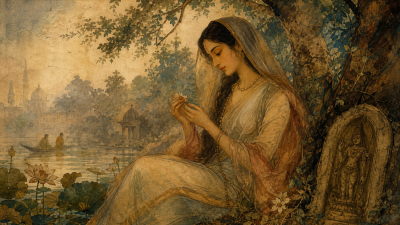
The Bengal School is characterized by a distinct “ethereal” or “dreamlike” quality. The style was deliberately evocative rather than descriptive.
- The Wash Technique: Introduced by Abanindranath Tagore after interacting with Japanese artists Taikan and Shunso. It involves soaking the paper in water after applying layers of transparent watercolour, resulting in a soft, misty finish with blurred outlines.
- Muted Color Palette: Use of soft, somber, and earthy tones instead of the bright, garish colors found in contemporary commercial art.
- Elongated Limbs: Human figures often featured delicate, elongated fingers and limbs, reminiscent of the Ajanta Murals.
- Stylized Anatomy: Unlike Western realism, the school prioritized the emotional “Bhava” (expression) over perfect anatomical accuracy.
Major Artists and Their Contributions
The school produced a generation of artists who later headed art institutions across India, spreading the “Indian Style.”
| Artist | Notable Contribution/Work | Key Feature |
| Abanindranath Tagore | Bharat Mata (1905) | Depicted India as a four-armed goddess holding food, cloth, palm leaf, and beads. |
| Nandalal Bose | Sati, Shiv and Sati | Illustrated the original manuscript of the Constitution of India; designed Padma awards. |
| Asit Kumar Haldar | The Flame of Heritage | Specialized in lacquer work on wood and Buddhist themes. |
| M.A.R. Chughtai | The Gloaming | Integrated Persian and Mughal aesthetics with the Bengal Wash style. |
| Kshitindranath Majumdar | Sri Chaitanya series | Known as the “Saint Artist” for his spiritual and Bhakti-themed works. |
Themes and Subjects
The subject matter was a conscious blend of history, mythology, and the simplicity of rural life.
- Mythology and Epics: Reinterpretation of scenes from the Ramayana, Mahabharata, and the Puranas.
- Historical Narratives: Depictions of Mughal and Rajput history, such as Abanindranath’s The Passing of Shah Jahan.
- Literary Inspiration: Visual representations of poems by Kalidasa (e.g., Meghadoota) and Rabindranath Tagore.
- Daily Life: Romanticized versions of village life, featuring bird sellers, pilgrims, and farmers.
Institutional Influence and Legacy
The Bengal School was not just a style but a movement that institutionalized Indian art.
- Indian Society of Oriental Art (1907): Founded to promote Indian-style paintings and organize exhibitions.
- Kala Bhavana (Santiniketan): Established by Rabindranath Tagore, where Nandalal Bose shaped a new curriculum that integrated art with nature and rural crafts.
- Vichitra Club: A cultural hub at the Tagore residence (Jorasanko) that served as a laboratory for experiments in art, music, and drama.
Fact Sheet for UPSC Prelims
- E.B. Havell’s Influence: He authored The Ideals of Indian Art, which argued that Indian art was superior in its spiritual depth compared to Western art.
- Bharat Mata Iconography: Originally titled Bangamata, it was renamed during the anti-partition protests in Bengal to represent the national spirit.
- Shift to Modernism: While the Bengal School was nationalist, it eventually faced criticism from the “Progressive Artists’ Group” for being too sentimental and traditional, leading to the birth of Indian Modernism.
- Nandalal Bose’s “Haripura Posters”: Created for the 1938 Congress session at Haripura, these posters depicted common Indian people (musicians, hunters, carpenters) using bold, local styles.
- Japanese Connection: The school’s “Wash” technique is technically a hybrid of the Japanese Nihonga style and Indian watercolor traditions.
- Recognition: The Bengal School is considered the first modern “identity-based” art movement in India, bridging the gap between traditional folk arts and modern international styles.