
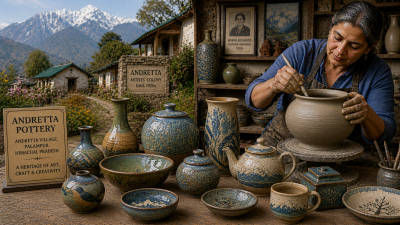
Andretta Pottery is a distinct school of ceramic art located in the small village of Andretta, near Palampur in the Kangra Valley of Himachal Pradesh. Unlike many indigenous Indian pottery styles that evolved from ancient tribal traditions, Andretta is a contemporary-classic craft. It was established in the 1980s by Mini Singh, the daughter of the renowned potter Gurcharan Singh (who was instrumental in the Delhi Blue Pottery trust). The movement was originally seeded much earlier in the 1920s and 40s by Norah Richards, an Irish dramatist known as the “Grandmother of Punjabi Theatre,” and later nurtured by B.C. Sanyal and Sobha Singh. This transformed the village into an artists’ colony, blending Himalayan sensibilities with modern studio pottery techniques.
Technical Characteristics and Materials
Andretta pottery is classified as Studio Pottery, which emphasizes the artist’s individual touch rather than mass production. It is famous for its slipware technique and specific aesthetic choices.
- Clay Sourcing: The artisans use local terracotta clay sourced from the Kangra Valley. This clay is known for its high iron content and fine plasticity.
- Slipware Technique: A “slip” (a liquefied suspension of clay in water) is applied to the surface of the vessel. Andretta is particularly famous for its Slip Trailing method, where liquid clay is “drawn” onto the pot to create raised patterns.
- Glazing: The pottery is known for its vibrant lead-free glazes. The signature colors include Deep Blue, Turquoise, and Sunlight Yellow, often reflecting the hues of the Dhauladhar mountain range.
- Firing: Unlike traditional open-pit firing, Andretta uses modern kilns (up-draught and down-draught) to fire the stoneware at temperatures ranging from 1100°C to 1250°C, ensuring high durability.
Artistic Motifs and Design Philosophy
The designs of Andretta pottery are a synthesis of local Pahari culture and international influences.
- Pahari Motifs: Many designs are inspired by traditional Kangra miniature paintings and local flora, such as the rhododendron and pine needles.
- Functional Elegance: While highly artistic, the pottery is designed for functional use. Common items include tea sets, dinnerware, and “Rangoli” platters.
- Abstract Geometrics: Contemporary Andretta artists often use sgraffito (scratching through a surface to reveal a lower layer of a contrasting color) to create modern geometric patterns.
Comparative Overview: Andretta vs. Traditional Rural Pottery
| Feature | Andretta Pottery (Studio) | Traditional Rural Pottery (e.g., Kutch/Longpi) |
| Origin | 20th Century Artistic Movement | Ancient/Pre-historic Traditions |
| Material | Refined Clay with High-fire Glazes | Raw Earthy Clay / Stone Mix |
| Primary Tool | Electric or Kick Wheel | Manual Stone Wheel or Hand-molding |
| Firing Temp | High (1100°C+) | Low to Medium (600°C – 900°C) |
| Aesthetic | Glossy, Colorful, Contemporary | Matte, Earthy, Traditional |
| Producer | Trained Studio Potters | Hereditary Artisan Communities |
Socio-Economic Impact and Tourism
Andretta has evolved into a global hub for ceramic education.
- Andretta Pottery and Craft Society: This institution provides residential training programs, attracting students from across the world and sustaining the local economy through “Art Tourism.”
- Women Empowerment: The craft has provided a significant platform for local Himachali women to gain technical skills and financial independence.
- Geographical Identity: While it does not yet hold a GI tag like Kutch or Khurja pottery, it is recognized globally as a unique Himalayan brand, contributing to the “Made in India” luxury craft segment.
Key Factoids for UPSC Prelims
- Mini Singh: The pioneer who shifted from Delhi to Andretta to start the pottery revolution.
- Norah Richards: The Irish woman who invited artists to Andretta, creating the cultural infrastructure for the craft to thrive.
- Terracotta vs. Stoneware: While the base is local terracotta, the high-firing and glazing often push the final product toward the “stoneware” category in terms of strength.
- Environmental Aspect: The use of lead-free glazes and natural pigments makes Andretta pottery safe for food consumption and environmentally sustainable.
- Cultural Hub: Andretta is unique because it is one of the few places in India where “Theatre, Painting, and Pottery” coexist as a unified heritage ecosystem.
Current Status and Preservation
Andretta remains one of the most successful examples of a “living laboratory” for craft. The transition from purely traditional utility to high-end studio art has protected the village from the urban migration that plagues many other artisan clusters. The village serves as a model for the One District One Product (ODOP) initiative, showcasing how localized artistic excellence can achieve international market reach.
Last Modified: May 5, 2026