
The Rashtrakuta Empire (8th to 10th century CE) represents the zenith of Indian rock-cut architecture. Ruling primarily from Manyakheta, they inherited the artistic traditions of the Early Chalukyas and Pallavas but scaled them to unprecedented proportions. Their work is characterized by “monolithic” carving—the process of excavating an entire temple complex out of a single mountain of basaltic rock, moving from top to bottom.
The Kailasa Temple (Cave 16, Ellora)
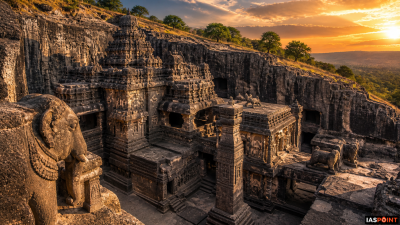
The Kailasa (Kailashanatha) temple at Ellora, commissioned by King Krishna I (756–773 CE), is the most remarkable achievement of the Rashtrakutas. It is a free-standing, multi-storeyed temple complex carved out of a single megalith.
- Engineering Marvel: Unlike traditional buildings constructed from the ground up, the Kailasa was carved vertically from the top of the hill downwards. Engineers removed over 200,000 tonnes of rock to reveal the structure.
- Architectural Synthesis: It combines the Dravida style (resembling the Virupaksha temple at Pattadakal) with unique Rashtrakuta innovations.
- Key Components:
- Nandi Mandapa: A separate pavilion for Shiva’s mount, connected to the main temple by rock-cut bridges.
- Dhvajastambhas: Two massive free-standing victory pillars (nearly 15 meters high) flanking the entrance.
- Shikhara: A four-tiered Dravidian pyramidal tower.
Iconic Sculptural Panels at Ellora
The sculptural program of the Rashtrakutas is noted for its dramatic energy, monumental scale, and anatomical precision.
- Ravana Shaking Mount Kailasa: Located on the plinth of the Kailasa temple, this masterpiece depicts Ravana attempting to uproot the mountain while Shiva remains calm, pressing his toe down to trap Ravana. It is celebrated for its depiction of muscular tension and divine serenity.
- Andhakasura Vadha: A fierce representation of Shiva slaying the demon Andhaka, showcasing the “Raudra” (furious) aspect of the deity.
- The Gajalakshmi Panel: Located at the entrance, depicting the goddess Lakshmi being bathed by elephants, symbolizing prosperity and sovereignty.
- The Elephant Plinth: The entire main temple sits on a high plinth carved with a continuous frieze of life-sized elephants that appear to be holding up the entire celestial structure.
Elephanta Caves (Gharapuri)
Located on an island near Mumbai, the Elephanta Caves represent the mature phase of Rashtrakuta sculptural art (mid-8th century).
- Trimurti (Sadashiva): This 6-meter-high colossal bust is the most famous Rashtrakuta sculpture. It represents three faces of Shiva:
- Vamadeva (Left): The feminine, creative aspect.
- Tatpurusha (Center): The serene, preservative aspect.
- Aghora (Right): The fierce, destructive aspect.
- Ardhanarishvara: A sophisticated relief depicting the union of Shiva and Parvati as a single half-male, half-female entity, representing the non-duality of the universe.
- Gangadhara Murti: Depicts Shiva catching the falling River Ganga in his matted hair to break her fall.
Comparative Features of Rashtrakuta Sculpture
| Feature | Description |
| Material | Dark volcanic Basalt (Trap rock), allowing for intricate detailing and high polish. |
| Scale | Marked by “Gigantism”—figures are often larger than life-size to inspire awe. |
| Motion | Sculptures often depict “frozen action” or dynamic movement (e.g., dancing Shiva). |
| Regional Influence | Blends the “Deccani” style with elements of North Indian (Gupta-Vakataka) and South Indian (Pallava) traditions. |
Notable Cave Sites and Monoliths
While Ellora and Elephanta are the primary centers, the Rashtrakuta influence extended to other significant rock-cut sites.
- Jogeshwari Caves: Noted for its elaborate Brahmanical shrines and transitional architectural features.
- Mandapeshwar Caves: Contains a rare rock-cut Sahasralinga and depictions of Nataraja.
- Dashavatara Cave (Cave 15, Ellora): Originally a Buddhist monastery, it was converted into a Shiva-Vaishnava shrine. It houses the famous “Vishnu as Narasimha” (Lion-man) relief.
Technical Facts for UPSC Prelims
- Patronage: While Krishna I is the most famous patron, later kings like Dhruva and Govinda III continued the expansion of rock-cut sites.
- Religious Pluralism: The Rashtrakutas patronized Hindu (Ellora Caves 13-29), Buddhist (Caves 1-12), and Jain (Caves 30-34) sculptures simultaneously.
- Jain Sculptures: The Indra Sabha and Jagannatha Sabha at Ellora are the finest examples of Rashtrakuta Jain rock-cut art, featuring detailed carvings of Tirthankaras like Mahavira and Parshvanatha under ornate canopies.
- UNESCO Recognition: Both Ellora (1983) and Elephanta (1987) are designated UNESCO World Heritage Sites.
Trivia for Competitive Exams
- The Kailasa temple is the only temple in the world that was “built” by removing rock rather than adding it.
- The Portuguese named the “Gharapuri” island “Elephanta” after seeing a massive monolithic stone elephant near the landing quay (this elephant is now located at the Jijamata Udyaan in Mumbai).
- The Rashtrakuta artists utilized a technique called circumambulation path (Pradakshina-patha) within the rock-cut structure itself, ensuring the monolithic temple functioned exactly like a structural one.