
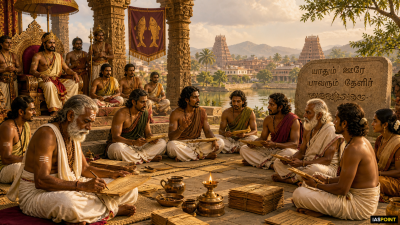
The term Sangam refers to the legendary assemblies (academies) of Tamil poets and scholars that flourished under the royal patronage of the Pandyan kings in Madurai. While the traditional timeline spans thousands of years, modern historians date the Sangam era primarily between 300 BCE and 300 CE. This literature represents the earliest known body of South Indian literature, providing an invaluable window into the socio-economic, political, and cultural life of the ancient Tamil country (Tamizhakam).
The Three Sangams (Muchchangam)
According to the Tamil tradition mentioned in the commentary on the Iraiyanar Agapporul, three successive assemblies were held:
| Sangam | Venue | Chairman | Surviving Literature |
| First (Thenmadurai) | Madurai (Submerged) | Sage Agastya | None |
| Second (Kapatapuram) | Kapatapuram (Submerged) | Sage Agastya / Tolkappiyar | Tolkappiyam |
| Third (Madurai) | Modern Madurai | Nakkirar | Ettutogai, Pattupattu |
Key Components of Sangam Corpus
The Sangam literature is broadly divided into two categories based on the subject matter: Akam (subjective/inner life, primarily love) and Puram (objective/outer life, primarily war, ethics, and kingship).
1. Tolkappiyam (Grammar and Poetics)
Authored by Tolkappiyar, a disciple of Agastya, it is the oldest surviving Tamil literary work.
- It is not merely a book on grammar (Eluttu and Col) but also discusses the classification of habitats, human emotions, and social customs (Porul).
- It provides the foundation for the Tinais (ecological zones).
2. Ettutogai (The Eight Anthologies)
This is a collection of eight narrative works composed by various poets:
- Narrinai: 400 short poems on love.
- Kuruntogai: 400 short poems on love.
- Aingurunuru: 500 short poems; 100 for each of the five landscapes.
- Padirruppattu: Provides historical information on Chera kings.
- Paripadal: Contains poems dedicated to gods like Vishnu and Murugan.
- Kalittogai: Noted for its use of the Kali meter.
- Akananuru: 400 poems on love.
- Purananuru: 400 poems on war and public life; a vital source for political history.
3. Pattupattu (The Ten Idylls)
This collection consists of ten longer poems, including:
- Tirumurugarruppadai: A devotional work dedicated to Lord Murugan by Nakkirar.
- Maduraikkanchi: Describes the socio-economic conditions of the Pandyan kingdom under Nedunjeliyan.
- Mullaippattu: Describes the rainy season and the pangs of separation.
The Concept of Ainthinai (The Five Landscapes)
Sangam poetry is uniquely characterized by the division of the Tamil land into five distinct ecological zones, each associated with a specific flower, mood, and lifestyle.
| Tinai (Landscape) | Geography | Primary Deity | Occupation | Love Mood |
| Kurinji | Hilly/Mountainous | Murugan | Hunting/Honey collection | Clandestine union |
| Mullai | Pastoral/Forest | Mayon (Vishnu) | Cattle rearing | Patient waiting |
| Marudam | Agricultural/Plains | Indiran | Farming | Lovers’ quarrels |
| Neital | Coastal/Littoral | Varunan | Fishing/Salt making | Pining/Anxious waiting |
| Palai | Arid/Desert | Korravai (Durga) | Waylaying/Robbery | Long separation |
Post-Sangam Literature (Pathinenkilkanakku)
As the Sangam age waned, a series of eighteen didactic works were composed, focusing on ethics and morals.
- Tirukkural: Authored by Thiruvalluvar, it is often called the “Tamil Veda” or the “Bible of the Tamil Land.” It is divided into three sections: Aram (Virtue), Porul (Wealth), and Inbam (Love).
- Naladiyar: A collection of 400 quatrains composed by Jaina monks emphasizing moral values.
The Twin Epics of Tamil Literature
Composed during the transition from the Sangam era to the early medieval period, these epics provide deep insights into the urban life of Puhar and Madurai.
- Silappadikaram (The Tale of the Anklet): Written by Ilango Adigal (a Chera prince). It tells the story of Kovalan, Kannagi, and Madhavi. It established the Pattini Cult (worship of the chaste wife).
- Manimekalai: Written by Sattanar. It is a sequel to Silappadikaram, following the life of Manimekalai (daughter of Kovalan and Madhavi) and her conversion to Buddhism. It is an important source for Buddhist philosophy in South India.
Socio-Economic Facts for UPSC
- Role of Women: Women were highly respected and many were poets (e.g., Avvaiyar). However, the practice of Sati (called Tipayadal) was mentioned in Purananuru as being practiced by some upper-class women.
- External Trade: Sangam literature frequently mentions Yavanas (Romans and Greeks). The poets describe Roman ships arriving with gold and leaving with pepper at the port of Musiri.
- Religion: The primary deity was Murugan (Seyon). Ancestor worship and the tradition of erecting Hero Stones (Virakal) in memory of fallen warriors were prevalent.
- Caste System: The Aryan Varna system was not fully established; society was divided into tribal groups like Panar (bards), Tudiyan, and Paraiyan.
Important Facts and Trivia
- The Legend of the Anklet: The Silappadikaram is the first work to highlight the concept of the “common man” as a protagonist rather than gods or kings.
- Muziris: Referred to as the first emporium of India in Sangam texts.
- Tol (Old) + Kappiyam (Poem): The Tolkappiyam is the only work from the Second Sangam that survived the great deluges (Kadal-kol) that supposedly submerged ancient Tamil lands.
- Augustan Age: Due to its literary excellence and the flourishing Roman trade, the Sangam age is often compared to the Augustan Age of Rome.