
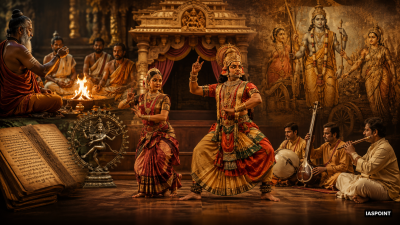
The origins of Indian drama are deeply rooted in a blend of religious ritualism, Vedic literature, and mythological narratives. Unlike many Western dramatic traditions, Indian theatre (Natya) was conceived as a holistic art form combining acting, dance, and music.
The Natyashastra: The Fifth Veda
The primary source for understanding the origins of Indian drama is the Natyashastra, an encyclopedic treatise on the performing arts attributed to Sage Bharata.
- Divine Origin Theory: According to the Natyashastra, Lord Brahma created Natyaveda (the science of drama) at the request of Indra and other gods. This was intended as a “Fifth Veda” to provide moral and spiritual education to all sections of society, specifically those excluded from Vedic study.
- Synthesis of the Four Vedas: Brahma is said to have synthesized elements from each of the existing Vedas to create drama:
- Pathya (Recitation): Derived from the Rig Veda.
- Gayan (Music/Chant): Derived from the Sama Veda.
- Abhinaya (Acting/Gesture): Derived from the Yajur Veda.
- Rasa (Sentiment/Emotion): Derived from the Atharva Veda.
Pre-Classical Elements: The Vedic and Epic Periods
Long before the formalization of drama, several elements existed in Indian tradition that provided the structural foundation for theatrical performance.
- Vedic Dialogue Hymns (Samvada Suktas): The Rig Veda contains dialogue hymns, such as the conversation between Pururava and Urvashi or Yama and Yami, which suggest a proto-dramatic tradition of recitation.
- Ritualistic Roots: Vedic sacrifices (Yajnas) involved symbolic movements and rhythmic chanting that shared characteristics with later dramatic performances.
- Epic Influence: The Ramayana and the Mahabharata provided the thematic soul of Indian drama. These epics introduced the concepts of Sutradhara (narrator) and Natas (performers) who traveled across kingdoms to recite heroic tales.
Archeological and Epigraphical Evidence
Beyond mythology, historical evidence confirms the antiquity of theatrical arts in ancient India.
- Jogimara Caves (Chhattisgarh): Dating back to the 2nd-3rd Century BCE, these caves contain inscriptions and architectural features that suggest they served as one of the earliest amphitheatres or performance spaces.
- Sitabenga Caves: Located in the Ramgarh hills, these show evidence of a rock-cut theatre, complete with holes for wooden poles to support curtains.
- Panini’s Ashtadhyayi: The 4th Century BCE grammarian Panini mentions the Nata Sutras (manuals for actors), indicating that acting was a recognized and codified profession by that era.
Key Structural Elements of Early Indian Drama
Early Indian drama was governed by the concept of Rasa (aesthetic flavor) rather than the Western focus on conflict and tragedy.
| Component | Description |
| Sutradhara | The “string-holder” or director/narrator who introduces the play. |
| Purvaranga | Elaborate preliminary rituals performed before the play begins. |
| Vidushaka | The “jester” or comic character, usually a Brahmin friend of the hero. |
| Nandi | A benedictory prayer offered at the start of the performance. |
| Prakrit vs. Sanskrit | Early plays used a “diglossic” approach; elite characters spoke Sanskrit, while women and commoners spoke Prakrit dialects. |
Major Schools and Evolution
The evolution of drama transitioned from the religious and ritualistic to the classical and courtly styles.
- The Bhasa Phase: Bhasa (c. 3rd-4th Century CE) is considered one of the earliest known playwrights. His works, like Swapnavasavadatta, moved away from strictly mythological themes to include human emotions and political intrigue.
- The Golden Age: During the Gupta Period, drama reached its zenith with Kalidasa. His work Abhigyanashakuntalam is considered the masterpiece of Indian classical drama, emphasizing the harmony between nature and human emotion.
- Shudraka’s Realism: The play Mrichchhakatika (The Little Clay Cart) departed from the usual royal protagonists, focusing instead on a commoner (Charudatta) and a courtesan (Vasantasena), showcasing the social diversity of ancient India.
Critical Facts for Prelims
- First Performance: According to legend, the first play performed was Asura Parajaya (The Defeat of the Demons), staged before the gods.
- Types of Plays: The Natyashastra classifies plays into ten types (Dasharupaka), with Nataka (heroic/mythological) and Prakarana (social/invented) being the most prominent.
- Absence of Tragedy: Unlike Greek drama, Indian classical drama traditionally ends on a positive or harmonious note, as the goal is the restoration of Dharma and the attainment of peace (Shanta Rasa).
- Patronage: Early drama flourished under the patronage of the Mauryas, Shungas, and reached its peak under the Guptas. Inscriptions of King Kharavela of Kalinga (Hathigumpha) also mention the organization of music and dance festivals.