
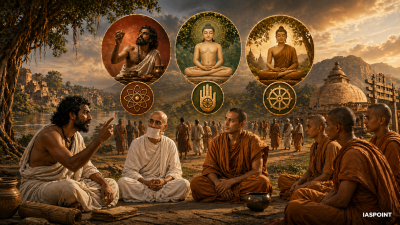
In the landscape of Indian philosophy, schools are classified as Nastika (Heterodox) if they reject the absolute authority of the Vedas. Unlike the Orthodox (Astika) schools, these systems do not look to Vedic revelation as the primary source of truth, instead relying on logic, empirical experience, or the teachings of enlightened masters. The primary schools under this category are Carvaka, Jainism, and Buddhism, which emerged as significant intellectual movements during the “Sramanic” period (6th century BCE).
Comparison of Primary Heterodox Schools
The following table summarizes the foundational differences in their philosophical outlooks:
| Feature | Carvaka (Lokayata) | Jainism | Buddhism |
| Pramanas (Knowledge) | Only Perception (Pratyaksha) | Perception, Inference, Testimony | Perception, Inference |
| Concept of Soul | No Soul (Dehatmavada) | Eternal Soul (Jiva) | No-Self (Anatta/Anatman) |
| Ultimate Reality | Materialism (Four Elements) | Pluralism (Anekantavada) | Momentariness (Kshanikavada) |
| Path to Goal | Sensory Enjoyment | Extreme Asceticism | The Middle Path (Madhyamaka) |
| Causation | Accidentalism (Yadrcchavada) | Multifaceted reality | Dependent Origination |
Carvaka School: The Radical Materialism
Also known as Lokayata (prevalent among the people), this school was reportedly founded by Brihaspati. It is the most radical departure from traditional Indian thought.
Core Philosophical Tenets
- Materialism: It recognizes only four elements—Earth, Water, Fire, and Air. It rejects ‘Akasha’ (Ether) because it cannot be perceived.
- Rejection of the Transcendental: There is no God, no soul, no heaven, and no afterlife. Consciousness is viewed as a byproduct of material combinations, much like the intoxicating power in fermented yeast.
- Hedonism: The ultimate goal of life is the maximization of pleasure and the avoidance of pain. Its famous motto is: “As long as you live, live happily. Even by taking a loan, drink ghee (clarified butter).”
- Epistemology: It accepts only Perception (Pratyaksha) as a valid source of knowledge. It rejects Inference (Anumana) because it relies on universal relations (Vyapti) that cannot be physically perceived.
Jainism: The Philosophy of Pluralism
Jainism is an ancient Nastika school that emphasizes non-violence (Ahimsa) and the liberation of the soul through rigorous self-discipline.
Metaphysical Doctrines
- Anekantavada: The doctrine of “manifold aspects.” It asserts that reality is complex and can be viewed from many different perspectives. No single statement can capture the absolute truth.
- Syadvada: The logic of relative predicates. Every judgment should be qualified with “Syat” (maybe or perhaps) to acknowledge its partial truth.
- Jiva and Ajiva: The universe is divided into living souls (Jiva) and non-living matter (Ajiva). Liberation involves purging the Jiva of the Karma (subtle matter) that clings to it.
The Path to Liberation (Triratna)
- Samyak Darshana: Right Faith.
- Samyak Jnana: Right Knowledge.
- Samyak Charitra: Right Conduct (guided by the Five Great Vows: Ahimsa, Satya, Asteya, Brahmacharya, and Aparigraha).
Buddhism: The Philosophy of Transition
Founded by Gautama Buddha, this school focuses on the cessation of suffering (Dukkha) through psychological and ethical transformation.
Fundamental Doctrines
- The Four Noble Truths: Suffering exists (Dukkha); there is a cause for suffering (Samudaya); suffering can end (Nirodha); and there is a path to end it (Magga).
- Pratityasamutpada: The doctrine of “Dependent Origination.” It states that everything arises in dependence upon causes and conditions; nothing exists independently.
- Anicca and Anatta: Buddhism teaches that all things are impermanent (Anicca) and that there is no permanent, unchanging soul (Anatta).
- Nirvana: The ultimate state of liberation, described as the “blowing out” of the fires of greed, hatred, and delusion.
Minor and Lesser-Known Heterodox Schools
While Buddhism and Jainism were the most successful, several other Nastika schools existed during the 6th century BCE.
Ajivika School
- Founder: Makkhali Gosala.
- Niyati (Fatalism): The central belief that everything is predetermined by fate. Human effort or Karma has no power to change the course of destiny.
- Historical Note: Bindusara (Mauryan King) was a prominent patron of this school, and the Barabar Caves were dedicated to them by Ashoka.
Ajnana School
- Nature: A school of radical skepticism.
- Philosophy: It held that it is impossible to attain certain knowledge of metaphysical questions. Proponents believed that claiming knowledge leads to arrogance and mental unrest.
Akriyavada
- Proponent: Purana Kassapa.
- Tenet: The belief that actions (good or bad) have no moral consequences. It denies the efficacy of Karma.
Essential Trivia for Prelims
- The Sramana Movement: The collective name for these non-Vedic movements that challenged the Brahminical social order and ritualism.
- Sarvadarshanasamgraha: A 14th-century text by Madhavacharya that provides a detailed summary of all Indian philosophical schools, starting with Carvaka.
- The Concept of Sunyata: Developed primarily in the Madhyamaka school of Mahayana Buddhism by Nagarjuna, asserting the “emptiness” or lack of inherent essence in all phenomena.
- Literature: While Jain scriptures are primarily in Prakrit/Ardhamagadhi, early Buddhist scriptures are in Pali, representing a move away from the elite Sanskrit of the Vedas.
- Atheism in Nastika Schools: While all these schools reject the Vedas, they are not all “atheistic” in the modern sense. Jainism and Buddhism reject a “Creator God” but acknowledge “God-like” enlightened beings (Tirthankaras and Buddhas).