
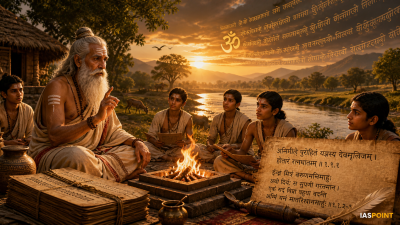
The Vedic period (c. 1500 – 600 BCE) marks the foundation of Indian civilization and its literary tradition. The word Veda is derived from the Sanskrit root Vid, meaning “to know,” signifying “sacred knowledge.” Initially transmitted through the oral tradition (Shruti—that which is heard), these texts were composed by various families of seers (Rishis). The Rig-Veda is the oldest among the four Vedas and serves as the primary source for reconstructing the socio-political and religious life of the Early Vedic Aryans.
Structural Composition of the Rig-Veda
The Rig-Veda Samhita is a collection of 1,028 hymns (Suktas) organized into ten books known as Mandalas. These hymns were recited by the Hotri priests during sacrificial rituals.
- Family Books: Mandalas II to VII are known as the “Family Books” as they are attributed to specific families of Rishis like Gristamada, Vishwamitra, Atri, Bharadwaj, and Vashistha. These are considered the oldest portions of the text.
- Later Additions: Mandalas I and X are the latest additions to the Samhita. Mandala X is particularly significant for its philosophical depth and the inclusion of the Purusha Sukta.
- The Soma Mandala: Mandala IX is entirely dedicated to Soma, the personified sacred juice and the god of plants.
| Component | Description |
| Mandala | 10 Books containing hymns. |
| Sukta | 1,028 Hymns (including 11 Valakhilya or supplementary hymns). |
| Richas | Approximately 10,552 verses or stanzas. |
| Shakhas | Various recensions (Shakala is the only surviving recension). |
Associated Brahamanas, Aranyakas, and Upanishads
Each Veda is attached to secondary texts that explain the rituals, philosophy, and mystical meanings of the hymns. The Rig-Veda has a distinct set of associated literature:
- Brahmanas: These prose texts explain the ritualistic application of the hymns. The two primary Brahmanas are the Aitareya and Kaushitaki (or Sankhyayana).
- Aranyakas: Known as “Forest Books,” these transition from ritualism to philosophy. They are the Aitareya Aranyaka and Kaushitaki Aranyaka.
- Upanishads: These represent the Vedanta (end of the Vedas) and focus on Atman (soul) and Brahman (ultimate reality). Key Upanishads include the Aitareya and Kaushitaki.
Socio-Political Glimpses in Rig-Vedic Hymns
The Rig-Veda provides empirical data regarding the transition from a pastoral to a semi-sedentary society.
- Battle of the Ten Kings (Dasrajan War): Mentioned in Mandala VII, this conflict occurred on the banks of the river Parushni (Ravi). Sudas, the King of the Bharata tribe, defeated a confederacy of ten tribes (five Aryan and five non-Aryan).
- Tribal Polity: Terms like Sabha (assembly of elders), Samiti (general assembly), and Vidatha (folk assembly) highlight the democratic elements of early Aryan governance.
- Geography: The text mentions the Sapta-Sindhu region (Land of Seven Rivers). The river Saraswati is lauded as the most sacred (Naditarna), while the Ganges is mentioned only once and the Yamuna thrice.
Religious and Philosophical Concepts
The Rig-Vedic religion was characterized by Henotheism—the worship of one god at a time while acknowledging others.
The Vedic Pantheon
- Indra: The most important deity (250 hymns), known as Purandara (breaker of forts) and the god of rain/thunder.
- Agni: The fire god (200 hymns), acting as an intermediary between gods and men.
- Varuna: The upholder of the natural and moral order (Rta).
- Soma: The god of plants and the intoxicating drink used in rituals.
The Purusha Sukta and Varna System
Mandala X contains the Purusha Sukta, which provides the first mention of the four-fold division of society (Varna). It describes the creation of the four Varnas from the body of the Primeval Being (Purusha):
- Brahmanas: From the mouth.
- Kshatriyas: From the arms.
- Vaishyas: From the thighs.
- Shudras: From the feet.
Literary Trivia and Facts for Aspirants
- UNESCO Recognition: The Rig-Veda was included in UNESCO’s “Memory of the World” Register in 2007 to preserve its oral tradition.
- The Gayatri Mantra: This famous mantra, dedicated to the solar deity Savitri, is found in the Third Mandala, composed by Rishi Vishwamitra.
- River Identification: The Rig-Veda refers to modern rivers by Vedic names: Vitasta (Jhelum), Asikni (Chenab), Parushni (Ravi), Vipas (Beas), and Sutudri (Sutlej).
- Women Seers: The Rig-Veda mentions female seers known as Brahmavadinis, such as Lopamudra, Ghosha, and Apala, indicating a high status of women in the early Vedic period.
- Marriage Hymns: Mandala X contains the Vivaha Sukta, which outlines the earliest forms of marriage rituals and ceremonies.