

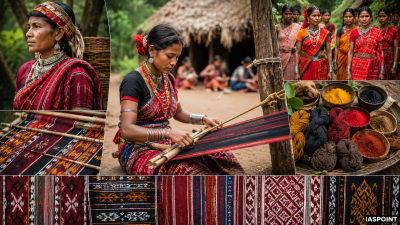
Tribal textiles in India are a sophisticated expression of indigenous identity, reflecting the ecological diversity and social hierarchy of over 700 recognized Scheduled Tribes. Beyond mere utility, clothing serves as a “social skin” that communicates marital status, clan lineage, and ritual purity. These textiles are characterized by the use of organic fibers, natural dyes, and the persistence of the “Loin Loom” (back-strap loom) tradition.
Regional Specializations in Tribal Weaving
The diversity of tribal clothing is categorized by geographical clusters, each utilizing materials native to their specific biosphere.
North-Eastern Hill Tribes
The North-East is the heartland of tribal weaving, where every woman is traditionally expected to be a master weaver.
- Naga Textiles: Each of the 16+ Naga tribes has distinct shawl patterns. For example, the Tsungkotepsu (Ao Naga) is a warrior shawl featuring motifs of tigers, elephants, and human heads.
- Mizo ‘Puan’: The Puan is the traditional wrap-around skirt. The Puanchei is the most colorful version, essential for weddings and festivals like Chapchar Kut.
- Apatani Weaves: Known for their use of broad stripes and geometric patterns, primarily in red, yellow, and white, using cotton and eri silk.
- Meghalaya’s Eri Silk: The Khasi and Jaintia tribes are renowned for Ryndia (Eri silk), known as the “peace silk” because the pupae are not killed during extraction.
Central Indian Plateau
- Kotpad Handloom (Odisha): Practiced by the Mirgan community for the Bhatra and Gond tribes. It is the first tribal textile to receive a GI Tag. It uses the root of the Aal (Indian Madder) tree for its characteristic deep red and maroon dyes.
- Santhal ‘Phuta’ Saree: Traditionally a short, coarse cotton saree (usually 3 yards) worn without a blouse to facilitate free movement during forest work. It features simple check patterns and borders.
- Gond Textiles: Focus on heavy cotton weaves with motifs inspired by Gond paintings, including birds, trees, and animals.
Southern and Western Ghats
- Toda Embroidery (Pukhoor): The Toda tribe of the Nilgiris creates the Poothukuli shawl. It is a thick white cotton cloth with bold red and black geometric embroidery done by counting threads (warp and weft) without a tracing pattern. It has been granted GI status.
- Lambani/Banjara Embroidery: The nomadic Lambani women wear the Phetiya (skirt) and Kanchali (blouse) adorned with heavy mirror work (Abhla), shells, and coins, reflecting their historically nomadic lifestyle.
Traditional Materials and Indigenous Technology
Tribal textiles are synonymous with sustainability, relying on “Slow Fashion” techniques that have remained unchanged for centuries.
Fibers and Dyes
- Wild Silks: India’s tribal belts are the primary source of Vanya (wild) silks, including Tussar (Jharkhand/Chhattisgarh), Muga (Assam), and Eri (Meghalaya).
- Natural Colorants:
- Indigo: For blues and blacks.
- Madder (Aal): For reds and maroons.
- Turmeric/Harsinghar: For yellows and oranges.
- Iron Rust/Clay: For deep browns and greys.
The Loin Loom (Back-strap Loom)
Most hill tribes use the portable Loin Loom. It is unique because the weaver’s body weight provides the tension for the warp threads. This limits the width of the fabric but allows for a dense, high-quality weave that is extremely durable.
Significant Tribal Motifs and Symbolism
Motifs in tribal textiles are never purely decorative; they are symbolic representations of the tribal cosmos.
| Motif | Tribe/Region | Symbolic Meaning |
| Butterfly | Bodo (Assam) | Symbol of beauty and the soul; central to Hajw Agor patterns. |
| Human Head | Naga (Various) | Historically represented the success of a warrior; now a symbol of bravery. |
| Temple (Phul) | Kotpad (Odisha) | Represents the connection between the earthly and the divine. |
| Buffalo Horn | Toda (Nilgiris) | Reverence for the buffalo, which is central to Toda religion. |
| Crab/Fish | Santhal/Munda | Proximity to riverine ecosystems and fertility. |
Tribal Jewelry and Accessories
Clothing is often incomplete without distinct tribal ornaments, which often serve as a form of “wearable wealth.”
- Dokra Jewelry: Non-ferrous metal casting using the lost-wax technique, used by Gonds and Santhals to make anklets, necklaces, and hairpins.
- Beadwork: The Nyishi and Wancho tribes of Arunachal Pradesh use intricate beadwork to denote social status and age.
- Silver and Nickel: Extensively used by Bhil and Lambani women in the form of heavy Hansli (neck collars) and Kada (bangles).
Facts for UPSC Prelims
- GI Tagged Tribal Textiles: Kotpad Handloom (Odisha), Toda Embroidery (Tamil Nadu), Muga Silk (Assam), and Chakhesang Naga Shawls.
- TRIFED and ‘Tribes India’: The Tribal Co-operative Marketing Development Federation of India is the nodal agency for the global marketing of tribal textiles.
- The Concept of ‘Vanya Silk’: India is the only country in the world producing all four commercial varieties of silk (Mulberry, Tussar, Eri, and Muga), with the latter three being purely tribal initiatives.
- Kapdaganda Shawl: A unique hand-woven shawl of the Dongria Kondh tribe (Odisha) which is gifted by a girl to her suitor as a token of love.
- Cultural Regulation: In many Naga tribes, wearing a shawl pattern to which one is not entitled (based on social achievements or feasts performed) was traditionally considered a serious social offense.
Current Status and Preservation
The Ministry of Tribal Affairs and the Development Commissioner (Handlooms) have initiated several clusters to prevent the extinction of tribal weaves. Challenges include the influx of cheap powerloom imitations and the declining interest of the younger generation in the time-consuming Loin Loom process. Brands like “FabIndia” and “Tribes India” have helped in mainstreaming these textiles into urban fashion.
Last Modified: May 7, 2026