
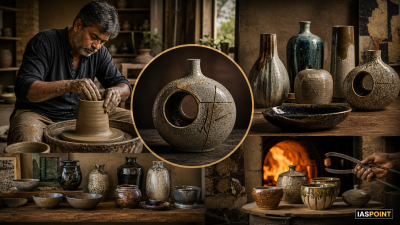
Studio pottery in India represents a departure from the traditional, hereditary-based “Kumbhar” system toward a personalized, artist-driven form of ceramic art. Unlike traditional pottery, which is often functional and mass-produced within a community, studio pottery is characterized by individual artists working in their own studios, experimenting with glazes, firing techniques, and non-traditional forms. This movement gained momentum in the mid-20th century, blending indigenous clay traditions with global aesthetic influences, particularly from Japan and the United Kingdom.
Pioneers of the Indian Studio Pottery Movement
The foundation of modern studio pottery in India was laid by a few visionary artists who introduced high-fire ceramics and glazed stoneware to the Indian landscape.
- Sardar Gurcharan Singh: Often hailed as the “Father of Indian Studio Pottery.” He founded the Delhi Blue Pottery Trust in 1952. After training in Japan, he introduced the concept of stoneware and celadon glazes to India, moving away from the low-fire terracotta prevalent at the time.
- Mansimran Singh: Son of Gurcharan Singh, he played a pivotal role in establishing Andretta Pottery in Himachal Pradesh, creating a rural-urban bridge for ceramic art.
- K.V. Jena: A key figure at the Banaras Hindu University (BHU), he was instrumental in integrating academic rigor with ceramic practice.
- Ray Meeker and Deborah Smith: Founders of the Golden Bridge Pottery in Pondicherry (1971). They were instrumental in popularizing wood-fired kilns and functional stoneware that emphasized “truth to materials.”
Technical Variations and Firing Methods
Modern studio potters in India utilize a variety of firing techniques that dictate the final texture, color, and durability of the art piece.
- Stoneware: Fired at high temperatures (approx. 1200°C to 1300°C), resulting in a dense, stone-like, and non-porous finish. It is the mainstay of the Andretta and Auroville schools.
- Earthenware: Fired at lower temperatures (below 1100°C). While traditional, studio potters use it for experimental “Raku” firing or specialized slips.
- Raku Firing: A Japanese-inspired technique where glowing hot pottery is removed from the kiln and placed in a container with combustible materials (like sawdust). The thermal shock creates metallic lusters and “crackle” glazes.
- Anagama Firing: Use of ancient wood-fired tunnel kilns. This method relies on the natural ash from the wood to fly through the kiln and melt onto the pots, creating a natural, unpredictable glaze.
Key Hubs of Studio Pottery in India
The geography of studio pottery is centered around clusters that offer specific clay types or artistic environments.
| Hub | Primary Technique/Style | Notable Association |
| Puducherry (Auroville) | High-fire Stoneware, Wood-firing | Golden Bridge Pottery |
| Andretta (Himachal) | Slipware, Glazed Terracotta | Mini Singh & Mansimran Singh |
| Delhi | Blue Pottery influences, Contemporary Art | Delhi Blue Pottery Trust |
| Khurja (Uttar Pradesh) | Commercial-Studio Hybrid, Glazing | Central Glass and Ceramic Research Institute |
| Chennai (DakshinaChitra) | South Indian motifs, Stoneware | Local Ceramic Residencies |
Comparative Analysis: Traditional vs. Studio Pottery
| Parameter | Traditional Pottery (Kumbhar Tradition) | Studio Pottery (Modern Movement) |
| Artisan Background | Hereditary (Caste-based) | Academic/Self-taught Artists |
| Technology | Manual Stone/Wooden Wheel | Electric Wheel & Kick Wheels |
| Firing | Open-pit / Low-temperature | Gas, Electric, or Wood Kilns (High-temp) |
| Glazing | Rare (Mostly Ochre/Natural Slips) | Extensive use of Chemical & Mineral Glazes |
| Intent | Mass Utility and Ritual Use | Aesthetic Expression & Limited Edition Decor |
Innovations in Glazes and Decoration
Studio potters have moved beyond the traditional “Geru” (red) and “Khadi” (white) to a more complex chemical palette.
- Celadon Glazes: Pale green glazes originating from East Asia, popular in the Delhi Blue and Andretta schools.
- Tenmoku: A dark, iron-rich glaze that creates a deep black or “oil spot” finish, often used in Indian stoneware.
- Sgraffito and Inlay: Techniques where the artist scratches through a layer of slip to reveal a contrasting color underneath, or inlays different clay colors into the body.
- Crystalline Glazes: High-tech glazes where zinc crystals are grown inside the kiln during the cooling process, creating flower-like patterns on the surface.
Contemporary Challenges and Trends
- Sustainability: Shift toward “Paper Clay” (mixing paper pulp with clay) to reduce weight and carbon footprint during firing.
- Digital Integration: Use of 3D printing in ceramic design to create complex geometries impossible to achieve on a wheel.
- Market Dynamics: Transition from being a “hobbyist craft” to a high-value art investment, with galleries in Mumbai and Delhi hosting dedicated ceramic biennales.
- Raw Material Scarcity: Increasing difficulty in sourcing high-quality “Fire Clay” and specific minerals like Cobalt and Feldspar due to mining regulations.
Key Factoids for UPSC Prelims
- Blue Pottery Influence: While Jaipur Blue Pottery is traditional, the Delhi Blue Pottery movement started by Gurcharan Singh is a “Studio” adaptation that uses actual clay (unlike the non-clay Jaipur version).
- Terracotta vs. Stoneware: In the Indian context, the UPSC aspirant should distinguish between the two based on porosity—Stoneware is vitrified (glass-like and waterproof) while Terracotta remains porous.
- Phoebe Palmes: An English potter who, along with Gurcharan Singh, helped bridge the gap between British Slipware and Indian forms.
- Ceramic Center of India: While Khurja is the industrial capital, Auroville is considered the spiritual and technical capital of high-end studio ceramics in India.
- International Recognition: Indian studio potters are increasingly represented at the IAC (International Academy of Ceramics), marking India’s shift from a land of “folk pottery” to a global player in “ceramic art.”