
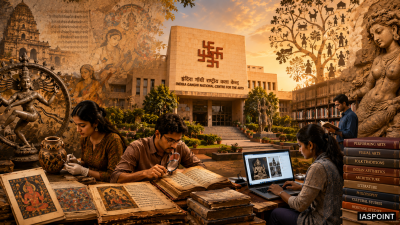
The Indira Gandhi National Centre for the Arts (IGNCA) is a premier autonomous research institute under the Ministry of Culture, Government of India. Established as a center for encompassing all forms of arts—each form being an integral part of the whole—it functions as a major resource center for the arts, especially written, oral, and visual source materials. Unlike institutions focused solely on performing or fine arts, the IGNCA adopts a multidisciplinary approach, viewing the arts within the context of the natural and human environment.
Historical Genesis and Philosophy
- Establishment: Launched on November 19, 1985, by the then Prime Minister Rajiv Gandhi; it was formally constituted as an autonomous trust in 1987.
- Conceptual Foundation: The center is based on the “Kala” (Art) philosophy which emphasizes the unity of all arts. It follows the vision of Dr. Kapila Vatsyayan, its founding director, who integrated the study of Indian arts with modern scientific methodology.
- Headquarters: Initially located near Janpath, New Delhi, the institution is currently part of the larger cultural redevelopment plan under the Central Vista Project.
Organizational Structure: The Six Functional Units
The IGNCA operates through six specialized divisions, each catering to a distinct aspect of Indian heritage and academic research.
| Division Name | Core Functional Area |
| Kala Nidhi | A multi-form library and information system serving as a national repository of manuscripts, books, and photographs. |
| Kala Kosh | Focuses on the publication of fundamental texts, such as the Kalatattvakosa (a lexicon of fundamental concepts in Indian arts). |
| Janapada Sampada | Dedicated to the study of “Janapada” (the people), covering tribal and folk arts, crafts, and oral traditions. |
| Kaladarsana | The executive wing for dissemination; it organizes exhibitions, seminars, and public lectures. |
| Cultural Informatics | Utilizes technology for the preservation and digital documentation of cultural heritage. |
| Sutradhara | The central administrative unit that provides logistical and coordination support to all other divisions. |
Key Academic and Research Initiatives
- National Mission for Manuscripts (NMM): IGNCA is the nodal agency for this mission, which was launched in 2003 to document, preserve, and digitize the vast manuscript wealth of India.
- Kalatattvakosa Series: A landmark project that defines and explains the core technical terms of Indian arts through multidisciplinary research.
- Vraja Prakalpa: A specialized research project dedicated to the cultural and artistic landscape of the Vraja region (Mathura-Vrindavan).
- Vedic Heritage Portal: An initiative to map the Vedic heritage of India, providing digital access to Vedic chants, texts, and rituals.
Preservation and Documentation Efforts
- Manuscript Repository: The center houses microfilms of over 3 lakh manuscripts from various libraries across the world, making it one of the largest such collections globally.
- Rock Art Conservation: The Janapada Sampada division leads extensive field studies on rock art sites in India (such as Bhimbetka) to understand early human creativity.
- Oral Tradition Documentation: Systematic recording of “Loka-parampara” (folk traditions) and vanishing languages to ensure the survival of India’s intangible heritage.
Outreach and International Collaboration
- Exhibitions: IGNCA hosts major international exhibitions, such as “The Earth and the Sky” and “Prakriti,” which explore the relationship between man and nature.
- Academic Courses: It offers specialized Post Graduate Diploma courses in subjects like Cultural Informatics, Buddhist Studies, and Manuscriptology.
- UNESCO Participation: IGNCA frequently partners with UNESCO for the “Memory of the World” register and other heritage conservation projects.
Facts and Trivia for UPSC Prelims
- The Emblem: The emblem of IGNCA is the Vaman-Sutra, a symbolic representation of the cosmic man, reflecting the center’s philosophy of the interconnectedness of all life and art.
- Kala Nidhi Digital Library: The digital wing provides access to rare books and the Personal Collections of eminent scholars like Suniti Kumar Chatterji and Ananda Coomaraswamy.
- Mauryan Architecture Focus: The center has conducted significant research into the evolution of the Stupa and the philosophical origins of Indian temple architecture.
- Cultural Mapping: Under the “Mera Gaon, Meri Dharohar” initiative, IGNCA is involved in the cultural mapping of 6.5 lakh villages in India.
- Nodal Status: It serves as the primary technical advisor to the Government of India for the establishment of the National Museum of India within the new Central Vista framework.