
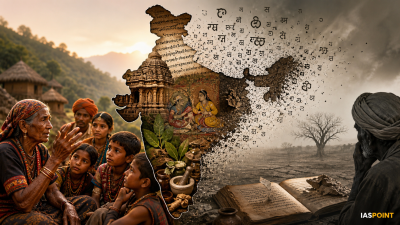
India is one of the most linguistically diverse nations globally, yet it also faces the highest risk of linguistic extinction. As of 2026, approximately 197 Indian languages are in various stages of endangerment. In the context of Indian Art and Culture, the loss of a language is not merely a loss of communication but the erasure of intangible heritage, including traditional medicine, ecological knowledge, and oral epics.
UNESCO Classification of Endangerment
UNESCO categorizes languages based on “intergenerational transmission”—the degree to which a language is passed from parents to children.
| Status | UNESCO Criteria | Examples in India |
| Vulnerable | Spoken by most children, but restricted to specific domains (e.g., home). | Manipuri (Meitei), Bodo |
| Definitely Endangered | Children no longer learn the language as a “mother tongue” in the home. | Gondi, Kurukh, Tulu |
| Severely Endangered | Spoken by grandparents; while the parent generation may understand it, they do not speak it to children. | Koro (Arunachal), Kota (Tamil Nadu) |
| Critically Endangered | The youngest speakers are grandparents and older, and they speak the language partially or infrequently. | Great Andamanese, Asur, Nihali |
| Extinct | No speakers left. | Aka-Bo (Extinct 2010), Aka-Kora (Extinct 2009) |
Distribution and Regional Hotspots
Language endangerment in India is most acute in regions with high tribal concentrations and geographic isolation.
- Andaman and Nicobar Islands: This is the most critical zone. The Great Andamanese family is nearly extinct. Languages like Jarawa and Onge are vulnerable due to limited speaker populations, while Sentinelese remains unclassified due to lack of contact.
- The Northeast: Home to over 200 Tibeto-Burman languages. Smaller dialects in Arunachal Pradesh (e.g., Miji, Puroik) face pressure from Hindi and Assamese.
- Central Tribal Belt: In states like Odisha, Jharkhand, and Chhattisgarh, languages like Mundari, Kui, and Juango are losing ground to regional dominant languages like Odia and Hindi.
- The Himalayas: Several dialects of the Pahari group and Ladakhi are seeing a decline in younger speakers due to migration and modernization.
Critical Case Studies: Unique Linguistic Identities
- Santhali (The Survivor): While many tribal languages are dying, Santhali (Austro-Asiatic) is a success story. It was added to the Eighth Schedule (92nd Amendment, 2003) and uses its own script, Ol Chiki, which has bolstered its survival.
- Nihali: A “Language Isolate” spoken in Maharashtra and Madhya Pradesh. It has no proven genetic relationship with any other language family in the world, making its potential extinction a massive scientific loss.
- Toda and Kota: Spoken by small pastoral and artisan communities in the Nilgiris (Tamil Nadu). These are Dravidian languages with unique phonetic structures (e.g., Toda’s trills) that are not found in any other Indian language.
The 11 Classical Languages (Update 2024–2026)
As of 2026, the Government of India has expanded the list of Classical Languages to 11. This status provides funding for preservation, helping languages that might otherwise face “vulnerability.”
- Original Six: Tamil (2004), Sanskrit (2005), Telugu (2008), Kannada (2008), Malayalam (2013), Odia (2014).
- New Additions (2024): Marathi, Pali, Prakrit, Assamese, and Bengali.
- Note: The inclusion of Pali and Prakrit is significant for UPSC as they are the primary languages of ancient Buddhist and Jain canons, respectively, and were previously considered “dead” or purely liturgical.
Government Initiatives and Safeguards
The Government of India has implemented several institutional frameworks to arrest the decline of these mother tongues.
Scheme for Protection and Preservation of Endangered Languages (SPPEL)
- Nodal Agency: Central Institute of Indian Languages (CIIL), Mysuru.
- Objective: To document and archive all mother tongues spoken by fewer than 10,000 speakers.
- Scope: The scheme creates dictionaries, grammars, and ethnolinguistic videos of endangered dialects.
Constitutional Provisions
- Article 29: Protects the right of any section of citizens to conserve their distinct language, script, or culture.
- Article 350A: Directs states to provide instruction in the mother-tongue at the primary stage of education for linguistic minorities.
- Article 350B: Establishes the office of the Special Officer for Linguistic Minorities to monitor safeguards.
Facts and Trivia for Prelims
- Language vs. Dialect: The Indian government officially recognizes a “language” if it has a script; many tribal “dialects” are actually sophisticated languages that lack a formal writing system.
- The 10,000 Rule: UNESCO considers any language spoken by fewer than 10,000 people as “potentially endangered.”
- Script Adoption: To ensure survival, tribes are increasingly developing scripts, such as Warang Chiti (Ho) and Tolong Siki (Kurukh).
- Language Families: Endangered languages in India span across the Austro-Asiatic, Tibeto-Burman, Dravidian, and Indo-Aryan families, plus several Isolates (like Nihali and Great Andamanese).