
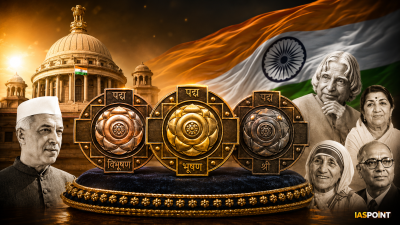
The Padma Awards are among the highest civilian honors in India, instituted in 1954 along with the Bharat Ratna. Originally, they were classified as “Pahela Varg” (Class I), “Dusra Varg” (Class II), and “Tisra Varg” (Class III). These were renamed via a Presidential Notification on January 8, 1955, to their current three-tier nomenclature.
- Padma Vibhushan: Conferred for exceptional and distinguished service.
- Padma Bhushan: Conferred for distinguished service of a high order.
- Padma Shri: Conferred for distinguished service in any field.
The awards are announced annually on the eve of Republic Day and are presented by the President of India at Rashtrapati Bhavan, typically in March or April.
Constitutional and Legal Status
The validity of the Padma Awards has been a subject of judicial scrutiny regarding Article 18(1) of the Constitution, which prohibits the State from conferring titles.
- Balaji Raghavan v. Union of India (1996): The Supreme Court upheld the constitutional validity of the Bharat Ratna and Padma Awards. It ruled that these are “National Awards” and not “titles” in the sense of the nobility titles prohibited by Article 18.
- Non-Titular Nature: Recipients are prohibited from using the award names as prefixes or suffixes (e.g., “Padma Shri [Name]”). Misuse can result in the forfeiture of the award.
- Suspensions in History: The awards have been suspended twice due to political and legal challenges:
- 1977 to 1980: Suspended by the Morarji Desai government.
- 1992 to 1995: Suspended during litigation regarding their constitutional validity.
Eligibility and Selection Process
The Padma Awards seek to recognize “work of distinction” where an element of public service is involved.
- Who can Apply: Any person without distinction of race, occupation, position, or sex is eligible. Self-nomination is permitted.
- Exclusions: Serving Government servants, including those working with PSUs, are not eligible, with the specific exception of Doctors and Scientists.
- Nomination Window: Nominations are usually invited between May 1st and September 15th each year through an online portal managed by the Ministry of Home Affairs.
- Selection Body: The Padma Awards Committee, constituted by the Prime Minister every year, scrutinizes all nominations. The committee is headed by the Cabinet Secretary and includes the Home Secretary, Secretary to the President, and four to six eminent persons.
- Approval: The committee’s recommendations are submitted to the Prime Minister and the President for final approval.
Statutory Rules and Limits
Specific guidelines govern the number and frequency of these awards to maintain their prestige and exclusivity.
| Feature | Statutory Rule / Limit |
| Annual Limit | Maximum of 120 awards per year (excluding posthumous and NRI/Foreigner awards). |
| Posthumous Policy | Generally not conferred posthumously; however, exceptions are made if the person died within one year of the announcement. |
| Higher Award Gap | A higher category of Padma award can only be conferred after at least 5 years have passed since the previous award. |
| Monetary Grant | None. The award does not include any cash allowance or financial benefit. |
Fields of Recognition
The awards are distributed across a broad spectrum of “any field of human endeavor,” with specific sub-categories frequently recognized:
- Art: Music, painting, sculpture, cinema, theatre, etc.
- Social Work: Charitable service, contribution in community projects, etc.
- Public Affairs: Law, public life, politics, etc.
- Science & Engineering: Space engineering, nuclear science, information technology, etc.
- Trade & Industry: Banking, economic activities, management, etc.
- Medicine: Medical research, specialization in Ayurveda, Homeopathy, etc.
- Literature & Education: Journalism, teaching, literacy promotion, etc.
- Civil Service: Excellence in administration by government servants (post-retirement or eligible categories).
- Sports: Athletics, mountaineering, adventure, yoga, etc.
Entitlements and Honors
While the award carries no monetary value, it provides significant state-level recognition and symbolic privileges.
- The Medallion: A bronze medallion (Peepal leaf design for Bharat Ratna, circular for Padma awards) and a miniature replica for ceremonial use.
- The Sanad: A certificate of honor signed and sealed by the President of India.
- Gazette Notification: The names of the awardees are published in the Gazette of India.
- State Funerals: In certain cases, depending on the state government’s protocol, recipients may be granted a state funeral.
- Exemptions: Travel concessions (like those for Bharat Ratna) are not standard for Padma awardees, though individual states may offer local benefits.
Recent Highlights and Trends (2024–2026)
In recent years, the selection process has shifted toward a “People’s Padma” approach, emphasizing unsung heroes and grassroots achievers.
- 2024 Milestones: Recognition of 132 individuals, including high representation from tribal communities and traditional artisans (e.g., preservation of indigenous languages and crafts).
- 2025–2026 Highlights: Continued focus on social impact, with a notable increase in awards for “Others – Agriculture” and “Others – Spiritualism,” reflecting a holistic view of national heritage and development.
- Diversity: Increased focus on women awardees (2024 saw 30 women recipients) and international friends of India (NRIs/PIOs/Foreigners) to strengthen cultural diplomacy.