
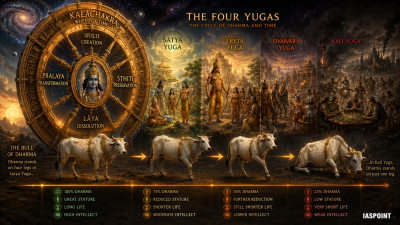
The theory of Yugas represents the cyclical conception of time in Indian cosmology, contrasting with the linear “arrow of time” prevalent in Western thought. In this framework, time is viewed as a Kalachakra (Wheel of Time), where creation, preservation, and dissolution follow a repetitive, four-stage pattern. As time progresses through these stages, there is a gradual decline in Dharma (righteousness), physical stature, longevity, and human intellect. This decline is metaphorically represented by the “Bull of Dharma,” which loses one leg in each successive Yuga.
The Four Yugas: Characteristics and Attributes
The Maha Yuga (Great Cycle) is composed of four distinct epochs, each defined by the prevailing level of virtue and the dominant mode of spiritual practice (Yuga Dharma).
| Yuga Name | Also Known As | Duration (Human Years) | Proportions | Key Characteristics |
| Satya Yuga | Krita Yuga (Golden Age) | 1,728,000 | 4 | Absolute Truth; 100% Dharma; Humans are giants and long-lived; Meditation is the primary spiritual path. |
| Treta Yuga | Silver Age | 1,296,000 | 3 | Appearance of sacrifice; 75% Dharma; Appearance of Kingship (Lord Rama); Rituals (Yajnas) are the primary path. |
| Dvapara Yuga | Bronze Age | 864,000 | 2 | Rise of diseases and internal strife; 50% Dharma; Ritualistic worship and Temple building (Archana) are the primary paths. |
| Kali Yuga | Iron Age | 432,000 | 1 | The age of quarrel and hypocrisy; 25% Dharma; Nama-Sankirtana (chanting) is the primary path for liberation. |
Mathematical Scaling of Cosmic Time
Indian astronomical texts like the Surya Siddhanta and the Vishnu Purana provide specific mathematical derivations for these cycles based on “Divine Years.”
Divine Years and Maha Yuga
- One Divine Day: Equivalent to one human year (six months of Uttarayana represent the day of the Devas).
- One Divine Year: 360 human years.
- Maha Yuga: Consists of 12,000 Divine Years.
- Satya Yuga: 4,800 Divine Years
- Treta Yuga: 3,600 Divine Years
- Dvapara Yuga: 2,400 Divine Years
- Kali Yuga: 1,200 Divine Years
- The total duration of a Maha Yuga in human years is 12,000 × 360 = 4,320,000 years.
Macro-Scaling: Manvantaras and Kalpas
- Manvantara: A period presided over by a Manu. There are 14 Manvantaras in one Kalpa. Each Manvantara equals 71 Maha Yugas (approx. 306.72 million years).
- Sandhyas: Junction periods between Manvantaras, equivalent to the duration of one Satya Yuga.
- Kalpa: One “Day of Brahma,” totaling 1,000 Maha Yugas (4.32 billion years). This is followed by a “Night of Brahma” of equal duration, during which the universe remains in a state of dissolution (Pralaya).
The Current Chronological Context
According to traditional calculations used in the Indian Panchangam, we are currently situated in the following specific point of cosmic time:
- Brahma’s Age: Brahma is currently 51 years old (out of a 100-year life span).
- Kalpa: We are in the Varaha Kalpa.
- Manvantara: We are in the 7th Manvantara, known as the Vaivasvata Manvantara.
- Yuga: We are in the Kali Yuga, which is traditionally believed to have commenced on February 18, 3102 BCE, following the departure of Lord Krishna.
Philosophical and Cultural Impact of Yuga Theory
The theory of Yugas has deeply influenced Indian social structures and cultural expressions.
- Avatara Doctrine: The concept that the Divine descends to Earth to restore balance. For example, Lord Rama appeared in Treta Yuga, Lord Krishna in Dvapara Yuga, and the Kalki Avatar is prophesied for the end of Kali Yuga.
- Standard of Dharma: The decline of Dharma explains the necessity for increasingly complex laws (Dharmashastras) as human moral capacity diminishes.
- Art and Architecture: The “Dvapara” and “Kali” ages saw the transition from internal meditation to external temple worship, leading to the massive construction of temple complexes across India to facilitate Bhakti.
Fact File for Aspirants
- The First Manu: Swayambhuva Manu.
- The Current Manu: Vaivasvata Manu.
- Sandhyas and Sandhyansas: Each Yuga is preceded by a ‘dawn’ (Sandhya) and followed by a ‘dusk’ (Sandhyansa), each lasting 1/10th of the Yuga’s total duration.
- Pralaya types: Indian texts describe three types of dissolution: Naimittika (Occasional, at the end of Brahma’s day), Prakritika (Elemental, at the end of Brahma’s life), and Atyantika (Final, through individual liberation/Moksha).
- Aryabhata’s View: Distinct from the Puranas, the mathematician Aryabhata suggested that all four Yugas are of equal duration (1,080,000 years each), though the Puranic unequal division remains the standard in cultural reckoning.