
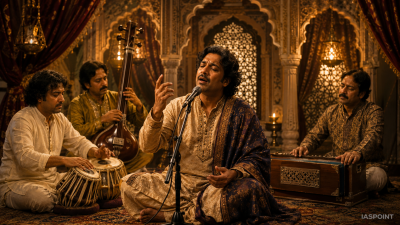
Khayal (or Khyal) is the most prominent genre of Hindustani classical vocal music today. The word “Khayal” is derived from Persian, meaning “imagination” or “fancy,” which accurately reflects the genre’s emphasis on improvisational freedom. While its roots are debated, it is generally accepted that Khayal evolved as a more flexible, lyrical, and decorative alternative to the rigid and somber Dhrupad style.
Key Historical Milestones
- Amir Khusrau (13th Century): Often credited with the conceptual origin of Khayal, blending Persian musical elements with Indian traditional forms.
- Sultan Hussain Sharqi of Jaunpur (15th Century): A significant patron who is believed to have further developed the Khayal structure.
- Niyamat Khan ‘Sadarang’ and Firoz Khan ‘Adarang’ (18th Century): Court musicians of the Mughal Emperor Muhammad Shah ‘Rangeela’. They composed thousands of Bandishes (compositions) that form the core repertoire of Khayal today. Ironically, they taught Khayal to their disciples but continued to perform Dhrupad themselves, as the latter was still considered the “noble” art.
Structural Anatomy of a Khayal Performance
A Khayal performance is typically divided into two distinct sections, characterized by tempo and depth of elaboration.
Bada Khayal (Vilambit)
- Tempo: Set in Vilambit Laya (slow tempo).
- Purpose: Focuses on the systematic development of the Raga (Vistar).
- Tala: Commonly set to Ektal, Jhumra, or Tilwada.
- Style: The singer explores the nuances of each note, often using Meend (glides) and Kan (grace notes) to establish the Raga’s identity.
Chhota Khayal (Drut)
- Tempo: Set in Drut Laya (fast tempo).
- Purpose: Showcases technical virtuosity and rhythmic dexterity.
- Tala: Commonly set to Teental, Japtal, or Ekatal.
- Style: Features rapid-fire Taans (fast melodic passages), Sargam (singing note names), and Bol-taans (melodic phrases using the lyrics of the song).
Essential Components of Khayal Gayaki
The beauty of Khayal lies in its various ornamentations and improvisational techniques:
- Alap: The slow, introductory movement exploring the Raga without rhythmic accompaniment.
- Taan: Rapid melodic phrases sung at a high speed.
- Bol-Baant: The rhythmic distribution of the words of the composition.
- Murki and Harkat: Subtle and delicate musical ornaments that add “sparkle” to the rendition.
- Gharana System: Khayal is the primary genre that gave rise to the Gharana system, where specific stylistic traits are passed down through generations.
Comparison: Khayal vs. Dhrupad
| Feature | Khayal | Dhrupad |
| Mood | Romantic, aesthetic, and diverse | Devotional, somber, and heroic |
| Flexibility | High (allows extensive improvisation) | Low (strictly follows traditional rules) |
| Ornamentation | Frequent use of Taans and Murkis | Minimal; uses Gamaks and Meend |
| Language | Primarily Braj Bhasha and Urdu | Primarily Sanskrit and Braj Bhasha |
| Percussion | Tabla | Pakhawaj |
Major Gharanas of Khayal
| Gharana | Distinctive Feature | Major Proponents |
| Gwalior | Known as the “Mother of Gharanas”; focuses on simplicity and Akara (open-throat singing). | Vishnu Digambar Paluskar, Pt. Omkarnath Thakur. |
| Kirana | Focuses on Swara (melody) and emotional depth; famous for extreme slow-tempo renditions. | Abdul Karim Khan, Bhimsen Joshi, Prabha Atre. |
| Agra | Blends Dhrupad elements with Khayal; emphasizes powerful voice and Nom-Tom Alap. | Faiyaz Khan, Khadim Hussain Khan. |
| Jaipur-Atrauli | Complex, rare Ragas and a “seamless” melodic flow without many gaps. | Alladiya Khan, Kishori Amonkar, Mallikarjun Mansur. |
| Patiala | Known for intricate Taans and a touch of folk (Punjabi) influence. | Bade Ghulam Ali Khan, Ajoy Chakrabarty. |
Trivia and Facts for UPSC Aspirants
- Gender and Khayal: While Dhrupad was historically dominated by male singers (though this has changed), Khayal has a long-standing tradition of both male and female maestros.
- The ‘Sadarang’ Signature: If you hear a composition containing the name “Sadarang” in the lyrics, it is a hallmark of the 18th-century Mughal court compositions.
- Transition of Patronage: The development of Khayal mirrors the shift of Indian music from the temples and the imperial courts of Delhi to the princely states like Baroda, Gwalior, and Rampur.
- Relationship with Thumri: Khayal singers often conclude their recitals with a Thumri or Dadra (semi-classical forms) to provide a lighter, more lyrical finish to a heavy classical session.
- Instruments: The primary melodic accompaniment for Khayal is the Harmonium or Sarangi, while the Tanpura provides the constant drone necessary for the singer to maintain pitch.