
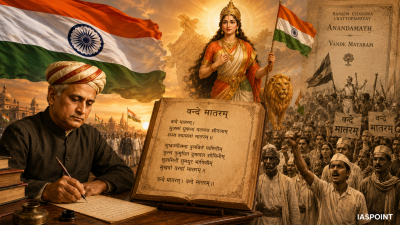
The National Song of India, “Vande Mataram,” holds a unique position in the Indian subconscious, serving as the primary anthem of the Indian independence movement. Composed by Bankim Chandra Chattopadhyay, it provided the conceptual framework for “Mother India” as a deity to be liberated.
- Literary Source: The song was originally written in 1875 and later included in Bankim Chandra’s Bengali novel Anandamath, published in 1882.
- Language: The lyrics are a blend of Sanskrit and Bengali (Sanskritized Bengali).
- Political Debut: It was first sung in a political context by Rabindranath Tagore at the 1896 session of the Indian National Congress in Calcutta.
- The 1905 Partition of Bengal: The song became the rallying cry for the Swadeshi Movement. The British administration eventually banned the public singing of “Vande Mataram” to curb the rising nationalist sentiment, which only served to increase its popularity.
- Constituent Assembly Adoption: On January 24, 1950, Dr. Rajendra Prasad (President of the Constituent Assembly) stated that “Vande Mataram” would be honored equally with the National Anthem, “Jana Gana Mana,” and shall have an equal status with it.
Musical Composition and Official Protocol
While the National Anthem has a strictly defined duration and rhythm, the National Song is performed with more rhythmic flexibility, though it maintains a standard ceremonial version.
- Original Tune: Rabindranath Tagore composed the first musical setting for the song.
- Popular Version: The most widely recognized modern tune was composed by Jadunath Bhattacharya.
- Official Duration: Unlike the National Anthem’s 52-second rule, there is no constitutional or legal time limit for singing “Vande Mataram.”
- Stanza Usage: Traditionally, only the first two stanzas of the original poem are recognized and performed as the National Song.
Comparison: National Anthem vs. National Song
For UPSC Prelims, understanding the distinction between the two symbols is crucial.
| Feature | National Anthem (Jana Gana Mana) | National Song (Vande Mataram) |
| Author | Rabindranath Tagore | Bankim Chandra Chattopadhyay |
| Adoption Date | January 24, 1950 | January 24, 1950 |
| First Performance | 1911 (INC Calcutta Session) | 1896 (INC Calcutta Session) |
| Legal Status | Protected under Prevention of Insults to National Honour Act, 1971 | Held in “Equal Status” by Constituent Assembly resolution |
| Core Theme | Unity in Diversity and Sovereignty | Personification of the Motherland and Sacrifice |
Constitutional and Judicial Standing
The status of the National Song is distinct from the National Anthem in terms of legal mandates and judicial interpretations.
- Article 51A: While the National Anthem is explicitly mentioned in the Fundamental Duties, “Vande Mataram” is considered part of the “ideals which inspired our national struggle for freedom” mentioned in Article 51A(b).
- Compulsion Issues: The Supreme Court and various High Courts have maintained that while the song is to be respected, there is no legal provision that mandates the compulsory singing of the National Song in schools or offices, unlike the protocol sometimes applied to the National Anthem.
- Privileges: Despite the lack of a formal penal code for “Vande Mataram” specifically (unlike the National Anthem), it is traditionally played at the conclusion of every session of the Lok Sabha and Rajya Sabha.
Important Facts and Trivia for Aspirants
- The Sannyasi Rebellion: The novel Anandamath, which contains the song, is set against the backdrop of the Sannyasi Rebellion of the 18th century.
- Translation: Sri Aurobindo Ghosh translated the song into English prose under the title “Mother, I bow to thee.”
- International Recognition: In a 2002 poll conducted by the BBC World Service, “Vande Mataram” was voted as the second most popular song in the world among thousands of entries.
- Lala Lajpat Rai: He started a journal named Vande Mataram from Lahore to spread nationalist ideas.
- Madam Bhikaji Cama: The first version of the Indian flag hoisted by her in Stuttgart (1907) had the words “Vande Mataram” inscribed on the central yellow stripe.
Symbolism in Art and Culture
The song transcended its musical form to influence various media during the freedom struggle:
- Visual Arts: Abanindranath Tagore’s famous painting “Bharat Mata” (1905) is considered a visual representation of the spirit of “Vande Mataram.”
- Broadcasting: All India Radio begins its daily national broadcast with a rendition of “Vande Mataram.”
- Role in INA: The Indian National Army (INA) under Subhash Chandra Bose utilized the song to maintain the morale of the troops, alongside the Hindustani version of the National Anthem.