
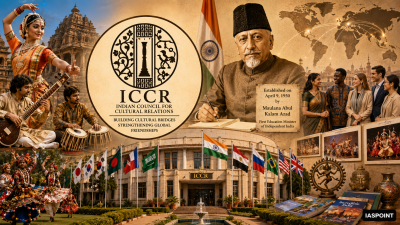
The Indian Council for Cultural Relations (ICCR) is India’s apex body for cultural diplomacy. It was established on April 9, 1950, by Maulana Abul Kalam Azad, the first Education Minister of independent India. The council was founded with the primary objective of establishing, reviving, and strengthening cultural relations and mutual understanding between India and other countries.
Administrative Framework
The ICCR functions as an Autonomous Body under the administrative control of the Ministry of External Affairs (MEA). This positioning is unique among cultural institutions, as its mandate is intrinsically linked to India’s foreign policy and “Soft Power” projection.
- Headquarters: Azad Bhavan, New Delhi.
- Regional Offices: It maintains a presence in major Indian cities like Mumbai, Kolkata, Chennai, Bengaluru, and Hyderabad to coordinate with local artists.
- International Presence: The ICCR manages over 35 Cultural Centres worldwide (e.g., Vivekananda Cultural Centre in Tokyo, Indira Gandhi Cultural Centre in Mauritius).
Core Mandate and Functions
The ICCR acts as the nodal agency for the following activities:
- Cultural Exchange Programmes (CEPs): Implementing bilateral cultural agreements between India and foreign nations.
- Global Outreach: Sending Indian cultural troupes (music, dance, theatre) abroad and hosting foreign ensembles in India.
- Scholarship Programs: Administering numerous scholarship schemes for foreign students to study in India, particularly in the fields of performing arts, AYUSH, and traditional sciences.
- Chair of Indian Studies: Establishing and maintaining Chairs of Indian Studies (Languages, Philosophy, History) in foreign universities to promote Indology.
Major Initiatives and Key Awards
The Council recognizes international contributions to Indian culture and promotes intellectual discourse through several high-profile initiatives:
| Initiative / Award | Description and Significance |
| Gisela Bonn Award | Instituted by ICCR to honor German nationals for their contribution to Indo-German friendship. |
| Distinguished Indologist Award | Presented to foreign scholars for significant contributions to the study of India’s history and culture. |
| World Sanskrit Award | Recognizes non-Indian scholars for their contribution to the promotion of the Sanskrit language. |
| Annaprashan / Gen-Next Democracy | Programs aimed at inviting young leaders and influencers from democratic nations to experience Indian heritage. |
| Distinguished Alumni Award | Given to foreign students who studied in India under ICCR scholarships and later achieved eminence in their fields. |
Promotion of Indian Languages and Traditional Knowledge
The ICCR is instrumental in the global promotion of India’s civilizational assets:
- International Day of Yoga (IDY): The ICCR is the lead agency for organizing and coordinating Yoga demonstrations and events across Indian missions globally every June 21st.
- Propagation of Hindi: It organizes World Hindi Conferences and sponsors Hindi teachers for deployment in foreign academic institutions.
- Promotion of AYUSH: Specifically allocates scholarships for foreign students to pursue undergraduate and postgraduate courses in Ayurveda, Yoga, Unani, Siddha, and Homeopathy.
Academic and Publication Activities
To provide a scholarly backbone to cultural diplomacy, the ICCR engages in significant intellectual production:
- Journals: It publishes journals in several languages including Indian Horizons (English), Gagananchal (Hindi), Papeles de la India (Spanish), and Rencontre avec l’ Inde (French).
- Library and Archives: Azad Bhavan houses a rare collection of manuscripts and books gifted by Maulana Azad, serving as a resource for researchers in international relations and culture.
Significance for UPSC Prelims
- Nodal Ministry: Unlike most cultural bodies under the Ministry of Culture, ICCR is under the Ministry of External Affairs.
- Founding Figure: Maulana Abul Kalam Azad (his birth anniversary, Nov 11, is National Education Day).
- Statutory Status: It is a registered society under the Societies Registration Act, 1860.
- Soft Power Tool: It is the primary vehicle for “Track II Diplomacy,” using culture as a bridge to improve political and economic ties.
- International Students: The ICCR portal “A2A” (Admissions to Alumni) is the digital platform for managing the entire lifecycle of international students in India.
Notable Facts and Trivia
- The Vivekananda Cultural Centre in Durban, South Africa, is one of the most active hubs for promoting the shared history of Gandhi and Mandela.
- The ICCR maintains the “Lata Mangeshkar Dance & Music Scholarship” specifically to encourage international students to learn Indian classical forms.
- It organizes the International Festival of Buddhist Heritage, showcasing India as the “Land of the Buddha” to Southeast Asian nations.
- The Council manages the prestigious Maulana Azad Memorial Lecture, which has been delivered by global leaders and thinkers including Martin Luther King Jr. and Nelson Mandela.