

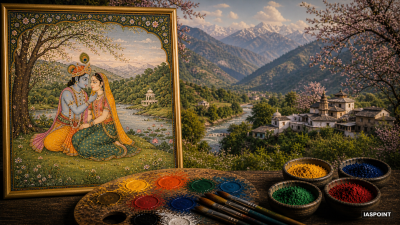
The Kangra School is the most celebrated and refined offshoot of the Pahari tradition, flourishing in the late 18th century. It represents the pinnacle of Rajput painting, succeeding the earlier Guler and Basohli styles. Centered in the Kangra Valley of Himachal Pradesh, it is characterized by its lyrical grace, rhythmic lines, and a deep, poetic obsession with the Bhakti movement.
Historical Genesis and Patronage
The school originated from the migration of artists from the Mughal court and the neighboring Guler state.
- The Guler Connection: The foundation was laid by the artist family of Pandit Seu. After the decline of the Guler state, his descendants, including Manaku and Nainsukh, brought a new naturalism to the Kangra court.
- The Sansar Chand Era (1775–1823): The school reached its zenith under the patronage of Maharaja Sansar Chand. A devoted follower of Krishna, his religious fervor and aesthetic vision turned Kangra into a major hub of the arts, supporting a massive atelier that produced thousands of miniatures.
- Decline: The school began to fade after the Gurkha invasions and the subsequent rise of Sikh power in the hills during the mid-19th century.
Distinctive Stylistic Features
Kangra paintings are easily identifiable through their “feminine” elegance and sophisticated technical execution.
- The Kangra Face: Faces are typically shown in profile with a straight nose, high forehead, and “porcelain” skin. The eyes are often almond-shaped or “lotus-like” (Khonjan-Netra).
- Color Palette: Use of soft, cool, and delicate colors derived from minerals and plants. While primary colors are used, they are often muted compared to the bold Basohli style.
- Landscape and Nature: Unlike other schools that used flat backgrounds, Kangra art features realistic Himalayan topography. Flowering trees, winding streams, rolling green hills, and varied birdlife (peacocks, sarus cranes) are integral to the composition.
- Technical Finesse: Known for “Sufi” (fine) linework. The brushstrokes are so delicate that they can capture the transparency of a muslin odhani (veil).
Core Themes and Literary Inspirations
The Kangra school is essentially a visual translation of Hindi and Sanskrit erotic and devotional poetry.
- Krishna Leela: The primary theme, focusing on the divine love between Radha and Krishna, symbolizing the union of the human soul with the divine.
- Gita Govinda: Extensive sets based on Jayadeva’s poem, capturing the emotional nuances of love, separation, and reunion.
- Nayaka-Nayika Bheda: A systematic classification of heroes and heroines based on their emotional states (e.g., Abhisarika—the heroine going to meet her lover in the dark).
- Barahmasa: Depicting the twelve months of the year, correlating the changing seasons with human emotions.
- Bhagavata Purana and Ramayana: Elaborate series depicting the childhood of Krishna and the epic journey of Rama.
Comparison: Kangra vs. Other Pahari Sub-schools
| Feature | Kangra School | Basohli School | Guler School |
| Mood | Lyrical and Graceful | Bold and Intense | Naturalistic and Soft |
| Coloring | Soft pastels and gold | Vibrant primary colors | Muted earthy tones |
| Eyes | Narrow and elongated | Large and expressive | Realistic and gentle |
| Landscape | Elaborate Himalayan views | Minimal/Decorative | Transitional landscapes |
Prominent Artists of the Kangra Tradition
While many works remain anonymous, the influence of specific families is well-documented:
- Manaku: Often credited with the famous 1730 Gita Govinda series which transitioned the style from Guler to Kangra.
- Kushala and Fattu: Descendants of Nainsukh who worked under Sansar Chand, further refining the Kangra idiom.
- Purkhu: A leading artist known for his ability to handle large-scale compositions and courtly scenes.
Fact Sheet for UPSC Prelims
- Geographic Reach: Though named after Kangra, the style influenced painting in neighboring Chamba, Mandi, and Suket.
- The “Lyrical Naturalism”: This term is often used by art historians (like Ananda Coomaraswamy) to describe the unique Kangra blend of realistic nature and poetic sentiment.
- Materials: Paintings were executed on Vasli (handmade paper). Pigments included Kajal (lampblack) for black, Hingul (cinnabar) for red, and Safeda (lead white).
- Chitrashala: Maharaja Sansar Chand established a dedicated department for paintings, ensuring that artists were given high social status.
- Relationship with Music: Many Kangra paintings are visual representations of Ragas and Raginis, bridging the gap between visual art and Indian classical music.
Trivia: The “Unseen” Blue
The Kangra artists were masters of using different shades of blue to represent the “Ghanshyam” (cloud-colored) Krishna. They often used ground lapis lazuli or indigo, layering it to create a luminous quality that made the central figure appear to glow against the dark forest of Vrindavan.
Last Modified: May 5, 2026