
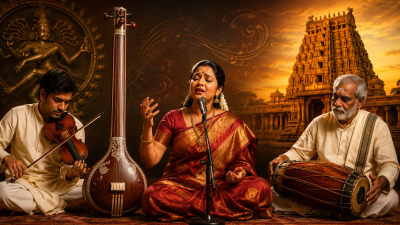
Carnatic music (Karnātaka Saṃgīta) is the classical music tradition of South India, prevalent in Andhra Pradesh, Telangana, Karnataka, Kerala, and Tamil Nadu. Unlike Hindustani music, which underwent significant Persian influence, Carnatic music remained relatively insulated, preserving more of the ancient Indian musical traditions. It is deeply rooted in Bhakti (devotion) and is characterized by a sophisticated mathematical structure and intricate melodic ornamentations known as Gamakam.
Historical Milestones and Pioneers
The foundation of modern Carnatic music was laid between the 13th and 18th centuries through the works of several saint-composers.
- Purandara Dasa (1484–1564): Universally acknowledged as the Pitamaha (Grandfather) of Carnatic Music. He codified the beginner lessons (Sarali Varisai, Jantai Varisai) and introduced the Mayamalavagowla scale as the standard for beginners.
- Venkatamakhin (17th Century): Author of Chaturdandi Prakashika, he developed the 72 Melakarta system, providing the mathematical framework for classifying Ragas.
- The Trinity of Carnatic Music: The 18th century is considered the “Golden Age” due to three prolific composers born in Tiruvarur:
- Tyagaraja: Famous for his Pancharatna Kritis and deep devotion to Lord Rama.
- Muthuswami Dikshitar: Known for his intellectual compositions in Sanskrit, including the Navagraha Kritis.
- Syama Sastri: Celebrated for his mastery over complex rhythmic structures (Tala) and devotion to Goddess Kamakshi.
The Melakarta System: Classification of Ragas
The Carnatic system uses a highly structured mathematical classification called the 72 Melakarta (parent) Ragas. This is more comprehensive than the 10-Thaat system of Hindustani music.
| System Component | Description |
| Janaka Raga | The 72 parent Ragas (Melakartas) that contain all seven notes (Swaras) in both ascent and descent. |
| Janya Raga | Derived Ragas that originate from a Melakarta by omitting notes or changing their order. |
| Katakapayadi Sankhya | An ancient alphanumeric code used to determine the number and notes of a Melakarta Raga from its name. |
Structural Components of a Performance
A standard Carnatic concert (Kutcheri) follows a specific pedagogical and performance sequence.
- Varnam: A complex exercise performed at the beginning to warm up, capturing the essence of the Raga.
- Kriti: The core of the performance; a fixed composition consisting of three parts:
- Pallavi: The thematic line or “refrain.”
- Anupallavi: The second section, usually sung in a higher register.
- Charanam: The concluding verse(s) that often include the composer’s signature (Mudra).
- Ragam Thanam Pallavi (RTP): The pinnacle of a concert where the artist demonstrates pure improvisation.
- Ragam: Melodic improvisation without rhythm.
- Thanam: Rhythmic improvisation using syllables like “Anantha.”
- Pallavi: A single line of lyrics set to a complex Tala.
Important Carnatic Musical Terms
- Gamakam: Subtle oscillations or glides on a note; it is the “life-breath” of Carnatic melody.
- Mudra: The signature of the composer embedded in the lyrics (e.g., Guruguha for Muthuswami Dikshitar, Tyagaraja for Tyagaraja).
- Kalpanaswara: On-the-spot melodic improvisation using note names (Sa, Ri, Ga, Ma…) performed at the end of a composition.
- Neraval: Improvising on a specific line of the lyrics while maintaining the original melody and rhythm.
Comparative Analysis: Carnatic vs. Hindustani Music
While both share the fundamentals of Raga and Tala, their execution differs significantly.
| Feature | Carnatic Music | Hindustani Music |
| Region | South India | North India, Pakistan, Bangladesh |
| Influence | Indigenous/Vedic | Synthesis of Vedic, Persian, and Arabic |
| Freedom | Strict adherence to compositions | High emphasis on improvisation |
| Laya (Rhythm) | Mathematical and complex | Fluid and emotive |
| Time Theory | No strict association with time of day | Strictly follows Raga-Time cycles |
| Classification | 72 Melakarta system | 10 Thaat system |
| Main Instrument | Veena / Violin / Mridangam | Sitar / Sarod / Tabla |
Instruments of the Carnatic Tradition
Carnatic music utilizes specific instruments, some of which are unique to the Southern tradition.
- Venu: The bamboo flute, distinct for having eight holes.
- Veena (Saraswati Veena): The premier plucked string instrument, often associated with the goddess of learning.
- Violin: Though Western in origin, it was adapted into Carnatic music by Baluswami Dikshitar and is now the primary melodic accompaniment.
- Mridangam: The primary percussion instrument; a two-headed barrel drum.
- Ghatam: A specially baked clay pot played with fingers.
- Kanjira: A small frame drum with a lizard-skin head.
- Nadaswaram: A powerful wind instrument played during weddings and temple festivals.
Factoids and Trivia for UPSC Aspirants
- The Mudra of the Trinity: Tyagaraja used “Tyagaraja”; Muthuswami Dikshitar used “Guruguha”; Syama Sastri used “Syama Krishna.”
- Tansen of the South: Tyagaraja is often compared to Tansen for his impact on the musical landscape.
- The 72 Melakarta Creator: While Venkatamakhin proposed the theory, it was Govindacharya who finalized the names used today.
- Tyagaraja Aradhana: An annual music festival held in Tiruvaiyaru (Tamil Nadu) where hundreds of musicians sing the Pancharatna Kritis in unison to honor the saint.
- UNESCO Recognition: The city of Chennai is part of the UNESCO Creative Cities Network (UCCN) for its rich musical heritage, particularly the “December Music Season.”