

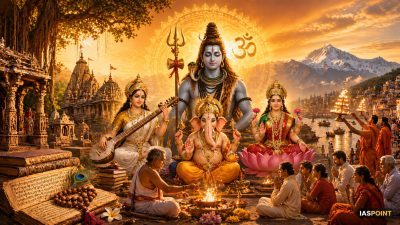
Hinduism, often referred to as Sanatana Dharma (the Eternal Way), is one of the world’s oldest living religions. Unlike proselytizing faiths, it evolved through a synthesis of various Indian cultural and spiritual traditions.
Core Philosophical Foundations
The bedrock of Hindu thought lies in the pursuit of four goals of human life, known as Purusharthas.
- Dharma: Righteousness, moral values, and duty.
- Artha: Prosperity and economic values.
- Kama: Pleasure, love, and psychological values.
- Moksha: Liberation from the cycle of birth and death (Samsara).
The Six Schools of Classical Philosophy (Shad-darshana)
The orthodox (Astika) schools recognize the authority of the Vedas. These schools represent the intellectual pinnacle of ancient Indian thought.
| School | Founder/Proponent | Key Features |
| Nyaya | Gautama | Focused on logic, methodology, and epistemology. |
| Vaisheshika | Kanada | Atomistic pluralism; everything is composed of five elements (Earth, Water, Fire, Air, Ether). |
| Samkhya | Kapila | Dualism between Purusha (consciousness) and Prakriti (matter); oldest school. |
| Yoga | Patanjali | Practical application of Samkhya; emphasizes meditation and physical discipline. |
| Purva Mimamsa | Jaimini | Focuses on the ritualistic part of the Vedas and the power of Mantras. |
| Vedanta | Vyasa/Badarayana | Focuses on the Upanishads; explores the relationship between Brahman and Atman. |
Sub-Schools of Vedanta
Vedanta has significantly influenced modern Hinduism through various interpretations of the nature of reality.
- Advaita Vedanta (Adi Shankara): Absolute monism; Brahman is the only reality, and the world is Maya (illusion).
- Vishishtadvaita (Ramanuja): Qualified monism; the world and individual souls are real but are parts of Brahman.
- Dvaita (Madhvacharya): Dualism; Brahman (Vishnu) and the individual soul are eternally distinct.
- Shuddhadvaita (Vallabhacharya): Pure non-dualism; Krishna is the supreme Brahman.
- Dvaitadvaita (Nimbarka): Dualistic non-dualism; the soul is both different and non-different from God.
Major Sects and Traditions
Hinduism is traditionally divided into four major denominations based on the primary deity worshipped.
Vaishnavism
- Focuses on the worship of Vishnu and his ten incarnations (Dashavatara).
- Key incarnations include Rama, Krishna, Buddha (in some traditions), and the future Kalki avatar.
- Strongly associated with the Bhakti Movement in South and North India.
Shaivism
- Focuses on Shiva as the Supreme Being.
- Prominent sub-sects include Pashupata, Shaiva Siddhanta, Kashmir Shaivism, and Lingayatism (founded by Basavanna in Karnataka).
- Features the concept of the Lingam and Nandi.
Shaktism
- Worship of the Divine Mother (Devi or Shakti) as the ultimate reality.
- Important texts include the Devi Mahatmya and Lalita Sahasranama.
- Practiced through Tantric and Puranic traditions, particularly in Bengal, Assam, and Odisha.
Smartism
- Founded on the Panchayatana puja system popularized by Adi Shankara.
- Treats five deities as equal: Vishnu, Shiva, Ganesha, Surya, and Durga.
Sacred Literature: Shruti and Smriti
Hindu scriptures are categorized into two types based on how they were received and preserved.
- Shruti (That which is heard): Includes the four Vedas (Rig, Sama, Yajur, Atharva), their Brahmanas (ritual instructions), Aranyakas (forest treatises), and Upanishads (philosophical conclusions).
- Smriti (That which is remembered): Includes the Vedangas (limbs of Vedas like Grammar and Astronomy), Puranas (mythological stories), Itihasas (Ramayana and Mahabharata), and Dharmashastras (law books like Manusmriti).
Key Concepts and Terminology for Prelims
- Panchayatana: A temple layout where the main deity is surrounded by four subsidiary shrines.
- Trimurti: The triad of Brahma (Creator), Vishnu (Preserver), and Shiva (Destroyer).
- Tridevi: The triad of Saraswati, Lakshmi, and Parvati.
- Saguna Bhakti: Worship of God with form and attributes (e.g., Tulsidas, Chaitanya Mahaprabhu).
- Nirguna Bhakti: Worship of God without form or attributes (e.g., Kabir, Guru Nanak).
- Agamas: Sectarian scriptures that provide the methodology for temple construction and idol worship.
Major Hindu Festivals and Cultural Significance
- Kumbh Mela: The world’s largest religious gathering, held rotationally at Haridwar, Prayagraj, Nashik, and Ujjain every 12 years.
- Diwali: Marks the return of Rama to Ayodhya; signifies the victory of light over darkness.
- Holi: Spring festival associated with the legend of Prahlad and Holika, and the playfulness of Krishna.
- Navratri/Durga Puja: Nine nights dedicated to the forms of Shakti, culminating in Vijayadashami.
- Jagannath Rath Yatra: A massive chariot festival in Puri, Odisha, representing the journey of Krishna, Balarama, and Subhadra.
Temple Architecture Overview
Religious culture is physically manifested through three main styles of temple architecture:
- Nagara (North India): Characterized by curvilinear towers (Shikhara) and a square base.
- Dravida (South India): Distinguished by pyramid-like towers (Vimana) and massive gateways (Gopurams).
- Vesara (Hybrid): A fusion of Nagara and Dravida styles, prominently seen in the Hoysala and Chalukya temples.