
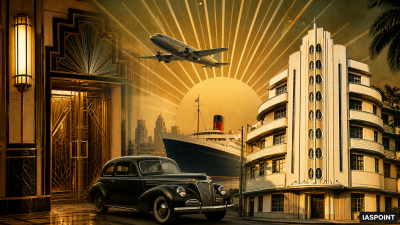
Art Deco was a global design movement that reached India in the 1930s, representing a shift toward modernity, speed, and industrial progress. Unlike the revivalist Indo-Saracenic style, Art Deco was a “machine-age” aesthetic that prioritized geometric symmetry and streamlined forms. India, particularly Mumbai, became a global hub for this style, with the city now hosting the second-largest concentration of Art Deco buildings in the world after Miami.
Core Architectural Characteristics
Art Deco in India is distinguished by its blend of Western modernist tropes with Indian tropical adaptations and local motifs.
- Streamlining and Verticality: Features smooth, rounded corners (aerodynamic forms) and “frozen fountain” motifs that emphasize height and upward movement.
- Geometric Patterns: Extensive use of zig-zags, sunbursts, chevrons, and stepped-back profiles (ziggurats).
- Nautical Elements: Many buildings incorporate porthole windows, ship-like railings, and observatory towers, reflecting the influence of the “Steamship” era.
- Tropical Decadence: Adaptations for the Indian climate include the use of wide balconies (verandahs), weather shades (chhajjas) integrated into the design, and “Jali” patterns reimagined in concrete.
- Materiality: Shift toward modern materials like Reinforced Cement Concrete (RCC), steel, and terrazzo flooring, often finished with polished stone or vibrant cement plasters.
The Mumbai Art Deco Cluster
The most significant concentration of this style is found in South Mumbai, specifically around the Oval Maidan and Marine Drive.
- Victorian and Art Deco Ensemble: In 2018, the Victorian Gothic and Art Deco Ensembles of Mumbai were declared a UNESCO World Heritage Site. This site highlights the juxtaposition of 19th-century Gothic revival and 20th-century Art Deco.
- Residential Precincts: The “Marine Drive” stretch features a continuous row of residential buildings with uniform heights and rounded balconies, designed to resemble a “Queen’s Necklace.”
- The Cinema Palaces: Art Deco was the preferred style for the grand movie theaters of the 1930s, such as Regal Cinema (the first Art Deco cinema in Mumbai), Eros Cinema, and Liberty Cinema.
Regional Variations and Key Examples
While Mumbai is the epicenter, Art Deco spread to other major Indian cities and Princely States as a symbol of being “modern.”
- Delhi: The New Delhi Town Hall and several bungalows in the Lutyens’ zone incorporate Art Deco elements. The Imperial Hotel is a prime example of Art Deco luxury.
- Kolkata: The Victoria House (CESC headquarters) and several private residences in South Calcutta exhibit the “Streamline Moderne” style.
- Princely States: Maharaja Umaid Singh of Jodhpur commissioned the Umaid Bhawan Palace, which is often cited as a fusion of Beaux-Arts, Art Deco, and Rajput traditions. The Chettinad Mansions in Tamil Nadu also adopted Art Deco interiors and facades in the mid-20th century.
Comparison: Indo-Saracenic vs. Art Deco
| Feature | Indo-Saracenic Architecture | Art Deco Architecture |
| Philosophy | Imperial Legitimacy (Past-facing) | Modernity and Progress (Future-facing) |
| Primary Forms | Domes, Minarets, and Arches | Geometrics, Streamlined curves, and Chevrons |
| Symmetry | Formal and traditional | Sleek and machine-inspired |
| Building Type | Administrative and Public | Residential, Cinemas, and Commercial |
| Color Palette | Earthy tones (Stone) | Bold, pastel, and vibrant cement colors |
Key Motifs and Symbolic Elements
Art Deco in India often incorporated local imagery to create a hybridized “Indo-Deco” sub-style.
- Flora and Fauna: Bas-reliefs of elephants, lotus flowers, and palm trees integrated into geometric frames.
- The Sunburst: A recurring motif symbolizing the dawn of a new era, often found on gates and grills.
- Indian Mythology: Modernist depictions of Indian deities or agrarian scenes (farmers, laborers) used in the murals of public buildings.
Trivia and Facts for UPSC Prelims
- UNESCO Status: Mumbai has the largest collection of Art Deco buildings in Asia and the second largest in the world, surpassed only by Miami Beach, USA.
- First Cinema: The Regal Cinema (1933) was the first building in India to have an underground parking lot and an extensive air-conditioning system, hallmarks of the Art Deco era’s focus on technology.
- Architects: Prominent firms that shaped Indian Art Deco include Master, Sathe & Bhuta, and Gregson, Batley & King.
- The “Frozen Fountain”: This is a specific Art Deco motif representing eternal life, often seen on the facades of theaters and office buildings in Mumbai.
- Transition to Modernism: Art Deco served as the bridge between the ornate historical styles of the 19th century and the stark, functional International Style (Modernism) introduced by Le Corbusier in Chandigarh.