

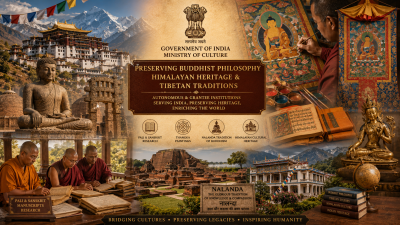
The Government of India, through the Ministry of Culture, maintains and funds several autonomous and grantee institutions dedicated to the preservation of Buddhist philosophy, Himalayan cultural heritage, and Tibetan traditions. These institutions serve as global hubs for Pali and Sanskrit research, the preservation of “Thangka” paintings, and the study of the Nalanda tradition of Buddhism.
Key Autonomous Institutions under Ministry of Culture
There are four primary autonomous organizations that form the backbone of Buddhist and Tibetan institutional research in India.
| Institution Name | Location | Established | Focus Area |
| Nava Nalanda Mahavihara (NNM) | Nalanda, Bihar | 1951 | Research in Pali language and Buddhist literature; Deemed University. |
| Central Institute of Buddhist Studies (CIBS) | Leh, Ladakh | 1959 | Preservation of Buddhist philosophy and Himalayan arts; Deemed University. |
| Central Institute of Higher Tibetan Studies (CIHTS) | Sarnath, UP | 1967 | Restoration of lost Sanskrit texts from Tibetan translations; Deemed University. |
| Central Institute of Himalayan Culture Studies (CIHCS) | Dahung, Arunachal Pradesh | 2003 | Buddhist and Himalayan studies for the North-Eastern youth. |
Nava Nalanda Mahavihara (NNM): The Revival of Nalanda
Founded at the initiative of Dr. Rajendra Prasad, the NNM was established to develop a center for higher studies in Pali and Buddhism along the lines of the ancient Nalanda University.
- Deemed University Status: It was granted the status of a Deemed University in 2006.
- Key Contribution: The publication of the entire Pali Tipitaka in Devanagari script.
- Xuanzang Memorial Hall: The institute manages the memorial dedicated to the famous Chinese traveler Xuanzang, symbolizing Indo-China cultural ties.
Central Institute of Higher Tibetan Studies (CIHTS), Sarnath
CIHTS was established as a result of a dialogue between Pt. Jawaharlal Nehru and the 14th Dalai Lama. It is a unique institution where traditional Tibetan monastic education meets modern academic research.
- Restoration Project: A core mission is the “Restoration of Lost Sanskrit Works” into Sanskrit from their Tibetan versions (Tanjur and Kanjur).
- Sowarigpa (Sowa-Rigpa): The institute is a major center for the study of this traditional Himalayan system of medicine, which is now officially recognized by the Government of India.
- Shantarakshita Library: One of the richest repositories of Buddhist and Tibetan microfilms and manuscripts in the world.
Central Institute of Buddhist Studies (CIBS), Leh
Originally called the “School of Buddhist Philosophy,” CIBS caters to the students of the Himalayan regions (Ladakh, Himachal Pradesh, Sikkim, etc.).
- Monastic Education: It provides an academic framework for monks and nuns (Sramanas) while integrating modern subjects.
- Preservation of Art: It offers specialized courses in Bhotia Language, traditional Thangka painting, and wood carving.
- Gonpa (Monastery) Schools: CIBS oversees numerous feeder schools located within various monasteries in Ladakh.
Other Significant Institutions and Grantee Bodies
1. Library of Tibetan Works and Archives (LTWA), Dharamshala
Founded by the 14th Dalai Lama in 1970, it functions as one of the most important libraries for Tibetan studies globally.
- Archives: It houses over 80,000 manuscripts and documents brought from Tibet.
- Cultural Artifacts: It contains a museum of rare icons, Thangkas, and 3D Mandalas.
2. Sikkim Research Institute of Tibetology (SRIT), Gangtok
Established in 1958, it is a world-renowned center for research into the Mahayana tradition and the history, religion, and culture of the Tibetan-speaking world.
- Foundation: The foundation stone was laid by the 14th Dalai Lama, and it was inaugurated by Pt. Jawaharlal Nehru.
- Holdings: It includes one of the largest collections of Tibetan books and manuscripts outside of Tibet.
International Buddhist Confederation (IBC)
The IBC is a global umbrella body headquartered in New Delhi. While it is an international organization, the Ministry of Culture, India, is a key patron.
- Objective: To provide a common platform for Buddhists worldwide and to promote the “Buddhist Circuit” in India.
- Events: It organizes the annual Vaisakh Buddha Purnima celebrations and international Buddhist conclaves.
Significance for UPSC Prelims
- Statutory Status: Note that NNM, CIBS, and CIHTS are Deemed Universities under the UGC Act, 1956.
- Nodal Ministry: All these institutes function under the Ministry of Culture, not the Ministry of Education.
- Sowa-Rigpa: Students should be aware that the study of this medicine is legally standardized through these institutes and falls under the Ministry of AYUSH for practice but under Culture for academic research.
- Geographical Importance: CIHCS in Dahung, Arunachal Pradesh, is strategically important for cultural integration in the North-East.
Notable Trivia and Facts
- The Pali Tipitaka project at Nava Nalanda Mahavihara is the first of its kind in India since the decline of the ancient universities.
- The Gilgit Manuscripts, some of the oldest surviving manuscripts in India (6th Century AD), are often the subject of joint research between these institutes and the National Archives.
- The “Guru-Shishya” tradition is strictly maintained in the pedagogical structure of CIBS and CIHTS, blending it with the modern 10+2+3 educational format.
- India’s “Soft Power” diplomacy often utilizes these institutes to strengthen ties with nations like Mongolia, Japan, South Korea, and Thailand.