
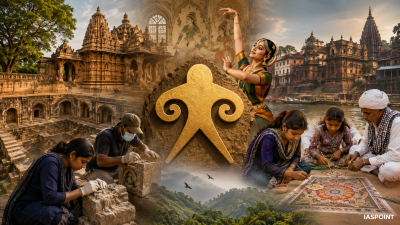
The Indian National Trust for Art and Cultural Heritage (INTACH) is India’s largest non-profit membership organization dedicated to heritage conservation. Founded in 1984 in New Delhi, it was established with the vision of creating a membership-driven movement to protect India’s diverse natural, architectural, and intangible heritage. Unlike government bodies such as the Archaeological Survey of India (ASI), which primarily protect monuments of national importance, INTACH focuses on “unprotected” heritage—local landmarks, community traditions, and regional history.
Institutional Framework and Leadership
- Legal Status: INTACH is registered as a non-profit society under the Societies Registration Act, 1860.
- Founding Figures: It was spearheaded by Rajiv Gandhi, Pupul Jayakar, and Chatrapati Singh, among others, to institutionalize heritage awareness.
- Organizational Reach: It operates through a vast network of over 200 regional and local chapters across India, making it a grassroots-level cultural force.
- Governance: The organization is governed by a Governing Council, often chaired by eminent conservationists or public figures.
Core Mandate and Functional Divisions
INTACH addresses heritage conservation through specialized divisions, each focusing on a specific niche of Indian culture:
| Division | Primary Responsibility |
| Architectural Heritage | Documentation and restoration of historic buildings, precincts, and “living” heritage sites. |
| Natural Heritage | Conservation of ecosystems, wetlands, sacred groves, and traditional water-harvesting systems. |
| Material Heritage | Restoration of paintings, manuscripts, textiles, and sculptures through specialized laboratories. |
| Intangible Cultural Heritage (ICH) | Documentation of oral traditions, folk arts, traditional crafts, and indigenous knowledge systems. |
| Heritage Education and Communication Service (HECS) | Aimed at sensitizing school and college students through Heritage Clubs and training programs. |
Key Initiatives and Conservation Projects
INTACH has pioneered several methodologies for heritage management in India, focusing on holistic restoration.
- Heritage Walks: INTACH popularized the concept of organized heritage walks in cities like Delhi, Ahmedabad, and Varanasi to reconnect citizens with their local history.
- Listing and Documentation: One of its most significant contributions is the creation of an exhaustive inventory of unprotected buildings across India, which often serves as a primary database for state-level heritage laws.
- Listing of Intangible Assets: It maintains a national registry of traditional craftsmen, musicians, and performing artists to ensure the survival of “at-risk” art forms.
- Disaster Recovery: INTACH has been instrumental in restoring heritage structures after major disasters, such as the Kutch Earthquake (2001) and the Kashmir Floods (2014).
Specialized Conservation Centres
To provide scientific support to its missions, INTACH operates several centers of excellence:
- Indian Council of Conservation Institutes (ICCI): A network of laboratories (with the main center in Lucknow) that scientifically treats and restores objects of art.
- INTACH Heritage Academy: A dedicated training center for architects, planners, and conservationists to learn the technical nuances of restoration and heritage management.
Significance for UPSC Prelims
- Nature of Organization: It is an Autonomous Non-Governmental Organization (NGO); it is not a statutory body or a direct subordinate office of the Ministry of Culture.
- Complementary Role: While the ASI protects approximately 3,600 monuments, INTACH deals with the lakhs of unprotected sites that fall outside the purview of the AMASR Act.
- International Recognition: INTACH has Special Consultative Status with the United Nations Economic and Social Council (ECOSOC).
- Heritage Awards: It instituted the “UNESCO-INTACH” awards to recognize excellence in the field of conservation across the Asia-Pacific region.
- Legislative Advocacy: INTACH frequently files Public Interest Litigations (PILs) to prevent the demolition of historic structures or the encroachment of natural heritage sites.
Notable Trivia and Facts
- The INTACH logo is based on the Vrishabha (Bull) motif from the Lomas Rishi Cave in the Barabar Hills of Bihar, representing the strength and continuity of Indian tradition.
- It played a central role in the nomination of several Indian cities for the UNESCO World Heritage City tag, including Ahmedabad and Jaipur.
- The organization publishes the Heritage Journal, a scholarly publication that documents various conservation techniques and case studies across the country.
- INTACH’s Young INTACH newsletter and website are the primary resources for heritage education at the secondary school level in India.