
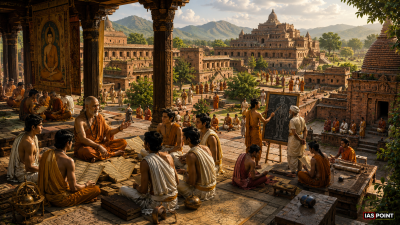
Ancient India was home to several world-renowned residential universities, often referred to as Mahaviharas. These institutions served as global hubs for intellectual exchange, attracting students from China, Korea, Tibet, Central Asia, and Southeast Asia. The education system was multidisciplinary, covering everything from theology and philosophy to medicine, astronomy, and warfare.
Taxila (Takshashila): The Hub of Secular Learning
Located in modern-day Pakistan, Taxila is considered one of the oldest universities in the world, thriving between 600 BCE and 500 CE. Unlike later universities, it did not have a centralized campus but functioned as a collection of specialized schools.
- Philosophical Orientation: Primarily a center for secular and Vedic studies rather than a monastic university.
- Specializations: Renowned for medicine (Ayurveda), political science (Arthashastra), and law.
- Notable Alumni and Faculty: Chanakya (Kautilya) composed the Arthashastra here; Panini codified Sanskrit grammar (Ashtadhyayi); Charaka (Ayurveda) and Jivaka (physician to Bimbisara) studied here.
- UNESCO Status: Designated as a World Heritage Site in 1980.
Nalanda Mahavihara: The Pinnacle of Buddhist Scholarship
Founded in the 5th century CE by Kumaragupta I of the Gupta Dynasty, Nalanda remained a premier institution until it was destroyed by Bakhtiyar Khilji in the late 12th century.
- Architecture and Scale: A massive residential complex with eight separate compounds, ten temples, and a nine-story library known as Dharmaganja (consisting of buildings named Ratnasagara, Ratnodadhi, and Ratnaranjaka).
- Curriculum: While it was a center for Mahayana Buddhism, it also taught the Vedas, Fine Arts, Medicine, and Mathematics.
- Admission Process: Highly competitive; potential students were interviewed by the Dwarapandita (Gate Scholar) to ensure academic rigor.
- Foreign Accounts: Xuanzang (Hiuen Tsang) and Yi Jing (I-Tsing) stayed here and provided detailed records of the disciplined lifestyle and the 10,000-student capacity.
Vikramshila: The Center for Tantric Studies
Established by King Dharmapala of the Pala Dynasty in the late 8th century, it was the main rival to Nalanda.
- Focus Areas: Specialized in Vajrayana Buddhism (Tantric studies), Logic, and Grammar.
- Institutional Structure: It had six colleges, each managed by a central pillar of scholarship.
- Global Influence: Atisa Dipankara, a famous scholar from Vikramshila, is credited with reviving Buddhism in Tibet.
Valabhi: The Hinayana Stronghold
Located in Saurashtra (Gujarat), Valabhi flourished under the patronage of the Maitraka Kings between 600 CE and 1200 CE.
- Sectarian Focus: A major center for Hinayana Buddhism, though it also offered secular subjects like Law (Niti), Economics (Varta), and Accountancy.
- Administrative Importance: It was famous for producing graduates who were often appointed to high government administrative posts.
- Comparisons: Gunamati and Sthiramati were two famous Buddhist scholars associated with this university.
Other Prominent Ancient Universities
| University | Region | Founder/Patron | Key Features |
| Odantapuri | Bihar | Gopala (Pala Dynasty) | Primarily a Buddhist monastery; served as a template for the Samye monastery in Tibet. |
| Jagaddala | Bengal | Ramapala (Pala Dynasty) | Specialized in Vajrayana Buddhism; many Sanskrit texts were translated into Tibetan here. |
| Pushpagiri | Odisha | Mauryan/Gupta influence | Located in the Lalitgiri-Ratnagiri-Udayagiri hills; mentioned by Xuanzang as a major Buddhist site. |
| Somapura | Bangladesh | Dharmapala | A major center for Buddhism, Jainism, and Hinduism; a UNESCO World Heritage site. |
| Kanchi | Tamil Nadu | Pallavas | A center for Vedic learning and an important site for both Hindu and Buddhist philosophy. |
| Sharada Peeth | Kashmir | Various | Dedicated to Goddess Sharada; a significant center for Sanskrit scholars and the Sharda script. |
Pedagogical Methods and Administration
The teaching-learning process in these universities was sophisticated and emphasized critical thinking over rote learning.
- Oral Tradition: Deeply rooted in the Shravana (listening), Manana (reflection), and Nididhyasana (meditation) methodology.
- Debates (Shastras): Formal debates were the primary method of assessment and for gaining prestige within the academic community.
- Autonomy: These universities were largely autonomous; while they received land grants (Agraharas) and royal patronage, the state did not interfere in the curriculum.
- Free Education: In many Mahaviharas, education, boarding, and lodging were provided free of cost, funded by the revenue from donated villages.
Decline of the Ancient University System
Several factors contributed to the eventual disappearance of these centers of excellence.
- Foreign Invasions: The most direct cause was the destruction by Central Asian invaders (e.g., Bakhtiyar Khilji’s destruction of Nalanda and Vikramshila).
- Loss of Patronage: As the regional kingdoms shifted or fell, the steady stream of land grants and financial support dried up.
- Rise of Temple Education: During the medieval period, education became more localized and centered around individual temples and mathas rather than large centralized universities.
Fact Sheet for Quick Revision
- First University to have an entrance exam: Nalanda.
- University specialized in the Sharda Script: Sharada Peeth.
- The “Oxford of Mahayana Buddhism”: Nalanda.
- The university known for producing state administrators: Valabhi.
- Primary source of information for Nalanda: Si-Yu-Ki (Records of the Western World) by Xuanzang.