

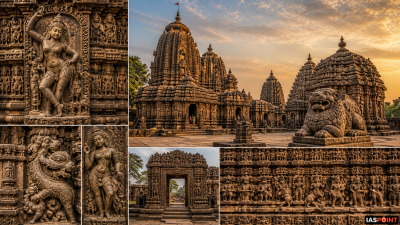
The Kalinga school of architecture and sculpture flourished in ancient Odra (modern Odisha) from the 7th to the 13th century CE. Reaching its zenith under the Bhauma-Kara, Somavamsi, and Ganga dynasties, this school is a sub-style of the Nagara (North Indian) tradition. Kalinga sculpture is characterized by its seamless integration with the temple structure, where the “Raha” (projections) and “Anuratha” (recesses) of the temple walls serve as a canvas for some of the most intricate stone carvings in human history.
Fundamental Characteristics of Kalinga Statuary
Kalinga artists transformed hard stones into fluid, lyrical forms, emphasizing a “roundedness” and volume that distinguishes them from the flatter reliefs of Central India.
- Horror Vacui (Fear of Empty Space): Kalinga temples are famous for being “sculptures in themselves.” Every inch of the exterior wall is typically covered with carvings, leaving no surface plain.
- The Parsvadevata System: Major deities are placed in central niches (Raha-paga) of the exterior walls. These are typically carved from high-quality chlorite to allow for sharper detailing.
- Naturalism and Emotion: Unlike the stiff formality of some medieval schools, Kalinga figures—especially female forms—exhibit graceful “Tribhanga” (triple-bend) postures and expressive faces.
Major Categories of Kalinga Sculpture
The decorative program of an Odishan temple is strictly categorized into specific types of figures and motifs:
- Alasa Kanyas (Indolent Maidens): These are the hallmark of Kalinga art. They depict women in various secular moods: Darpana (looking in a mirror), Nupurapadika (tying anklets), or Shalabhanjika (leaning against a tree).
- Gaja-Vyala (Leogryphs): Mythical lion-like creatures, often seen pouncing over elephants. They symbolize the victory of spirit over the material world or royal power.
- Nagas and Naginis: Serpentine deities depicted with human upper bodies and snake-like lower halves, usually shown coiling around pillars (Naga-stambhas).
- Mithuna and Maithuna: Erotic and amorous couples, most famously seen at Konark, representing fertility, auspiciousness, and the tantric philosophy of the era.
Evolutionary Phases and Key Examples
| Period | Key Temples | Sculptural Highlights |
| Early Phase (7th–9th c.) | Parasurameswar, Vaital Deul | Bold, heavy reliefs; strong influence of Gupta classical traditions; Lakulisha (Pashupata Shaivism) icons. |
| Middle Phase (10th–11th c.) | Mukteswar, Rajarani, Lingaraj | The “Gem of Odisha Architecture”; introduction of the Torana (archway) with exquisite carvings; transition to slender, graceful figures. |
| Ganga/Late Phase (12th–13th c.) | Puri Jagannath, Konark Sun Temple | Gigantic proportions; the pinnacle of Kalinga art; intricate life-size animal statuary and complex astronomical motifs. |
Masterpieces of Kalinga Sculpture
The Konark Sun Temple Statuary
The Sun Temple at Konark (the “Black Pagoda”) represents the absolute climax of the Kalinga style.
- The Seven Horses: Seven spirited horses pull the chariot of Surya, representing the days of the week.
- The Twenty-Four Wheels: Massive wheels with spokes acting as sundials, decorated with intricate medallions depicting hunters, musicians, and daily life.
- War Elephants and Stallions: Huge monolithic free-standing sculptures of elephants and horses flanking the entrance, noted for their raw power and anatomical realism.
- Chlorite Icons of Surya: Three images of the Sun God placed to catch the rays of the sun at dawn, noon, and sunset, displaying fine jewelry and “Northern Dress” (boots and waistbands).
The Mukteswar Torana
The free-standing arched gateway (Torana) at the Mukteswar Temple in Bhubaneswar is considered one of the finest pieces of Indian sculpture. It features two female figures reclining gracefully over the arch, surrounded by scrolls and floral patterns.
The Lingaraj Temple Sculptures
As the largest temple in Bhubaneswar, its exterior niches house masterfully carved images of Parvati, Ganesha, and Kartikeya. The “Shalibhanjikas” here are noted for their sophisticated jewelry and hairstyles.
Technical and Archaeological Facts for UPSC Prelims
- Materials Used:
- Khandolite: A metamorphosed khondalite rock, used for the main structure.
- Chlorite (Muguni pathara): A dark, fine-grained stone used specifically for the main icons and doorframes because it allows for microscopic detail.
- Laterite: Used for the foundation and boundary walls.
- The Shilpa Shastras: Kalinga sculptors followed the Bhuvanapradipa, a specialized regional architectural manual that dictates the proportions of every limb of a statue.
- Navagraha Slabs: Almost every Kalinga temple features a horizontal slab above the entrance depicting the Nine Planets (Navagrahas), a protective and astrological motif.
- Bho Motifs: A decorative medallion found on the temple’s shikhara, often featuring a “Kirtimukha” (Face of Glory) at the apex.
Trivia and Unique Observations
- The Royal Horse of Konark: The state emblem of Odisha is derived from the monolithic war horse sculpture found at the Konark temple complex.
- The Missing Capping Stone: Legend says the “Amalaka” of Konark contained a massive magnet that stabilized the iron beams of the temple, a testament to the intersection of sculpture and ancient engineering.
- Music in Stone: At the Konark temple, the Natamandira (Dance Hall) features carvings of musicians playing instruments so detailed that musicologists have used them to reconstruct medieval Odia musical traditions.
- Secular Life: Unlike many other schools that focus purely on the divine, Kalinga art provides a 360-degree view of medieval society, depicting everything from kitchen scenes and teachers with students to royal processions and giraffes (suggesting maritime trade with Africa).