
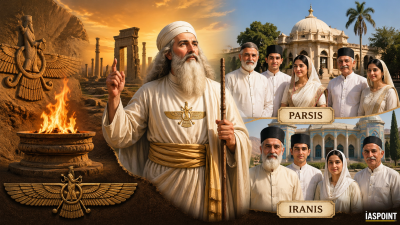
Zoroastrianism is one of the world’s oldest monotheistic religions, founded by the Prophet Zarathustra (Zoroaster) in ancient Iran approximately 3,500 years ago. Its adherents in India are primarily known as Parsis (meaning “Persians”) and a smaller, more recent group known as Iranis.
- Migration (8th Century CE): Following the Arab conquest of Persia, a group of Zoroastrians fled to preserve their faith. According to the Qissa-i Sanjan (an epic poem recounting the migration), they landed at Sanjan on the coast of Gujarat.
- The Sugar in the Milk Story: Tradition holds that the local Hindu King, Jadi Rana, sent a full bowl of milk to the refugees to signify his kingdom was full. The Zoroastrian priests added sugar to the milk without spilling a drop, symbolizing they would blend into the culture like sugar and sweeten the land without displacing anyone.
- Legal Status: Parsis are a notified religious minority under the National Commission for Minorities Act, 1992. Despite their small population, they are one of the most urbanized and successful communities in India.
Core Philosophical Tenets and Beliefs
Zoroastrianism is characterized by a dualistic cosmology of good and evil and a strict code of ethics based on individual choice.
- Monotheism: Worship of Ahura Mazda (the “Wise Lord”) as the supreme creator.
- Dualism: The eternal struggle between Spenta Mainyu (the good spirit) and Angra Mainyu (the destructive spirit).
- The Triple Path: The central maxim of the faith is Humata, Hukhta, Hvarshta—Good Thoughts, Good Words, and Good Deeds.
- Elements of Nature: Fire, Water, Earth, and Air are considered sacred. Fire is seen as a symbol of Ahura Mazda’s purity and light, though Zoroastrians are not “fire worshippers” but rather treat fire as a medium for prayer.
Sacred Scriptures and Language
The religious texts of Zoroastrianism provide insight into ancient Indo-Iranian history and share linguistic roots with the Rig Veda.
- Avesta: The primary collection of sacred texts. It is written in the Avestan language, which is closely related to Vedic Sanskrit.
- The Gathas: The core liturgical hymns composed by Prophet Zarathustra himself, found within the Yasna section of the Avesta.
- Zend: The term refers to the commentary and translation of the Avesta into Pahlavi (Middle Persian).
Sectarian Divisions: The Calendar Dispute
Unlike other religions divided by theology, the sects in Indian Zoroastrianism are primarily divided by the calendar they follow.
| Sect | Description |
| Shahenshahi | The largest group in India; they follow the calendar that has not introduced a leap year since the fall of the Sassanid Empire. |
| Kadmi | Claim to follow the “original” Iranian calendar; their New Year falls one month earlier than the Shahenshahis. |
| Fasli | A smaller group that uses a seasonal calendar where the New Year always falls on the Vernal Equinox (March 21). |
Rituals, Festivals, and Cultural Heritage
Zoroastrian life is marked by unique rites of passage and festivals that celebrate the natural cycles of the year.
Rites of Passage
- Navjote Ceremony: The formal initiation of a child into the faith between ages 7 and 11. The child is invested with the Sudreh (sacred shirt) and Kusti (sacred thread).
- Marriage (Ashirwad): Performed by two priests; the couple is showered with rice to symbolize prosperity.
Death Rituals: The Tower of Silence
- Dokhmenashini: To avoid polluting the sacred elements of Earth, Fire, and Water, the deceased are placed in a Dakhma (Tower of Silence).
- Ecological Disposal: The bodies are exposed to the sun and scavenging birds (vultures). Due to the decline in vulture populations, many Dakhmas now utilize solar concentrators.
Major Festivals
- Jamshedi Navroz: The Persian New Year celebrated on the Spring Equinox (March 21). It is listed under the UNESCO Representative List of the Intangible Cultural Heritage of Humanity.
- Pateti: A day of penitence and reflection on the last day of the Parsi year.
- Khordad Sal: The birth anniversary of Prophet Zarathustra.
- Gahambars: Six seasonal festivals celebrated with community feasting.
Architectural and Artistic Heritage
- Fire Temples (Agiary/Atash Behram): There are three grades of fire temples based on the sanctity of the fire. The highest grade is the Atash Behram. There are only eight Atash Behrams in India (four in Mumbai, two in Surat, one in Navsari, and one in Udvada).
- Iranshah Atash Behram: Located in Udvada, Gujarat, it houses the oldest continuously burning fire in India, brought by the original settlers.
- Faravahar Motif: The iconic winged disc representing the soul’s progress and the divine blessing.
- Parsi Gara Embroidery: A unique craft blending Persian, Chinese, and Indian motifs (primarily birds and flowers) on silk sarees.
Notable Contributions and Trivia for UPSC
- Parsi Pioneers: The community has produced legendary figures such as Dadabhai Naoroji (The Grand Old Man of India), Pherozeshah Mehta, Homi J. Bhabha (Father of the Indian Nuclear Program), and J.R.D. Tata.
- Jiyo Parsi Scheme: A central sector scheme launched by the Ministry of Minority Affairs to arrest the population decline of the Parsi community in India through medical interventions and advocacy.
- Fire Grading: The three grades of fire are Atash Behram (highest), Atash Adaran, and Atash Dadgah.
- Linguistic Link: The similarity between Avestan and Sanskrit is a major point of study in Indo-European linguistics (e.g., Avestan Homa is Vedic Soma; Ahura is Asura).