
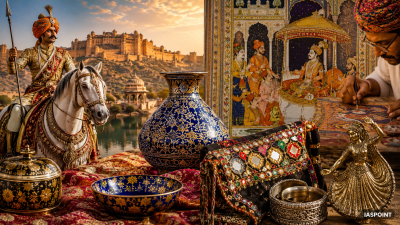
The Rajputana region, primarily modern-day Rajasthan, served as the cradle for some of India’s most opulent and resilient handicraft traditions. Emerging between the 8th and 18th centuries, Rajput art was heavily influenced by the chivalric code of the warrior clans and their patronage of the arts. These crafts represent a synthesis of indigenous folk traditions with sophisticated Persian and Mughal aesthetics, adapted to the arid landscape of the Thar Desert.
Rajput Painting Traditions: The Miniature Schools
Rajput paintings are characterized by their vibrant colors, derived from minerals, plant sources, and even semi-precious stones. They predominantly focused on themes of the Ramayana, Mahabharata, and the romantic tales of Radha and Krishna.
- Mewar School: Known for its bold colors and emotional intensity. It is one of the most important schools of Rajasthani miniature painting.
- Marwar (Jodhpur) School: Featured tall, graceful figures and a preference for yellow and red tones.
- Kishangarh School: Famous for the “Bani Thani” painting (often called the Mona Lisa of India), characterized by elongated features and arched eyebrows.
- Bundi and Kota Schools: Distinguished by their detailed depiction of lush vegetation, wildlife, and hunting scenes.
- Bikaner School: Heavily influenced by Mughal delicacy, focusing on finer lines and subtle shading.
Architectural Handicrafts and Stone Carving
The Rajputs were master builders, and their expertise extended to the intricate decorative elements of their forts and havelis.
- Jali Work (Lattice): Intricately carved stone screens made from sandstone or marble, providing ventilation and privacy (Purdah) while creating geometric light patterns.
- Usta Art (Bikaner): The practice of “Manawari” or gold embossing on camel hide and walls. It involves floral and geometric patterns painted with real gold.
- Inlay Work: Primarily using Makrana marble, artisans embedded semi-precious stones to decorate palace interiors.
Rajput Textile and Embroidery Heritage
The textile crafts of the Rajput region are famous for their “Rangeelo” (colorful) nature, often using techniques that have survived for centuries.
- Bandhani (Tie-Dye): The art of tying small knots in fabric before dyeing to create patterns. Major centers include Jodhpur and Sikar.
- Leheriya: A unique diagonal striped pattern representing waves, traditionally worn during the Teej festival and the monsoon.
- Gota Patti: Originating in Rajasthan, this involves sewing small pieces of gold or silver ribbon (Gota) onto fabric to create elaborate floral patterns.
- Zardosi: Heavy metal embroidery used for royal garments and ceremonial umbrellas.
Metal and Weaponry Crafts
Reflecting the martial heritage of the Rajputs, metalwork was often focused on weaponry and royal utility items.
- Koftgari: The art of inlaying light metal (gold or silver) on a dark, hard metal surface (usually steel). Traditionally used to decorate sword hilts and daggers.
- Thewa Art: A specialized craft from Pratapgarh where 23-carat gold film is fused onto colored glass to create intricate mythological scenes.
Summary Table of Rajput Handicrafts
| Craft Category | Major Center | Key Technique/Feature | Material Used |
| Bani Thani | Kishangarh | Elongated eyes and features | Mineral colors on paper |
| Koftgari | Jaipur / Udaipur | Metal inlay on steel weapons | Gold and Silver wire |
| Usta Art | Bikaner | Gold embossing and painting | Camel hide / Plaster |
| Bandhani | Jodhpur / Bikaner | Tie and Dye patterns | Silk and Cotton |
| Blue Pottery | Jaipur | No clay used; low-fire glazing | Quartz and Glass powder |
| Thewa Art | Pratapgarh | Gold on Glass fusion | 23K Gold and Glass |
| Mojari | Jodhpur / Jaipur | Hand-stitched leather | Camel/Sheep leather |
Technical Facts and Trivia for UPSC
- Blue Pottery Distinction: Unlike traditional pottery, Jaipur Blue Pottery does not use clay. It is made from a paste of quartz stone powder, glass, borax, and Multani Mitti (Fuller’s earth).
- The “Bani Thani” Postcard: The Bani Thani painting was so significant that the Indian government issued a commemorative stamp based on it in 1973.
- Makrana Marble: The white marble used in Rajput palaces (and the Taj Mahal) is unique because it is non-porous and does not turn yellow over time.
- Indigo and Alizarin: Traditional Rajput textiles relied heavily on Indigo (blue) and Alizarin (red) dyes, which were historically significant trade commodities.
- Pichwai Art: A sub-sect of Rajput painting from Nathdwara, these are large cloth paintings used as backdrops for the deity Shrinathji.
Modern Conservation and GI Status
The Government of Rajasthan, through “Rajasthali” (the state emporium), provides a platform for these artisans. Several Rajput crafts have received Geographical Indication (GI) tags:
- Blue Pottery of Jaipur
- Kathputlis of Rajasthan
- Thewa Art of Pratapgarh
- Makrana Marble
- Molela Clay Work
- Pokaran Pottery
Institutional Framework
The Rajasthan Small Industries Corporation Ltd. (RAJSICO) and the West Zone Cultural Centre (Udaipur) are the primary bodies responsible for the promotion and preservation of Rajput handicrafts. The annual “Shilpgram Mela” in Udaipur serves as a critical marketplace for traditional artisans to showcase their heritage to a global audience.
Last Modified: May 6, 2026