
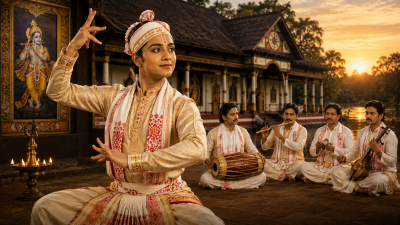
Sattriya is a classical dance form originating from the northeastern state of Assam. It was introduced in the 15th century CE by the great Vaishnavite saint and reformer, Srimanta Sankardev, as a powerful medium for propagation of the Vaishnava faith.
The Sattras: Living Monastic Traditions
The name ‘Sattriya’ is derived from Sattra, which refers to the Vaishnavite monasteries or institutions. For centuries, the dance was nurtured and preserved within these Sattras by male monks known as Bhokots. It was traditionally performed as part of the daily rituals and during special festivals.
Recognition as a Classical Dance
Sattriya was officially recognized as the eighth classical dance of India by the Sangeet Natak Akademi in November 2000. This recognition transitioned the form from a purely monastic ritual to a globally recognized performing art.
Technical Foundations and Stylistic Elements
Sattriya is governed by the principles of the Natyashastra and the Srihastamuktavali. It is a unique synthesis of various folk dances like Bihu, Bodos, and Mising dance, refined into a classical structure.
The Core Components of Movement
- Mati Akhara: These are the basic exercises and postures that form the foundation of Sattriya. There are 64 such exercises, categorized into various groups based on the part of the body being trained.
- Bhramari and Chari: The dance involves complex spins (Bhramari) and graceful gaits (Chari).
- Nritta, Nritya, and Natya: Like other classical forms, it includes pure rhythmic dance, expressive dance with mudras, and dramatic storytelling.
Masculine and Feminine Aspects
Sattriya contains both Tandava (vigorous) and Lasya (graceful) elements.
- Paurashik Bhangi: The masculine style, characterized by strength and vigor.
- Stri Bhangi: The feminine style, characterized by fluidity and grace.
The Ankiya Nat and Narrative Structure
The primary thematic source for Sattriya is the Ankiya Nat, a type of one-act play also pioneered by Srimanta Sankardev.
Key Literary and Performance Elements
- Brajavali: The plays and songs are written in Brajavali, a unique literary language that is a mix of Assamese, Maithili, and Braj Bhasha.
- Bargeets: These are the devotional songs composed by Sankardev and his disciple Madhavdev, which serve as the musical backbone of the performance.
- Sutradhara: The lead narrator or conductor of the play who recites Sanskrit verses and explains the story to the audience.
Repertoire and Major Dance Items
The Sattriya repertoire is vast and varies depending on the specific Sattra tradition.
| Dance Item | Description |
| Gayan-Bayan | The opening ritual where a group of musicians play the Khol and Cymbals in a synchronized rhythmic pattern. |
| Ojapali | A traditional narrative form where the lead singer (Oja) is supported by a group (Palis). It includes the Sattriya Ojapali which focuses on Vishnu’s incarnations. |
| Krishna Nritya | A solo or group dance depicting the life and childhood antics of Lord Krishna. |
| Nadu Bhangi | A specific dance piece relating to the stories of Krishna’s life. |
| Jhumura | A technical dance piece often associated with the compositions of Madhavdev. |
| Chali Nritya | A graceful dance form that showcases the refined Lasya movements of the tradition. |
Costume, Ornaments, and Musical Instruments
The attire of Sattriya is deeply influenced by the traditional handloom of Assam, emphasizing the use of local silk and indigenous designs.
Attire and Jewelry
- Pat and Muga Silk: The costumes are made of Pat (white/mulberry silk) and Muga (golden silk) featuring traditional Assamese motifs like Kingkhap.
- Dhoti and Chadar: Male dancers wear the Dhoti and a wrap-around cloth. Female dancers wear the Ghuri (skirt) and Chadar (veil).
- Kanchi: A gold-embroidered waist cloth.
- Assamese Jewelry: The ornaments are made using the Kesa Sun (raw gold) technique. Key pieces include the Kopali (forehead ornament), Muthi Kharu (traditional bangles), and Thoka-Puro (earrings).
Orchestral Accompaniment
- Khol: A two-faced asymmetrical drum made of clay, which is the primary rhythmic instrument.
- Bhortal: Large cymbals that provide a resonant rhythmic pulse.
- Manjira: Smaller cymbals used for keeping time.
- Flute and Violin: Modern additions that provide melodic depth to the Bargeets.
Key Personalities and Modern Evolution
Initially restricted to male monks (Bhokots), the dance is now performed by both men and women on the secular stage.
- Srimanta Sankardev: The founder and visionary behind the Sattriya movement.
- Madhavdev: The primary disciple of Sankardev who enriched the repertoire with his compositions.
- Maniram Datta Muktiyar Barbayan: A legendary figure who contributed significantly to the modern systematization of the dance.
- Late Dr. Bhupen Hazarika: Played a pivotal role in lobbying for the classical status of Sattriya.
- Contemporary Exponents: Ghanakanta Bora, Jatin Goswami, Sharodi Saikia, and Indira P.P. Bora.
Facts for UPSC Prelims
- UNESCO Connection: While Sattriya itself is a classical dance, the Majuli Island (the heart of Sattra culture) has been on the tentative list for UNESCO World Heritage sites.
- Eka Sarana Dharma: The socio-religious movement founded by Sankardev which used Sattriya as a tool for social integration and spiritual teaching.
- Brajavali Language: It is crucial to remember that the lyrics are not in pure Assamese but in Brajavali, which was designed to be understood by people across North India during the Bhakti period.
- The Drum: The Khol used in Sattriya is distinct from the Mridangam or Pakhawaj in its construction and the unique “Boli” (syllables) played on it.