
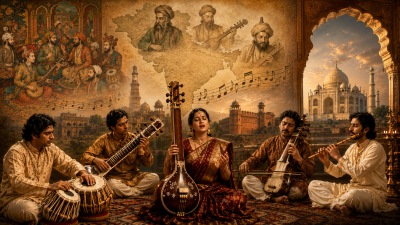
Hindustani Classical Music is the traditional music of Northern India, Pakistan, Bangladesh, and parts of Nepal. It emerged as a distinct system from the common fountainhead of Indian music around the 13th and 14th centuries, primarily due to the synthesis of indigenous Vedic traditions with Persian and Central Asian influences during the Delhi Sultanate and Mughal eras.
Historical Evolution and Synthesis
The divergence from the older, unified Indian musical tradition (which remains closer to the Carnatic system) was marked by a shift toward more flexible melodic structures and the assimilation of new instruments and genres.
- Persian Influence: Scholars like Amir Khusrau introduced Persian elements, including the Qaul (ancestor of Qawwali) and the Sitar.
- The Mughal Zenith: The reign of Akbar saw the formalization of the Dhrupad style, led by legendary figures like Mian Tansen.
- The Post-Mughal Transition: During the 18th century, the more emotive and flexible Khayal style replaced the rigid Dhrupad in royal courts.
- Modern Codification: In the early 20th century, Vishnu Narayan Bhatkhande and Vishnu Digambar Paluskar revolutionized the system by introducing formal notation and the Thaat classification.
The Thaat System (Classification of Ragas)
V.N. Bhatkhande categorized Hindustani Ragas into ten parent scales known as Thaats. Every Hindustani Raga must belong to one of these ten foundational structures.
| Thaat | Notes (Swaras) Used | Equivalent Western Scale |
| Bilawal | All Shuddha (Natural) notes | C Major (Ionian) |
| Kalyan | Teevra Ma (Sharp 4th) | Lydian |
| Khamaj | Komal Ni (Flat 7th) | Mixolydian |
| Bhairav | Komal Re and Dha (Flat 2nd and 6th) | Double Harmonic |
| Bhairavi | Komal Re, Ga, Dha, Ni (All flats) | Phrygian |
| Asavari | Komal Ga, Dha, Ni | Aeolian (Natural Minor) |
| Kafi | Komal Ga and Ni | Dorian |
| Todi | Komal Re, Ga, Dha and Teevra Ma | – |
| Purvi | Komal Re, Dha and Teevra Ma | – |
| Marwa | Komal Re and Teevra Ma | – |
Major Vocal Styles and Genres
Hindustani music is classified into several genres based on the temperament, structure, and lyrical content of the performance.
Dhrupad
- The oldest surviving vocal style, characterized by its spiritual, austere, and masculine nature.
- It focuses on the purity of the Raga and avoids heavy ornamentation.
- Traditionally accompanied by the Pakhawaj.
- Major Gharanas: Dagarvani, Bishnupur, and Darbhanga.
Khayal
- The most popular modern genre; the word literally means “imagination.”
- It allows for greater improvisation and uses ornaments like Taans (fast melodic runs).
- Typically performed in two parts: Bada Khayal (slow) and Chhota Khayal (fast).
- Major Gharanas: Gwalior (oldest), Agra, Jaipur-Atrauli, and Kirana.
Thumri
- A semi-classical form focused on romantic and devotional themes, often centered on the Krishna-Radha lore.
- It is known for Bhav Batana (expressing emotions through lyrics).
- Major Gharanas: Lucknow and Benares.
Tappa
- Derived from the folk songs of camel riders in North-West India.
- Characterized by extremely fast and complex “rolling” melodic phrases.
The Gharana System (Lineage of Schools)
The Gharana system is a unique socio-musical institution where specific styles of singing are passed down through a Guru-Shishya (teacher-disciple) parampara.
- Gwalior Gharana: The mother of all Khayal gharanas; emphasizes simplicity and clarity. (Key figures: Vishnu Digambar Paluskar).
- Kirana Gharana: Focuses on perfect intonation of notes (Swara). (Key figures: Abdul Karim Khan, Bhimsen Joshi).
- Agra Gharana: Known for its deep, resonant voice and connection to Dhrupad. (Key figures: Faiyaz Khan).
- Jaipur-Atrauli Gharana: Famous for complex Ragas and intricate melodic patterns. (Key figures: Alladiya Khan, Kishori Amonkar).
Core Musical Elements and Terminology
- Vistar: The slow, gradual expansion of a Raga.
- Meend: A smooth glide from one note to another, essential for the “curves” of Hindustani melody.
- Gamak: A heavy oscillation on a note.
- Taan: A rapid musical phrase sung in a single breath, often using vowels or “Sargam” (note names).
- Bandish: A fixed melodic composition set to a specific Tala.
Key Instruments of the Hindustani Tradition
Hindustani music utilizes a distinct set of instruments categorized by the Natya Shastra classification system.
- Sitar: A plucked string instrument (Tata Vadya) popularized by Ravi Shankar.
- Sarod: A fretless string instrument known for its deep, introspective sound (Tata Vadya). (Key figure: Amjad Ali Khan).
- Bansuri: The bamboo flute (Sushira Vadya) associated with Lord Krishna. (Key figure: Hariprasad Chaurasia).
- Santur: A hammered dulcimer from Kashmir (Ghana Vadya). (Key figure: Shivkumar Sharma).
- Tabla: The primary rhythm keeper (Avanaddha Vadya). (Key figure: Zakir Hussain).
Comparative Facts: Hindustani vs. Carnatic
- Geography: Hindustani is prevalent in North India; Carnatic is restricted to the four Southern states.
- Freedom: Hindustani allows more scope for improvisation; Carnatic is more composition-centric.
- Classification: Hindustani uses the 10-Thaat system; Carnatic uses the 72-Melakarta system.
- Time Theory: Hindustani strictly adheres to Raga-Time association; Carnatic generally does not.
- Language: Hindustani uses Braj Bhasha, Hindi, and Urdu; Carnatic uses Telugu, Kannada, Sanskrit, and Tamil.
Important Trivia for Competitive Exams
- Amir Khusrau: Known as the “Tuti-e-Hind” (Parrot of India), credited with inventing the Sitar and the Khayal style.
- Mian Tansen: One of the Nine Gems of Akbar’s court; his works include Sangeeta Sara and Rajmala.
- Vishnu Narayan Bhatkhande: Often called the “Father of Modern Hindustani Music Theory” for his monumental work Hindustani Sangeet Paddhati.
- UNESCO Recognition: The Vedic Chanting of India (the root of Hindustani music) is inscribed on the UNESCO Representative List of the Intangible Cultural Heritage of Humanity.