
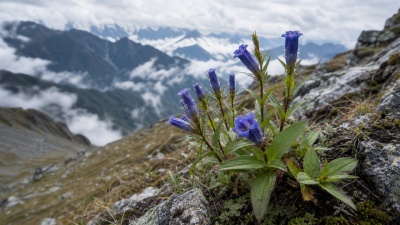
Cyananthus hookeri, a Himalayan flowering plant (family Campanulaceae), was recorded in Tawang district, Arunachal Pradesh, after 158 years; Botanical Survey of India scientists found it near Chuna Valley at about 3,600 m and the rediscovery was published in Oryx on 30 June 2026.
Taxonomy & historic record
- Scientific name: Cyananthus hookeri; family Campanulaceae.
- Original Indian record: Documented by Joseph Dalton Hooker in Sikkim in 1867.
- Record gap: No confirmed Indian record for 158 years prior to this finding.
Rediscovery details
- Survey & timing: Field survey by Botanical Survey of India in September 2025; publicised July 2026.
- Location & elevation: Chuna Valley, near Mago village, Tawang district; approximately 3,600 metres above sea level.
- Population observed: Fewer than 50 mature plants on alpine grassy and rocky slopes.
- Range update: First confirmed record from Arunachal Pradesh; previously known only from Sikkim.
Conservation assessment
- IUCN recommendation: Authors recommended national classification as Endangered under IUCN criteria due to small population and restricted range.
- Threat metric: Observed mature-plant count (<50) aligns with thresholds used in IUCN assessments for very small populations.
IASPOINT Booster Facts
- Botanical Survey of India: National agency for taxonomic research and floristic surveys under the Ministry of Environment, Forest and Climate Change.
- Oryx: International conservation journal (Cambridge University Press); article published online 30 June 2026.
- Biogeography: Site lies within the Eastern Himalaya biodiversity hotspot as defined by Conservation International.