
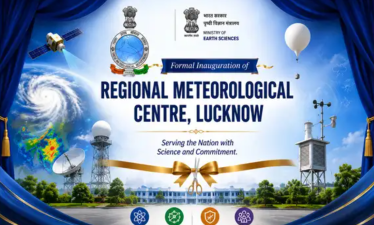
The Union Minister of State for Science and Technology, Dr. Jitendra Singh, along with Uttar Pradesh Chief Minister Yogi Adityanath, inaugurated the new Regional Meteorological Centre (RMC) at Lucknow. This facility marks a step toward decentralizing meteorological operations and expanding regional localized weather monitoring. The newly upgraded centre will exclusively cater to the weather forecasting, monitoring, and early warning requirements of Uttar Pradesh and Uttarakhand. This development aligns with the broader national expansion of climate observation infrastructure carried out under the flagship Mission Mausam initiative.
Core Objectives and Functional Mandate
The RMC Lucknow has been established to upgrade weather tracking from broad regional projections to highly localized, micro-precision forecasting.
Impact-Based Forecasting
The centre will shift focus toward impact-based forecasting services. Rather than merely predicting weather parameters like rainfall or temperature, the system analyzes and communicates what the weather will do. This approach helps disaster management authorities assess real-time risk to infrastructure, public safety, and logistics.
Regional Focus Areas
The territorial jurisdiction of RMC Lucknow covers two distinct geographic zones: the Indo-Gangetic plains of Uttar Pradesh and the mountainous terrain of Uttarakhand. The facility provides customized weather solutions for:
- Disaster Management: Early warnings for cloudbursts, flash floods, landslides, and avalanches in the Himalayan segments of Uttarakhand, alongside heatwaves, lightning strikes, and floods in Uttar Pradesh.
- Agricultural Support: District-level agro-met advisories for farmers to assist in precise planning for sowing, irrigation, and harvesting cycles.
- Aviation and Tourism: Dedicated aviation meteorological services across eleven operational airports in Uttar Pradesh, alongside tailored mountain weather advisories and transit forecasts for tourists and pilgrims.
Meteorological Infrastructure Expansion
The upgrade to an RMC brings a major expansion in observational equipment across the region to plug long-standing data gaps.
| Observational Asset (Uttar Pradesh) | Status in 2014 | Current Status (2026) |
| Doppler Weather Radars (DWR) | 1 | 3 (with 6 more being commissioned) |
| Automatic Weather Stations (AWS) | 59 | 107 |
| Automatic Rain Gauges (ARG) | 132 | 140 |
| Lightning Sensors | 0 | 7 |
Infrastructure Upgrades in Uttarakhand
Uttarakhand, despite its vulnerability to extreme mountain weather events, lacked a single Doppler Weather Radar in 2014. The state now operates three dual-polarization Doppler Weather Radars. The setup is complemented by an expanded grid of Automatic Weather Stations and lightning detection grids to intercept fast-developing convective storms over the high-altitude terrains.
Connection to Mission Mausam
The establishment of RMC Lucknow is integrated into the central government’s Mission Mausam initiative, which is executed by the Ministry of Earth Sciences.
National Doppler Weather Radar Grid
The Doppler Weather Radar network across India has grown from 17 units in 2014 to 50 operational units, covering more than 87% of the country’s landmass. Mission Mausam targets the addition of 50 more radars within the next two years, aiming for a total national grid of 100 radars. These modern systems employ dual-polarization technology to differentiate between various precipitation types like rain, hail, or drizzle, and can even measure raindrop sizes.
Nowcast and Micro-Precision Services
Data assimilated by the expanded observational network supports the ‘Nowcast’ service. This feature delivers time-specific and highly localized forecasts for the immediate three hours. It uses advanced numerical weather prediction models, high-performance computing, and Artificial Intelligence algorithms to optimize last-mile weather intelligence dissemination.
IASPOINT Booster Facts for UPSC
- IMD Institutional Framework: The India Meteorological Department (IMD) was established in 1875. It functions as the principal government agency in matters relating to meteorology, seismology, and allied subjects under the Ministry of Earth Sciences (MoES).
- Organizational Hierarchy: IMD is headed by the Director General of Meteorology and operates through dedicated Regional Meteorological Centres (RMCs). With the inclusion of Jammu and Lucknow, the total number of RMCs in India has expanded to eight.
- Key Digital Dissemination Tools: IMD uses specialized mobile applications for public alerts: MAUSAM for general tracking, MEGHDOOT for agro-met advisories, and DAMINI for real-time lightning warnings.
- Atmospheric Research Testbed: To understand monsoon dynamics, the Ministry of Earth Sciences has also operationalized a specialized Atmospheric Research Testbed (ART) at Silkheda in Sehore district, Madhya Pradesh, to study cloud microphysics and land-atmosphere interactions in the monsoon core zone.