
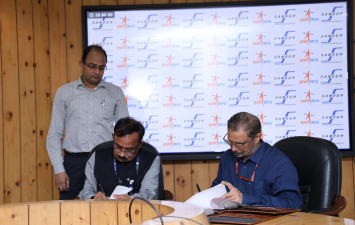
On 13 May 2026, the Indian Space Research Organisation Telemetry, Tracking and Command Network (ISTRAC) signed a Memorandum of Understanding (MoU) with the Society for Applied Microwave Electronics Engineering and Research (SAMEER) at its headquarters in IIT Bombay, Mumbai. The agreement establishes a long-term research and development partnership to build indigenous high-power systems for deep space missions. By combining ISTRAC’s tracking capabilities with SAMEER’s microwave expertise, the initiative focuses on creating next-generation communication hardware, reducing reliance on foreign original equipment manufacturers, and securing self-reliance in deep space exploration.
Institutional Framework and Stakeholders
Deep space communication demands specialised infrastructure and advanced research laboratories. This domestic partnership brings together two critical technical bodies under different Union ministries.
ISRO Telemetry, Tracking and Command Network (ISTRAC)
- Core Mandate: Headquartered in Bengaluru, ISTRAC provides tracking, telemetry, and command support to launch vehicles and satellite missions.
- Deep Space Network Operation: It manages the Indian Deep Space Network (IDSN) at Byalalu, Karnataka, which contains large parabolic antennas capable of maintaining radio contact with interplanetary voyages.
- Frequency Bandwidth: IDSN primarily handles communication using the X-band frequency spectrum, enabling high-frequency data transmission across millions of kilometres.
Society for Applied Microwave Electronics Engineering and Research (SAMEER)
- Administrative Status: An autonomous Research and Development laboratory functioning under the Ministry of Electronics and Information Technology (MeitY).
- Technical Specialisation: Founded originally out of the Tata Institute of Fundamental Research (TIFR), SAMEER focuses on microwave engineering, electromagnetics, and radio frequency technologies.
- Role in Partnership: Designing and engineering ground-based and on-board hardware components required to boost space signals.
Technological Innovations in Deep Space Transmissions
The primary technical bottleneck in interplanetary exploration is the extreme attenuation of radio signals over astronomical distances. The ISTRAC-SAMEER partnership targets this challenge by modernising ground station transmitter systems.
High-Power Amplifiers (HPAs)
Before a tele-command radio signal is broadcasted from Earth to a distant spacecraft, it must pass through a ground-based high-power amplifier. These systems multiply the electrical signal strength to ensure that the command remains readable by the probe despite cosmic background noise and atmospheric interference.
Gallium Nitride (GaN) Semiconductors
Traditional space communication hardware relies on silicon or gallium arsenide transistors. The new framework introduces Gallium Nitride (GaN) semiconductor modules to transform the hardware layer:
- Higher Power Density: GaN devices operate at much higher voltages and currents per unit area compared to traditional silicon chips.
- Thermal Efficiency: They tolerate extreme thermal loads, reducing the bulk and mass required for cooling systems at ground stations.
- Integrated Supply Chain: The collaboration integrates homegrown, compact GaN chip designs manufactured by the Gallium Arsenide Enabling Technology Centre (GAETEC), a specialized foundry operating under the Defence Research and Development Organisation (DRDO).
Structural Comparison of Deep Space Infrastructure
| Infrastructure Unit | Operating Agency | Primary Spectrum utilized | Core Mission Tracking |
| Indian Deep Space Network (IDSN) | ISTRAC, ISRO | X-Band, S-Band, Ka-Band | Chandrayaan Series, Mars Orbiter Mission, Aditya-L1 |
| Deep Space Network (DSN) | NASA / JPL (USA) | X-Band, Ka-Band, S-Band | Voyager probes, Mars Rovers, Artemis missions |
| ESTRACK Network | European Space Agency | X-Band, Ka-Band | BepiColombo, Juice, Solar Orbiter |
Industrial Integration and Indigenisation
The transition toward indigenous deep space hardware supports the broader framework of domestic manufacturing and high-tech supply chains.
- MSME Participation: The development of modular GaN amplifiers involves domestic Micro, Small, and Medium Enterprises for precision machining, component assembly, and environmental stress testing.
- Standardisation: By creating national standards for dataset and component validation, India creates a technical blueprint exportable to international space agencies.
- Strategic Security: Eliminating foreign dependency for high-power amplifiers shields India’s strategic space programs from sudden export controls or international supply chain disruptions.
IASPOINT Booster Facts for UPSC
- The X-Band Spectrum: This radio frequency band falls within the microwave region, ranging from 8 to 12 Gigahertz (GHz). It is highly favored for deep space communication due to lower atmospheric attenuation and high data carrying capacity.
- GAETEC Facility: The Gallium Arsenide Enabling Technology Centre based in Hyderabad is the critical semiconductor foundry that supplies the specific GaN chip technologies used in this deep space project.
- Sovereign Interplanetary Capabilities: India joins an elite group of nations—including the United States, Russia, the European Space Agency, China, and Japan—possessing autonomous deep-space ground tracking networks.
- The Inverse Square Law Problem: Radio signals traveling through space experience power loss proportional to the square of the distance from the transmitter. A signal sent to Mars can drop in intensity by a factor of trillions, making high-power amplification on Earth mandatory.
- Byalalu Earth Station Location: The IDSN facility is strategically situated in a natural bowl-shaped depression in Byalalu village near Bengaluru to block terrestrial radio frequency interference from surrounding cities.