
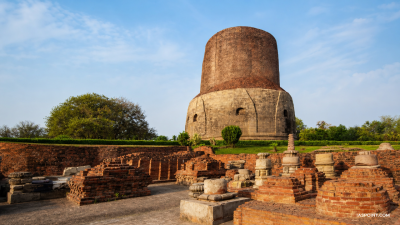
Sarnath in Uttar Pradesh was inscribed on the UNESCO World Heritage List on 25 July 2026 at the 48th session in Busan, becoming India’s 45th World Heritage Site and Uttar Pradesh’s fourth.
Site and significance
- Dharmachakra Pravartan: Site of Buddha’s first sermon after enlightenment; term means “setting in motion the Wheel of Dharma”.
- Location: Situated near Varanasi on the Ganges plains, about 10 km north‑east of Varanasi city.
- Periodal layers: Archaeological remains span Mauryan, Kushan and Gupta periods.
Inscription and nomination
- Inscription: 25 July 2026 at the 48th session of the World Heritage Committee, Busan, South Korea.
- Tentative list: Sarnath placed on India’s UNESCO tentative list on 3 July 1998.
- Nomination: Formal nomination submitted in January 2025 for the 2025–26 cycle; category accepted as cultural property.
Key tangible features
- Dhamek Stupa: Large cylindrical stupa dating to post‑Mauryan phases.
- Ashokan pillar & Lion Capital: Pillar complex with the Lion Capital; original emblematic sculpture is associated with the site and displayed locally.
- Sarnath Museum & ruins: Excavated monastic complexes and Gupta‑period sculptures preserved in situ and in the museum.
IASPOINT Booster Facts
- World Heritage Convention 1972: Adopted to identify and protect properties of Outstanding Universal Value.
- Property categories: Cultural, natural and mixed; cultural criteria are i–vi.
- Procedure: Inclusion on a State’s tentative list is a prerequisite for nomination; Committee meets annually to decide inscriptions.
- Counts: India now 45 World Heritage Sites; Uttar Pradesh now 4 World Heritage Sites.