
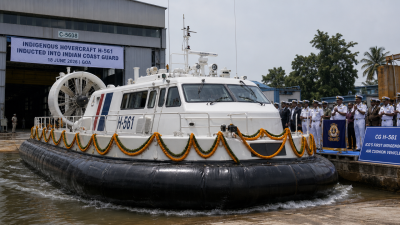
On 18 June 2026 the Indian Coast Guard inducted its first indigenous Air Cushion Vehicle (ACV), H-561, at Chowgule & Company shipyard in Goa.
Platform Details
- Designation: Air Cushion Vehicle (ACV) H-561; first of six indigenous ACVs ordered for the Coast Guard.
- Builder: Chowgule & Company Private Limited; platform carries over 50% indigenous equipment.
- Contract: Six-ACV acquisition valued at Rs 387.4 crore.
Technical Performance
- Speed: Achieved 52 knots in sea trials; contractual requirement 48 knots.
- Design feature: Flexible skirt and lift fan create an air cushion allowing very shallow-draft operation.
Operational Roles
- Missions: Coastal surveillance, rapid response, search and rescue (SAR), and humanitarian assistance.
- Terrain advantage: Suited for shallow waters, mudflats, riverine, estuarine and coastal zones inaccessible to conventional craft.
Deployment
- Planned base: Reported stationing at Haldia, West Bengal to support riverine and deltaic eastern sectors.
IASPOINT Booster Facts
- ACV principle: Air cushion reduces hull‑water contact, enabling amphibious transit and low ground pressure.
- Organisational link: Indian Coast Guard functions under the Ministry of Defence.
- Unit of speed: 1 knot = 1.852 km/h; 52 knots ≈ 96.3 km/h.
- Policy link: Indigenous content aligns with national emphasis on domestic defence manufacturing (Aatmanirbhar Bharat).