
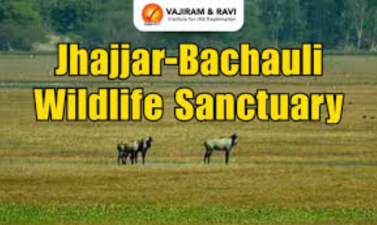
The Punjab Forest Department has formulated a ₹5.36-crore eco-tourism development master plan for the Jhajjar-Bachauli Wildlife Sanctuary, located in the Rupnagar district. The sanctuary, renamed the Sri Guru Tegh Bahadur Wildlife Sanctuary by the Punjab State Board for Wildlife, is being developed as the state’s first dedicated leopard tourism destination. Spanning an area of 289 acres in the Shivalik foothills, the site represents a critical ecological habitat and transit corridor for migratory leopards. The project introduces low-impact, sustainable amenities, including leopard safaris and solar-powered facilities, designed to support biodiversity conservation and generate local employment while preventing human-wildlife conflict.
Geographical and Structural Profile
Location and Land Composition
The sanctuary is located approximately 15 kilometers from Anandpur Sahib in the Rupnagar district of Punjab. It spans a total area of 289 acres, distributed across three distinct agrarian villages:
- Jhajjar: 218 acres
- Bachauli: 55 acres
- Lamlehri: 16 acres
Terrain and Basin
Situated within the ecologically fragile Shivalik Hills landscape, the sanctuary lies in close proximity to the Sutlej River basin. The terrain features the typical undulating topography of the lower Shivalik foothills, characterized by seasonal torrents, or choes, which act as vital water channels during monsoon periods.
Floral and Faunal Diversity
Vegetation Type
The sanctuary comprises tropical dry deciduous forest cover. The canopy consists of native and naturalized tree species interspersed with tall grasses, which provide cover for predatory mammals. Prominent flora includes Khair (Acacia catechu), Shisham (Dalbergia sissoo), Eucalyptus, Neem (Azadirachta indica), and Amla (Phyllanthus emblica).
Wildlife Assemblage
The protected area forms an essential ecological pocket for several mammals, reptiles, and avian species.
- Apex Predator: Common Leopard (Panthera pardus)
- Herbivores: Sambar, Barking Deer (Muntjac), and Blue Bull (Nilgai)
- Other Mammals: Wild Boar, Jackal, Mongoose, Jungle Cat, and Indian Pangolin
- Reptiles: Indian Rock Python, Common Cobra, and Monitor Lizard
Eco-Tourism Master Plan and Infrastructure
Low-Impact Facilities
The development blueprint focuses on introducing sustainable, emission-free visitor facilities to prevent the degradation of the core habitat. The plan includes the deployment of battery-operated transit vehicles, elevated wildlife observation decks, watchtowers, and eco-friendly nature trails.
Zoned Fencing and Conflict Mitigation
A portion of the infrastructure funding is designated for secure chain-link fencing around the proposed leopard safari area. Because the sanctuary is small and borders human settlements, these barriers are essential to prevent leopards from straying into nearby villages, protecting both local communities and the animals.
| Parameter | Sanctuary Details |
| Location | Rupnagar District, Punjab |
| Original Name | Jhajjar-Bachauli Wildlife Sanctuary |
| New Designation | Sri Guru Tegh Bahadur Wildlife Sanctuary |
| Total Area | 289 Acres (Among the smallest in Punjab) |
| Primary Forest Type | Tropical Dry Deciduous Forest |
| Key Ecological Role | Shivalik Leopard Migratory Corridor |
| Legal Status | Notified under the Wildlife Protection Act, 1972 |
IASPOINT Booster Facts for UPSC
- Wildlife Protection Act, 1972: The sanctuary was initially notified in 1998 under Section 18(1) of this Act. The law empowers state governments to declare areas of ecological, faunal, or floral value as sanctuaries.
- Leopard Census Landscape: In the national leopard estimation conducted by the National Tiger Conservation Authority (NTCA) and the Wildlife Institute of India (WII), Punjab’s leopards are counted under the broader ‘Shivalik Hills and Gangetic Plains’ landscape.
- Historical Significance of Renaming: The renaming honors the ninth Sikh Guru, Guru Tegh Bahadur. The decision coincides with the commemoration of his historical association with Anandpur Sahib, the town he founded in 1665.
- Leopard Status (IUCN): The Indian Leopard (Panthera pardus fusca) is categorized as “Vulnerable” on the IUCN Red List and is listed under Schedule I of the Wildlife Protection Act, 1972, granting it the highest level of legal protection.
- Other Key Protected Areas in Punjab: Notable wildlife sanctuaries in the state include Harike Wetland Wildlife Sanctuary (Tarn Taran), Abohar Wildlife Sanctuary (Fazilka – known for Blackbucks), and Kathlour-Kushlian Wildlife Sanctuary (Gurdaspur).
