
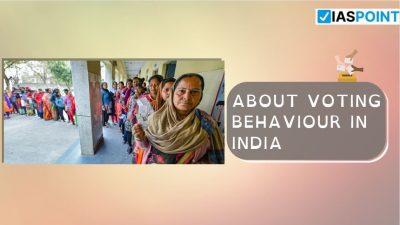
Voting behaviour refers to the patterns and reasons behind how individuals decide to cast their votes in elections. It encompasses both psychological and sociological factors. Political scientists and sociologists analyse these behaviours to understand electoral outcomes. Gordon Marshall defines it as the study of why people vote as they do. Stephen Wasby elaborates that it involves analysing individual psychology and institutional patterns affecting political action.
Significance of Voting Behaviour
The study of voting behaviour, known as psephology, is essential for several reasons:
- It aids in understanding political socialisation.
- It examines the internalisation of democratic values.
- It marks the impact of elections on political continuity or change.
- It assesses the modernity of electoral politics in relation to historical contexts.
Determinants of Voting Behaviour in India
Voting behaviour in India is shaped by various socio-economic and political factors. These factors are often interrelated and vary across different regions.
Socio-Economic Factors
Socio-economic conditions influence voter choices. Key determinants include:
Caste
Caste plays important role in Indian voting behaviour. Voters often support parties that represent their caste interests. Political parties strategise based on caste dynamics, leading to caste-based voting blocs. In states like Uttar Pradesh and Bihar, caste considerations are particularly prominent.
Religion
Religion is another vital factor. Political parties leverage religious sentiments to garner support. Despite India’s secular framework, religious affiliations strongly influence electoral choices. Research indicates that a considerable percentage of voters consider candidates’ religious backgrounds when voting.
Language
Language influences voting behaviour through regional sentiments. Political parties often appeal to linguistic identities, especially in states where language plays role in local governance. The reorganisation of states based on language further marks this factor.
Regionalism
Regional identities and sentiments affect voting behaviour. Regional parties often emerge to represent local interests. These parties appeal to voters based on regional aspirations, impacting electoral dynamics.
Personality of Leaders
Charismatic leaders can sway voters. The image and personality of prominent figures like Jawaharlal Nehru or Narendra Modi influence electoral outcomes. Voters often associate their choices with the perceived capabilities of these leaders.
Money
Financial considerations also play a role. Despite regulations on election spending, money often influences voter decisions. In many cases, voters may expect monetary compensation for their votes, denoting the transactional nature of some electoral interactions.
Performance of the Ruling Party
The performance of the incumbent party is a critical determinant. Voters assess the ruling party based on its election manifesto and actual governance. Discontent with the ruling party can lead to anti-incumbency sentiments, influencing electoral outcomes.
Party Identification
Emotional connections to political parties shape voting behaviour. Individuals often vote for parties they identify with, regardless of the party’s actions. Although party identification was stronger in earlier decades, its influence has waned over time.
Ideology
Political ideologies impact voter choices. Individuals committed to specific ideologies, such as socialism or secularism, tend to support parties that align with their beliefs. Ideological considerations remain in shaping electoral outcomes.
Additional Factors Influencing Voting Behaviour
Numerous other factors also affect voting behaviour:
- Political events, such as scandals or crises.
- Economic conditions, including inflation and unemployment.
- Factionalism within political parties.
- Demographic factors, including age and gender.
- Education levels of voters.
- Urban versus rural habitation.
- Socio-economic class distinctions.
- Family and kinship ties.
- Candidate orientation and personal appeal.
- Election campaigns and their effectiveness.
- Political family background of candidates.
Media Influence on Voting Behaviour
Media plays important role in shaping public opinion during elections. It influences voter perceptions and decisions through various channels.
Media Coverage
Media coverage of political events and campaigns impacts voter behaviour. Surveys indicate that voters often rely on media for information about candidates and policies. The extensive reach of print and broadcast media ensures that political narratives are widely disseminated.
Social Media
Social media has transformed political communication. With millions of active users, platforms like Facebook and Twitter shape political opinions, especially among younger voters. Studies show that portion of the electorate uses social media for political information.
Last Modified: March 9, 2024