

India, a geologically dynamic region, has been a witness to numerous seismic events throughout its history. The Indian subcontinent is situated at the boundary of the Indian Plate and the Eurasian Plate, leading to frequent tectonic movements.
Ancient Records and Legendary Quakes
India’s rich historical and mythological texts provide intriguing insights into ancient earthquakes. The “Valmiki Ramayana,” an ancient epic, recounts a great earthquake that is believed to have occurred during Lord Rama’s reign. While these records lack precise scientific data, they serve as early indicators of seismic activity in the region.
- The Great Assam Earthquake – 1897: One of the most catastrophic earthquakes in Indian history struck the northeastern state of Assam on June 12, 1897. With an estimated magnitude of 8.1, the earthquake caused massive devastation across a vast area of more than 60,000 square kilometers. The seismic shock was felt as far away as Tibet and Bangladesh. The death toll was estimated at around 1,500, and numerous villages and towns were reduced to ruins.
- The Bihar-Nepal Earthquake – 1934: On January 15, 1934, a devastating earthquake struck the Bihar-Nepal border with an estimated magnitude of 8.0. This quake caused widespread destruction, not only in Bihar but also in Nepal and northern Bengal. Over 10,000 people lost their lives, and many structures, including temples and monuments, were severely damaged.
- The Great Indian Ocean Earthquake (Sumatra-Andaman Earthquake) – 2004: Among the most catastrophic earthquakes ever recorded, the 2004 Indian Ocean earthquake, with a magnitude of 9.1-9.3, struck off the west coast of northern Sumatra on December 26, 2004. The quake triggered a series of devastating tsunamis that affected multiple countries, including India’s eastern coastal regions. The death toll in India surpassed 10,000, and millions were left homeless.
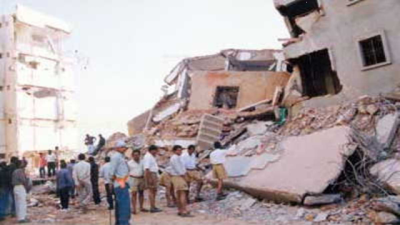
- Bhuj Earthquake – 2001: On January 26, 2001, the western state of Gujarat experienced a colossal earthquake, measuring 7.7 on the Richter scale. The epicenter was near the town of Bhuj. The quake’s intensity and shallow depth resulted in massive destruction across a vast area, including major cities like Ahmedabad and Rajkot. The death toll exceeded 20,000, and over 400,000 buildings were destroyed or damaged.
Recent Seismic Activity
In recent years, India has experienced several moderate to strong earthquakes. Some notable ones include the Sikkim earthquake in 2011, the Manipur earthquake in 2016, and the Uttarakhand earthquake in 2019. While these events were not as catastrophic as some of the historical quakes, they serve as reminders of India’s ongoing seismic vulnerability. The following table enlists some major earthquakes of India over the past few years.
| Year | Location | Magnitude | Impact and Effects |
| 1737 | Kolkata, West Bengal | 7.6 | One of the deadliest earthquakes in recorded history in India, causing massive destruction in Kolkata and surrounding areas. Estimated death toll: 300,000+. |
| 1819 | Kachchh, Gujarat | 7.7 | Devastating earthquake that caused widespread damage and loss of life in the Kachchh region. Estimated death toll: 1,543. |
| 1905 | Kangra, Himachal Pradesh | 7.8 | Another severe earthquake in India’s history, affecting the Kangra valley and nearby areas, resulting in significant casualties and structural damages. Estimated death toll: 20,000+. |
| 1950 | Assam-Tibet Border | 8.6 | One of the strongest earthquakes ever recorded in India, leading to casualties and extensive damage in Assam and parts of Tibet. Estimated death toll: 1,526. |
| 1993 | Latur, Maharashtra | 6.3 | A devastating earthquake that struck Latur, Maharashtra, causing massive destruction and loss of life. Estimated death toll: 10,000+. |
| 1999 | Chamoli, Uttarakhand | 6.8 | Significant seismic event causing destruction in Uttarakhand, leading to loss of life and extensive property damage. Estimated death toll: 103. |
| 2001 | Bhuj, Gujarat | 7.7 | A catastrophic earthquake that hit Bhuj, Gujarat, causing extensive devastation and significant loss of life and property. Estimated death toll: 20,000+. |
| 2004 | Sumatra-Andaman | 9.1 | The massive Indian Ocean earthquake and tsunami that led to widespread devastation across coastal regions of India, particularly in the Andaman and Nicobar Islands. Estimated death toll in India: 18,176. |
| 2015 | Nepal-India Border | 7.8 | A powerful earthquake that struck Nepal but also affected northern India, resulting in fatalities and damages in regions like Bihar, Uttar Pradesh, and Sikkim. Estimated death toll in India: 72. |
| 2021 | Sikkim-Nepal Border | 5.9 | An earthquake with its epicenter near the Sikkim-Nepal border, causing minor to moderate damage in Sikkim and surrounding areas. No casualties reported. |
Earthquake Preparedness and Mitigation
Learning from past experiences, India has taken significant strides in earthquake preparedness and mitigation. The National Disaster Management Authority (NDMA) and various state-level agencies have been working on disaster management plans, public awareness campaigns, and infrastructural resilience measures to reduce the impact of future earthquakes. The history of Indian earthquakes is a tale of resilience and adaptation in the face of natural calamities. From ancient legends to modern-day records, seismic events have shaped the country’s landscape and left an indelible mark on its history.
Last Modified: April 16, 2026