
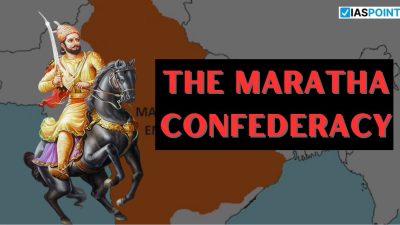
The Maratha Confederacy, also known as the Maratha Empire, was a prominent political entity in the Indian subcontinent during the early modern period. Established in 1674, it grew under the leadership of various rulers. The confederacy comprised the realms of the Peshwa and four major independent Maratha states.
Formation and Early History
The Maratha state began with the coronation of Shivaji as Chhatrapati in 1674. He led a rebellion against the Adil Shahi dynasty and the Mughal Empire. By 1707, the Marathas were recognised as a tributary state by Mughal Emperor Bahadur Shah I. Despite nominal allegiance to the Mughal Empire, the Marathas wielded substantial power in northern India.
Shivaji’s Legacy
Shivaji Bhonsle (1630–1680) was the founder of the Maratha state. He established Hindavi Swarajya, meaning “self-rule of Hindus.” His military tactics and governance laid the groundwork for the Maratha Empire. Shivaji’s reign saw the construction of numerous forts and the establishment of a competent administration.
Expansion under Peshwa Bajirao I
After Shivaji’s death, his grandson Shahu, with the guidance of Peshwa Bajirao I, revitalised Maratha power in the early 18th century. Bajirao I expanded the empire , extending its reach from Maharashtra to northern and central India. His military campaigns were marked by strategic brilliance and rapid conquests.
Structure of the Confederacy
The Maratha state was a confederacy comprising several princely states. The four major states were Gwalior (Scindias), Baroda (Gaekwads), Indore (Holkars), and Nagpur (Bhonsles). The Peshwa, based in Pune, acted as the central authority, although the states maintained considerable autonomy.
The Peshwa’s Role
The Peshwa served as the prime minister and was instrumental in the administration of the Maratha Empire. Initially appointed by Shivaji, the position became hereditary. The Peshwas, particularly Bajirao I and Balaji Bajirao (Nanasaheb), played vital roles in the expansion and consolidation of Maratha power.
Conflicts and Challenges
The Marathas faced challenges, including the Third Battle of Panipat in 1761, where they suffered a devastating defeat against the Afghan forces led by Ahmad Shah Durrani. This battle marked a turning point, leading to a decline in their power and influence.
Revival and Resurgence
Despite setbacks, the Marathas experienced a revival under Peshwa Madhav Rao I. He implemented reforms and strengthened the military. His leadership helped regain lost territories and reassert Maratha dominance in northern India.
Relations with the Mughals
The Marathas maintained a complex relationship with the Mughal Empire. Initially, they recognised Mughal suzerainty but effectively operated as independent rulers. The Marathas extracted tribute, known as chauth, from various regions, further solidifying their economic power.
Anglo-Maratha Wars
The British East India Company sought to expand its influence in India, leading to confrontations with the Marathas. The First Anglo-Maratha War (1775–1782) ended in a stalemate, while the Second Anglo-Maratha War (1803–1805) resulted in territorial losses for the Marathas.
Decline of the Confederacy
The Third Anglo-Maratha War (1817–1818) marked the end of the Maratha Confederacy. The British defeated the Maratha forces and exiled Peshwa Baji Rao II. The British established direct control over the Maratha heartland, effectively dismantling the confederacy.
Geography and Territory
At its height, the Maratha Confederacy spanned a vast area of the Indian subcontinent. It covered regions from Punjab in the north to Hyderabad in the south, and from Kutch in the west to Oudh in the east. The Marathas maintained tributary relationships with several regional powers.
Administration and Governance
The Maratha administration was characterised by a council system known as the Ashtapradhan, consisting of eight ministers. This council managed various aspects of governance, including finance, military, and foreign affairs. Shivaji’s administrative reforms laid the foundation for effective governance.
Military Structure
The Maratha military was initially a national army under Shivaji. However, with the rise of the Peshwas, it evolved into a feudal force. The army comprised soldiers from diverse backgrounds, including locals and foreign mercenaries. The Maratha Navy played important role in coastal defence and trade.
Cultural Contributions
The Marathas contributed to Indian culture, including literature, art, and architecture. They promoted Marathi as a literary language and supported various cultural institutions. The construction of forts and palaces reflected their architectural prowess.
Economic Policies
The Maratha economy was primarily agrarian, with agriculture as the mainstay. The Peshwas implemented policies to improve agricultural productivity and trade. They collected taxes from the regions under their control, which funded military campaigns and administrative expenses.
Legacy and Historical Significance
The Maratha Confederacy played a very important role in shaping modern India. Their resistance against Mughal rule and later against British colonialism laid the groundwork for future independence movements. The Maratha legacy continues to influence Indian politics and culture .
Notable Rulers and Leaders
Key figures in the Maratha Confederacy include:
- Shivaji Bhonsle – Founder of the Maratha state.
- Sambhaji – Shivaji’s son and successor.
- Shahu I – Grandson of Shivaji, instrumental in consolidating power.
- Bajirao I – Expanded the empire .
- Balaji Bajirao (Nanasaheb) – Furthered Maratha influence in northern India.
- Madhav Rao I – Revived the confederacy after the Panipat defeat.