
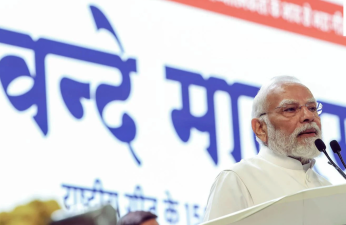
The January 28, 2026 order of the Union Ministry of Home Affairs (MHA) directing that all six stanzas of Vande Mataram be played at official functions — with everyone present required to stand at attention — has reignited an old constitutional debate. At its heart lies a larger question: Can the State mandate participation in a song that contains explicit religious imagery, and does such a directive align with India’s secular and constitutional framework? The issue demands a return to history, constitutional text, and judicial precedent.
The 1937 Compromise: Context, Consensus and Sensitivity
In October 1937, the Congress Working Committee met in Calcutta to deliberate objections raised to portions of Vande Mataram. Leaders of the national movement — including Dr. Rajendra Prasad, Sardar Vallabhbhai Patel, and Mahatma Gandhi — recognised concerns that certain later stanzas invoked Hindu deities such as Durga, Lakshmi and Saraswati.
The Committee resolved that only the first two stanzas would be used at national gatherings, as these verses celebrated the motherland in natural and cultural imagery without explicit religious invocation.
This decision reflected:
- Recognition of India’s multi-religious character.
- An effort to maintain unity within the freedom movement.
- An early articulation of what would later become constitutional secularism.
It was not a rejection of the song, but a calibrated accommodation in a plural society.
Constituent Assembly’s Deliberate Choice in 1950
On January 24, 1950, the Constituent Assembly adopted Jana Gana Mana as the National Anthem and accorded Vande Mataram equal honour as the National Song. However, crucially, only the first two stanzas were formally recognised in official usage.
This distinction was not accidental. The framers were conscious that the later stanzas, drawn from Bankim Chandra Chatterjee’s poem in Anandamath, contain devotional references that may not resonate uniformly across religious communities.
The constitutional framework further reflects this differentiation:
- Article 51A(a) lists the duty to respect the National Flag and the National Anthem.
- The National Song finds no mention in the Constitution.
- The Prevention of Insults to National Honour Act, 1971, protects the Anthem, Flag and Constitution — not the National Song.
The omission signals a constitutional hierarchy: while Vande Mataram holds cultural and historical importance, it does not enjoy the same legal status as the National Anthem.
Bijoe Emmanuel Case: The Right to Silence
The constitutional position on compelled patriotic expression was settled in Bijoe Emmanuel & Ors. v. State of Kerala (1986). In this case, three schoolchildren belonging to the Jehovah’s Witnesses faith stood respectfully during the National Anthem but refused to sing it due to religious beliefs.
The Supreme Court held that:
- Standing respectfully constitutes sufficient respect.
- Compelling singing violates Article 19(1)(a) (freedom of speech and expression).
- It also infringes Article 25 (freedom of conscience and religion).
The Court emphasised that respectful silence is not disrespect. The judgment reinforced a core constitutional principle: the State cannot prescribe orthodoxy in matters of belief or compel expressions of faith.
If even the National Anthem — constitutionally recognised and statutorily protected — cannot be compulsorily sung, the logic extends more strongly to the National Song, which lacks explicit constitutional mention.
Secularism and Freedom of Conscience
India’s secularism is not a strict separation model but one based on equal respect for all religions. Article 25 guarantees freedom of conscience — not merely the freedom to practise religion, but the freedom to refrain from acts that violate one’s belief.
The later stanzas of Vande Mataram describe the motherland as manifestations of specific Hindu deities. For adherents of other faiths, mandatory participation in such verses may raise questions of conscience.
The constitutional dilemma, therefore, is not about the literary or historical merit of the song, but about whether executive orders can override carefully evolved secular accommodations.
Executive Power and Constitutional Boundaries
The January 2026 directive was issued through executive order rather than legislative amendment. This raises institutional questions:
- Can executive instructions expand obligations beyond constitutional text?
- Can they override judicial precedent such as “Bijoe Emmanuel”?
- Does mandating participation risk infringing Articles 19 and 25?
The Supreme Court has consistently held that executive action must conform to constitutional limitations. Any order perceived as compelling religious conformity under the guise of patriotism would likely face judicial scrutiny.
What to Note for Prelims?
- Article 51A(a) — Fundamental Duty regarding Flag and Anthem.
- Prevention of Insults to National Honour Act, 1971.
- Status of National Anthem vs National Song.
- Key holding of Bijoe Emmanuel v. State of Kerala (1986).
- Article 25 — Freedom of conscience and religion.
What to Note for Mains?
- Constitutional morality versus majoritarian impulses.
- Scope of executive power under Articles 73 and 162.
- Judicial protection of freedom of expression and conscience.
- Secularism as part of the Basic Structure doctrine.
- Balancing patriotism with individual liberty in a plural society.
The debate over Vande Mataram is ultimately not about reverence for the nation, but about how a constitutional republic defines patriotism. India’s constitutional design protects both those who sing and those who, for reasons of conscience, choose respectful silence. The strength of the republic lies not in enforced uniformity, but in safeguarding equal citizenship within diversity.
Last Modified: February 14, 2026