
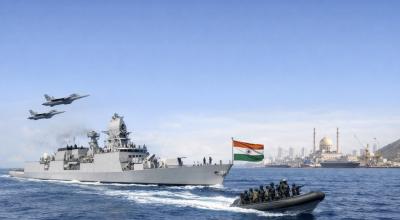
India is closely observing the rising tensions in West Asia in early 2026. The Indian Navy’s Operation Sankalp has two ships deployed in the Gulf of Aden and Gulf of Oman. These vessels are on standby for humanitarian assistance and disaster relief (HADR) if needed. The government is actively reviewing the situation to protect Indian interests in the region.
Operation Sankalp and Naval Deployment
Operation Sankalp began in 2019 to ensure the safety of Indian-flagged merchant ships against piracy threats in West Asia. Currently, a frigate and a destroyer are deployed for anti-piracy and maritime security missions. The Navy is prepared to switch to HADR roles if the conflict escalates. INS Surat is also stationed in Bahrain for regional maritime cooperation.
Government’s Strategic Review
On 1 March 2026, Prime Minister Narendra Modi chaired the Cabinet Committee on Security (CCS). The committee evaluated the conflict’s impact on India’s strategic, economic, and diaspora interests. Key ministers including Defence, Home, External Affairs, and Finance participated. The CCS continues to receive updates and plan responses to safeguard national interests.
India’s Maritime Security Approach
India maintains a strong naval presence in West Asia to protect trade routes and citizens. The Navy’s prior experience in evacuation and relief during crises strengthens its readiness. Operation Sankalp demonstrates India’s commitment to securing maritime commerce and regional stability amid geopolitical tensions.
India’s Diplomatic and Economic Stakes
West Asia holds vital energy and trade links for India. The large Indian diaspora in the region also requires protection. Economic ties and energy security are key factors in India’s vigilant monitoring. The government’s coordinated approach underlines the importance of integrated diplomacy and defence.
Topics for Prelims:
Operation Sankalp
- Started in 2019 for anti-piracy in Gulf of Aden and Gulf of Oman.
- Involves deployment of frigates and destroyers.
- Supports safety of Indian-flagged merchant vessels.
- Can be used for humanitarian assistance and disaster relief.
- Reflects India’s maritime security strategy in West Asia.
Cabinet Committee on Security (CCS)
- India’s highest decision-making body on security and strategic affairs.
- Chaired by the Prime Minister.
- Includes Defence, Home, External Affairs, and Finance Ministers.
- Reviews national security issues and crisis situations.
- Coordinates inter-ministerial responses to threats.
INS Surat
- Indian Navy’s guided missile destroyer.
- Deployed in Bahrain for maritime security cooperation.
- Part of India’s regional naval presence in West Asia.
- Supports anti-piracy and strategic engagement missions.
- Enhances India’s ability to respond to regional crises.
Questions for Mains:
- Critically discuss the role of the Indian Navy in ensuring maritime security in West Asia and its implications for India’s energy security. [GS-III-Internal & External Security]
- Examine the strategic importance of the Cabinet Committee on Security in India’s crisis management and decision-making processes. [GS-II-Constitution of India & Polity]
- Analyse the challenges and opportunities for India in protecting its diaspora and economic interests during regional conflicts in West Asia. [GS-II-International Relations]
- Estimate the impact of naval deployments like Operation Sankalp on India’s broader geopolitical influence and maritime diplomacy. [GS-III-Economic Development]
Answer Hints:
1. Critically discuss the role of the Indian Navy in ensuring maritime security in West Asia and its implications for India’s energy security. [GS-III-Internal & External Security]
- Indian Navy’s Operation Sankalp (since 2019) deployed frigates and destroyers in Gulf of Aden and Gulf of Oman for anti-piracy and maritime security.
- Ensures safety of Indian-flagged merchant vessels transporting critical energy supplies from West Asia to India.
- Protects vital sea lanes of communication (SLOCs) that are crucial for uninterrupted oil and gas imports.
- Naval presence deters piracy, terrorism, and hostile state actions, stabilizing maritime trade routes.
- Capability to conduct humanitarian assistance and disaster relief (HADR) adds to regional goodwill and security.
- Supports India’s energy security by safeguarding supply chains amid geopolitical tensions in West Asia.
2. Examine the strategic importance of the Cabinet Committee on Security in India’s crisis management and decision-making processes. [GS-II-Constitution of India & Polity]
- CCS is India’s highest decision-making body on security and strategic affairs, chaired by the Prime Minister.
- Includes key ministers – Defence, Home, External Affairs, and Finance, ensuring coordinated inter-ministerial responses.
- Provides a platform for timely review and assessment of national security threats and crises.
- Enables formulation of integrated strategies covering military, diplomatic, internal security, and economic dimensions.
- Facilitates swift decision-making during conflicts, ensuring clear directives and resource mobilization.
- Enhances India’s preparedness and response capability to evolving security challenges domestically and internationally.
3. Analyse the challenges and opportunities for India in protecting its diaspora and economic interests during regional conflicts in West Asia. [GS-II-International Relations]
- Large Indian diaspora in West Asia faces risks during conflicts, necessitating evacuation and protection mechanisms.
- Economic interests include vital energy imports and trade routes vulnerable to disruption in conflict zones.
- Challenges include complex regional geopolitics, proxy wars, and fluctuating alliances impacting security environment.
- India’s naval and diplomatic presence supports safe passage, evacuation, and crisis management for its citizens.
- Opportunities arise to strengthen bilateral ties, enhance regional cooperation, and project India as a responsible stakeholder.
- Coordinated efforts across defence, diplomacy, and diaspora engagement enhance India’s influence and safeguard interests.
4. Estimate the impact of naval deployments like Operation Sankalp on India’s broader geopolitical influence and maritime diplomacy. [GS-III-Economic Development]
- Operation Sankalp demonstrates India’s commitment to securing international maritime commons and trade routes.
- Enhances India’s stature as a net security provider in the Indian Ocean Region and West Asia.
- Strengthens bilateral and multilateral naval cooperation with regional partners, boosting maritime diplomacy.
- Projects India’s capability to protect its economic and strategic interests beyond its immediate neighborhood.
- Builds goodwill through HADR readiness and anti-piracy operations, contributing to regional stability.
- Supports India’s aspirations for greater geopolitical influence aligned with its economic development goals.