
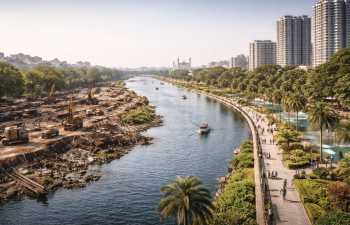
The Telangana government plans to transform the Musi River in Hyderabad into a perennial water body. The project aims to ensure year-round water flow and develop leisure, shopping, and heritage spaces along the riverbanks. This initiative has sparked controversy due to the displacement of long-term residents living on the riverbanks.
Overview of the Musi River
The Musi River is about 260 km long. It forms from two rivulets, Musa and Esi, originating in the Ananthagiri hills of Vikarabad district. The river flows through Hyderabad for 55 km. Floods in 1908 led to the creation of Osman Sagar and Himayat Sagar reservoirs to control floods. These tanks regulate the river flow and protect the city.
Development Plans and Proposals
The government intends to develop both sides of the river’s 55 km stretch. A detailed project report (DPR) is pending approval. The plan includes diverting 2.5 tmcft of water from the Godavari River via Mallanna Sagar Reservoir to keep Musi flowing year-round. The project also proposes 39 new sewage treatment plants (STPs) to supplement the existing 31 STPs to clean the river water. The ‘Gandhi Sarovar’ cultural precinct with the world’s tallest Gandhi statue is planned at the confluence of Musa and Esi rivers.
Progress and Opposition
In late 2024, a consortium was formed to prepare the DPR. The government began relocating residents from slums on the riverbed, triggering protests. The residents, supported by activists and voluntary groups, formed the ‘Musi Jan Andolan’ movement opposing forced evictions and lack of transparency. Recent land acquisition notifications have further fuelled opposition, especially from residents near the proposed Gandhi Sarovar site.
Current Status and Funding
The project’s first phase has received in-principle funding approval from the Asian Development Bank (ADB). Final approval and DPR clearance are awaited. The government has started work on less populated stretches along the Musa and Esi rivers covering 21 km to avoid immediate conflict.
Topics for Prelims:
Musi River
- Originates from Musa and Esi rivulets in Ananthagiri hills, Telangana.
- Flows 55 km through Hyderabad city.
- Length approximately 260 km.
- Osman Sagar and Himayat Sagar reservoirs control floods.
- Subject of urban waterfront development plans.
Musi Riverfront Development Project
- Goal to make the river perennial with year-round flow.
- Plans include leisure, shopping, and heritage spaces.
- Water to be diverted from Godavari River via Mallanna Sagar Reservoir.
- Proposed 39 new sewage treatment plants to clean the river.
- ‘Gandhi Sarovar’ precinct with tallest Gandhi statue planned.
Musi Jan Andolan Movement
- Formed by displaced residents and activists in 2024.
- Opposes forced evictions and lack of project transparency.
- Questions government’s urgency without DPR in public domain.
- Protests land acquisition near Gandhi Sarovar site.
- Demands residents’ participation in river rejuvenation.
Questions for Mains:
- Discuss the challenges and benefits of urban riverfront development projects in India in the light of the Musi Riverfront Development project. [GS-III-Economic Development]
- Critically examine the impact of forced displacement on urban poor communities during infrastructure development, with examples from Indian river rejuvenation projects. [GS-IV-Ethics, Integrity and Aptitude]
- Explain the role of water resource management in urban flood control and sustainable development, citing the Musi River and its reservoirs. [GS-III-Environment & Disaster Management]
- With suitable examples, discuss the importance of public participation and transparency in large-scale urban development projects in India. Comment on the consequences of their absence. [GS-II-Governance]
Answer Hints:
1. Discuss the challenges and benefits of urban riverfront development projects in India in the light of the Musi Riverfront Development project. [GS-III-Economic Development]
- Benefits – Improved urban aesthetics, creation of leisure and commercial spaces boosting local economy and tourism.
- Environmental gains – Year-round water flow, improved water quality via sewage treatment plants, enhanced biodiversity.
- Challenges – Displacement of long-term residents, land acquisition conflicts, inadequate public consultation.
- Technical challenges – Ensuring perennial flow by diverting water (e.g., Godavari to Musi), managing sewage inflow, flood control.
- Financial aspects – Need for large investments, dependence on multilateral funding (ADB), phased implementation.
- Social concerns – Balancing development with social equity, preserving heritage sites, addressing slum rehabilitation.
2. Critically examine the impact of forced displacement on urban poor communities during infrastructure development, with examples from Indian river rejuvenation projects. [GS-IV-Ethics, Integrity and Aptitude]
- Forced evictions disrupt livelihoods, social networks, and access to basic services for urban poor.
- Often lack of adequate rehabilitation and compensation leads to marginalization and poverty.
- Ethical concerns – Violation of rights, lack of informed consent, and transparency.
- Example – Musi Riverfront project evictions triggered protests due to abrupt relocations without DPR/public consultation.
- Similar cases – Yamuna riverfront, Sabarmati riverfront projects also faced opposition over displacement.
- Need for participatory planning, humane resettlement policies, and inclusive development to uphold dignity and rights.
3. Explain the role of water resource management in urban flood control and sustainable development, citing the Musi River and its reservoirs. [GS-III-Environment & Disaster Management]
- Water resource management ensures controlled river flow, preventing urban flooding and waterlogging.
- Osman Sagar and Himayat Sagar reservoirs on Musi act as flood control structures post-1908 devastating floods.
- Reservoirs regulate water release, store excess monsoon water, and maintain ecological flow in dry seasons.
- Integration with sewage treatment plants improves water quality, supporting sustainable urban ecosystems.
- Linking Godavari water via Mallanna Sagar reservoir to Musi aims at perennial flow, reducing water scarcity.
- Effective management supports urban resilience, groundwater recharge, and biodiversity conservation.
4. With suitable examples, discuss the importance of public participation and transparency in large-scale urban development projects in India. Comment on the consequences of their absence. [GS-II-Governance]
- Public participation ensures stakeholder ownership, reduces conflicts, and improves project design and acceptance.
- Transparency builds trust, allows scrutiny of DPRs, and prevents arbitrary decisions (e.g., land acquisition).
- Example – Musi Jan Andolan formed due to lack of transparency and forced evictions in Musi Riverfront project.
- Other examples – Delhi Metro, Mumbai Coastal Road projects showed better outcomes with public consultations.
- Absence leads to protests, legal challenges, delays, and social unrest, increasing project costs and risks.
- Governance frameworks (like EIA, Social Impact Assessment) mandate participatory processes for sustainable urban development.