
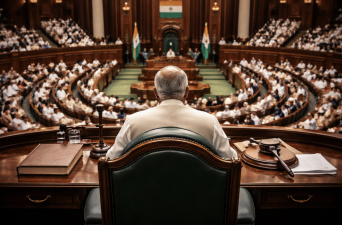
The recent no-confidence motion against Om Birla, the Speaker of the Lok Sabha, has brought renewed attention to the constitutional role and accountability of this key parliamentary office. Though rare, such motions show the importance of the Speaker’s impartiality and the challenges faced by parliamentary democracy in India.
Constitutional Position of the Speaker
The Speaker is the presiding officer of the Lok Sabha. The Constitution requires the Speaker to be impartial and above party politics once elected. The Speaker manages debates, enforces rules, protects members’ rights, and balances government and Opposition voices. Key powers include recognising members, interpreting procedures, disciplining members, and certifying Money Bills. These powers influence legislative outcomes and require strong constitutional protection.
Process for Removal of the Speaker
Removal of the Speaker is difficult by design. Article 94(c) mandates a resolution passed by a majority of all Lok Sabha members. A written notice with 14 days’ advance is required. At least 50 members must support the motion for discussion. The motion must state clear charges. The Speaker participates as a member during debate and votes initially but not in a tie. Historically, only three no-confidence motions against Speakers have occurred, all unsuccessful.
Challenges and Institutional Impact
The motion against Om Birla puts stress on challenges faced by the Speaker’s office. Increasing politicisation affects decisions on anti-defection and Money Bills. Partisan perceptions reduce trust and cause parliamentary deadlocks. Traditional conventions demanding neutrality have weakened amid political rivalry. This erosion harms the Speaker’s credibility and Parliament’s functioning.
Measures for Strengthening the Speaker’s Office
Restoring trust requires reinforcing conventions that the Speaker acts impartially. Greater transparency in rulings can reduce bias perceptions. Explaining decisions clearly is vital. Promoting dialogue between government and Opposition can ease confrontations. Codifying best practices on discretionary powers may clarify ambiguities while preserving procedural flexibility.
Topics for Prelims:
Speaker of Lok Sabha
- Presiding officer of Lok Sabha.
- Expected to be impartial after election.
- Certifies Money Bills.
- Has disciplinary and procedural powers.
- Protected by stringent removal process.
Removal Process of Speaker
- Requires resolution by majority of all members.
- 14 days’ notice before motion.
- Minimum 50 members’ support needed.
- Motion must state charges clearly.
- Speaker votes initially but not in tie.
Parliamentary Conventions
- Unwritten norms guiding Speaker’s neutrality.
- Help maintain trust and order.
- Weakened by rising political rivalry.
- Essential for smooth parliamentary functioning.
- Require collective reaffirmation by parties.
Questions for Mains:
- Critically analyse the constitutional safeguards for the Speaker of Lok Sabha and their effectiveness in ensuring impartiality. [GS-II-Constitution of India & Polity]
- Explain the significance of parliamentary conventions in maintaining democratic governance and how their erosion affects legislative functioning. [GS-II-Governance]
- With suitable examples, comment on the challenges faced by presiding officers in multi-party democracies and suggest reforms to uphold their neutrality. [GS-I-Indian Society]
- What are the roles and powers of the Speaker in the legislative process? How can transparency in these functions improve parliamentary democracy? [GS-II-Constitution of India & Polity]
Answer Hints:
1. Critically analyse the constitutional safeguards for the Speaker of Lok Sabha and their effectiveness in ensuring impartiality. [GS-II-Constitution of India & Polity]
- The Speaker is constitutionally required to be impartial and above party politics once elected (Article 93, Article 94(c)).
- Strong removal safeguards – Removal only by a resolution passed by a majority of all Lok Sabha members, with 14 days’ notice and minimum 50 members’ support.
- Powers include recognition of members, interpretation of rules, disciplinary authority, and certification of Money Bills, necessitating protection from political pressures.
- Historical rarity of no-confidence motions against Speakers (only three attempts, all unsuccessful) demonstrates procedural difficulty in removal.
- However, growing politicisation and perceptions of partiality question the practical effectiveness of these safeguards.
- Conventions and neutrality expectations supplement constitutional provisions but have weakened recently, affecting impartiality.
2. Explain the significance of parliamentary conventions in maintaining democratic governance and how their erosion affects legislative functioning. [GS-II-Governance]
- Parliamentary conventions are unwritten norms that ensure the Speaker’s neutrality and fair conduct of business.
- They maintain trust between government and Opposition, facilitating orderly debates and consensus-building.
- Conventions support smooth functioning by guiding discretionary powers and procedural decisions.
- Erosion leads to perceived bias, increased confrontations, and procedural deadlocks in Parliament.
- Weakening conventions undermine the credibility of parliamentary institutions and democratic governance.
- Reaffirmation of conventions by political parties is essential to restore trust and effective legislative functioning.
3. With suitable examples, comment on the challenges faced by presiding officers in multi-party democracies and suggest reforms to uphold their neutrality. [GS-I-Indian Society]
- Challenges include politicisation of decisions (e.g., anti-defection rulings, Money Bill certification) leading to allegations of bias.
- Multi-party nature intensifies political rivalry, making impartiality difficult to maintain.
- Frequent confrontations cause procedural deadlocks and erode trust among parties.
- Examples – No-confidence motions against Speakers (1954, 1966, 1987) reflect political tensions but failed due to high removal threshold.
- Reforms – Reinforce conventions of neutrality, increase transparency in procedural rulings, and codify best practices for discretionary powers.
- Promote structured dialogue between government and Opposition to reduce conflicts and improve consensus-building.
4. What are the roles and powers of the Speaker in the legislative process? How can transparency in these functions improve parliamentary democracy? [GS-II-Constitution of India & Polity]
- Roles – Presiding officer managing debates, enforcing rules, protecting members’ rights, balancing government and Opposition voices.
- Powers – Recognition of members to speak, interpretation of procedural rules, disciplinary authority, certification of Money Bills.
- Speaker’s decisions shape legislative outcomes and maintain order and decorum in the House.
- Transparency in rulings (e.g., explaining reasons for rejecting discussions or certifying bills) builds trust and reduces perceptions of partisanship.
- Open communication about procedural decisions encourages accountability and enhances legitimacy of parliamentary processes.
- Transparency encourages consensus and strengthens democratic governance by reinforcing the Speaker’s impartiality.