
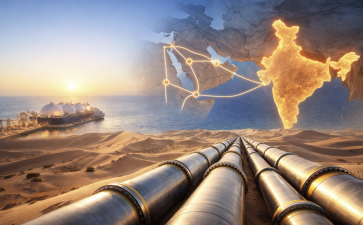
India’s energy imports from West Asia faced renewed scrutiny in 2026 amid regional conflicts. The shortage of liquefied petroleum gas (LPG) and liquefied natural gas (LNG) disrupted several sectors. India still imports over 60 per cent of its domestic gas from West Asia. Past efforts to diversify energy sources included plans for the Iran-Pakistan-India (IPI) pipeline, which ultimately failed. India later shifted focus to the Turkmenistan-Afghanistan-Pakistan-India (TAPI) pipeline, which also faces challenges.
The Iran-Pakistan-India (IPI) Pipeline Project
The IPI pipeline was proposed in the 1990s to transport natural gas from Iran’s vast reserves to South Asia. It aimed to supply 60 million standard cubic metres per day to India and Pakistan. The pipeline would span 2,775 km. India and Iran signed a Memorandum of About in 1993. Initially, Iran discussed the project with Pakistan but later invited India to join. The project promised cheaper gas compared to LNG imports.
India’s Entry and Exit from IPI
India joined talks after improved India-Pakistan relations post-1999. By 2005, both countries prioritised the pipeline for energy security. India’s rising gas demand in power and fertilisers made the project attractive. However, unresolved issues emerged – pricing disagreements, security risks in Pakistan’s Balochistan, and US sanctions on Iran. India wanted prices linked to global crude oil, while Iran demanded higher rates. Security concerns and US pressure led India to halt participation after 2007.
Aftermath and Shift to TAPI Pipeline
Post India’s exit, the project became the Iran-Pakistan pipeline, but Pakistan’s financial and security issues stalled progress. India then focused on the TAPI pipeline, transporting gas from Turkmenistan’s Galkynysh field through Afghanistan and Pakistan to India. Signed in 2010, TAPI had fewer diplomatic risks as Turkmenistan was not sanctioned. The Asian Development Bank supported financing. However, security and political instability delayed full operation. Only a small section between Turkmenistan and Afghanistan became active in 2025.
Current Energy Import Challenges
India’s dependence on West Asian gas remains high despite diversification attempts. Regional conflicts and sanctions continue to disrupt supply chains. The failure of major pipeline projects marks geopolitical and security complexities. India is exploring alternative energy sources and building strategic reserves to mitigate risks.
Topics for Prelims:
Iran-Pakistan-India (IPI) Pipeline
- Proposed in 1990s to transport Iranian gas to South Asia.
- Pipeline length planned – 2,775 km.
- Supply target – 60 million standard cubic metres per day.
- India joined talks after 2000s peace efforts with Pakistan.
- Project stalled due to pricing, security, and US sanctions.
Turkmenistan-Afghanistan-Pakistan-India (TAPI) Pipeline
- Signed in 2010 to transport gas from Turkmenistan to India.
- Length about 1,800 km; annual supply 33 billion cubic metres.
- Supported by Asian Development Bank and US strategic interests.
- Operational only between Turkmenistan and Afghanistan since 2025.
- Security and political instability delay full completion.
India’s Energy Import Dependency
- Over 60% of India’s gas imports come from West Asia.
- LPG and LNG shortages impact multiple sectors.
- India seeks diversification to reduce geopolitical risks.
- Pipeline projects face challenges from regional conflicts.
- Strategic reserves and alternate sources are key mitigation steps.
Questions for Mains:
- Critically discuss India’s energy security challenges in the context of West Asian geopolitical tensions and import dependencies. [GS-III-Economic Development]
- Analyse the role of transnational pipeline projects like IPI and TAPI in South Asia’s energy cooperation and regional politics. [GS-II-International Relations]
- With suitable examples, examine the impact of international sanctions on India’s foreign policy and energy diplomacy in West Asia. [GS-II-Constitution of India & Polity]
- Discuss in the light of India’s energy needs and security concerns, the strategic importance of diversifying energy sources beyond West Asia. [GS-III-Economic Development]
Answer Hints:
1. Critically discuss India’s energy security challenges in the context of West Asian geopolitical tensions and import dependencies. [GS-III-Economic Development]
- India imports over 60% of its domestic gas from West Asia, making it vulnerable to regional instability.
- Conflicts and sanctions in West Asia disrupt LPG and LNG supplies, affecting multiple sectors.
- Geopolitical tensions, such as wars and sanctions, increase supply uncertainty and price volatility.
- Dependence on a single region limits India’s bargaining power and energy resilience.
- Efforts to diversify supply sources (e.g., pipeline projects, alternate suppliers) face geopolitical and security challenges.
- Strategic reserves and domestic production enhancement are critical mitigation measures.
2. Analyse the role of transnational pipeline projects like IPI and TAPI in South Asia’s energy cooperation and regional politics. [GS-II-International Relations]
- IPI and TAPI aimed to enhance regional energy connectivity and cooperation among South Asian countries.
- IPI involved Iran, Pakistan, and India, but stalled due to pricing issues, security concerns, and US sanctions.
- TAPI involves Turkmenistan, Afghanistan, Pakistan, and India, with better diplomatic acceptance and multilateral support.
- Pipeline projects are influenced by bilateral relations (India-Pakistan tensions) and regional security (Balochistan insurgency, Afghanistan instability).
- They have potential to encourage economic interdependence but are vulnerable to political instability and external pressures.
- Support from international actors (e.g., US backing for TAPI, ADB financing) shapes project viability and regional geopolitics.
3. With suitable examples, examine the impact of international sanctions on India’s foreign policy and energy diplomacy in West Asia. [GS-II-Constitution of India & Polity]
- US sanctions on Iran curtailed India’s participation in the IPI pipeline to avoid jeopardizing US-India relations.
- Sanctions limited India’s ability to engage economically with Iran despite its vast gas reserves.
- India shifted focus to TAPI pipeline from Turkmenistan to avoid sanction-related diplomatic risks.
- Sanctions forced India to balance energy needs with strategic partnerships, influencing foreign policy choices.
- India’s energy diplomacy involves navigating complex international sanction regimes while securing energy supplies.
- Examples – Halting IPI negotiations post-2007, cautious trade with Iran, and strengthening ties with Gulf Arab states and Central Asia.
4. Discuss in the light of India’s energy needs and security concerns, the strategic importance of diversifying energy sources beyond West Asia. [GS-III-Economic Development]
- High dependence on West Asia exposes India to supply disruptions from conflicts, sanctions, and political instability.
- Diversification reduces geopolitical risks and enhances energy security and price stability.
- Alternatives include pipelines like TAPI, LNG imports from other regions, renewable energy, and domestic production.
- Strategic reserves of crude oil and LPG buffer against short-term supply shocks.
- Engaging with multiple suppliers improves bargaining power and supply chain resilience.
- Long-term energy security requires a balanced energy mix and international cooperation beyond West Asia.