
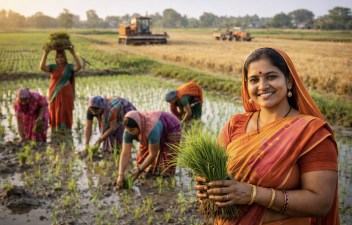
Agriculture remains a vital sector in India’s economy. In 2026, the United Nations declared it the International Year of the Woman Farmer (IYWF 2026). This recognises women’s crucial role in farming and allied activities worldwide. India hosted the Global Conference on Women in Agri-Food Systems (GCWAS-2026) in New Delhi, focusing on gender-inclusive agricultural development.
Women’s Role in Agriculture
Women make up 80% of rural agricultural workers in India. They work as labourers, self-employed farmers, and entrepreneurs. Their involvement spans crop production, livestock, agroforestry, processing, and marketing. Women’s participation boosts food security, rural livelihoods, and agricultural growth. IYWF 2026 aims to improve women’s access to land, finance, technology, and markets, promoting economic empowerment.
Government Schemes Supporting Women Farmers
Several schemes strengthen women’s role in agriculture. The Agriculture Infrastructure Fund (AIF) provides loans for storage and farm assets with interest subvention. The Integrated Scheme for Agricultural Marketing (ISAM) offers subsidies for marketing infrastructure. The Namo Drone Didi programme supplies drones to women’s self-help groups, encouraging technology use. The National Beekeeping and Honey Mission (NBHM) promotes scientific beekeeping for income generation. The Pradhan Mantri Kisan Samman Nidhi (PM-KISAN) gives direct income support to farmers, with 25% benefits reaching women.
Institutional and Community Support
Institutions like MANAGE, ICAR-CIWA, and NGRCA provide training, research, and gender-responsive agricultural technologies. Farm Machinery Training and Testing Institutes (FMTTIs) train women in mechanisation. Krishi Sakhis, trained women para-extension workers, offer grassroots support and advice. The Mahila Kisan Sashaktikaran Pariyojana (MKSP) and Agricultural Technology Management Agency (ATMA) promote skill development and food security groups among women. Farmer Producer Organizations (FPOs) unite women farmers for collective marketing and better incomes.
Impact and Innovations
Women-led FPOs are growing, with many having majority women members. Innovative farming models and gender-friendly tools help reduce women’s workload. Success stories like Kamini Nathsharma from Odisha illustrate how training and integrated farming improve incomes and nutrition. Technology adoption through drones and mechanisation is rising. Financial inclusion and capacity building empower women to become agri-entrepreneurs and leaders.
Topics for Prelims:
International Year of the Woman Farmer 2026
- Declared by United Nations in 2026.
- Focuses on women’s role in agriculture globally.
- Promotes equitable access to resources and markets.
- Includes global conferences and policy actions.
- Highlights economic empowerment of women farmers.
Key Government Schemes for Women Farmers
- Agriculture Infrastructure Fund (AIF) supports farm storage and assets.
- Integrated Scheme for Agricultural Marketing (ISAM) offers subsidies for infrastructure.
- Namo Drone Didi promotes drone technology for women SHGs.
- PM-KISAN provides direct income support to farmers.
- National Beekeeping and Honey Mission (NBHM) enhances beekeeping livelihoods.
Women Farmer Support Institutions
- MANAGE trains extension professionals with gender focus.
- ICAR-CIWA researches women-friendly agricultural technologies.
- NGRCA coordinates gender-responsive agricultural policies.
- Krishi Sakhis provide grassroots extension services.
- FMTTIs train women in farm machinery operation.
Questions for Mains:
- Discuss in the light of India’s agricultural growth, the role of women farmers and the impact of government schemes like PM-KISAN and AIF on their empowerment. [GS-III-Economic Development]
- Critically examine the significance of Farmer Producer Organizations (FPOs) in enhancing women’s participation and income in Indian agriculture. [GS-III-Economic Development]
- Explain the role of technology adoption, such as drones and mechanisation, in transforming women’s agricultural productivity and livelihoods. With suitable examples, discuss the challenges faced in technology diffusion among rural women farmers. [GS-III-Science & Technology]
- Comment on the importance of gender-responsive institutional support and community-based extension services like Krishi Sakhis in promoting sustainable and inclusive agriculture. How can these models be scaled up across India? [GS-II-Governance]
Answer Hints:
1. Discuss in the light of India’s agricultural growth, the role of women farmers and the impact of government schemes like PM-KISAN and AIF on their empowerment. [GS-III-Economic Development]
- Women constitute 80% of rural agricultural workers; contributors to crop production, livestock, processing, and marketing.
- Women’s participation enhances food security, rural livelihoods, and overall agricultural growth in India.
- PM-KISAN provides direct income support (Rs 6,000 annually), with around 25% benefits going to women, improving economic security and financial inclusion.
- Agriculture Infrastructure Fund (AIF) offers loans with interest subvention for post-harvest infrastructure, supporting women farmers’ access to credit and reducing post-harvest losses.
- Government schemes collectively improve women’s access to resources, technology, markets, and training, leading to empowerment and increased agricultural productivity.
- Empowerment through these schemes promotes women’s leadership, decision-making, and economic independence in rural India.
2. Critically examine the significance of Farmer Producer Organizations (FPOs) in enhancing women’s participation and income in Indian agriculture. [GS-III-Economic Development]
- FPOs unite small, marginal, and women farmers to collectively produce, process, and market agricultural products, enhancing bargaining power.
- Women-led FPOs are growing; over 1,175 FPOs have 100% women shareholders, promoting inclusivity and women’s leadership.
- FPOs improve market access, reduce intermediaries, and provide economies of scale, leading to higher incomes for women farmers.
- Government support through equity grants and credit guarantees strengthens FPOs’ financial stability and outreach.
- FPOs facilitate capacity building, skill development, and technology adoption among women farmers.
- Challenges include ensuring sustained participation, governance capacity, and equitable benefit sharing within FPOs.
3. Explain the role of technology adoption, such as drones and mechanisation, in transforming women’s agricultural productivity and livelihoods. With suitable examples, discuss the challenges faced in technology diffusion among rural women farmers. [GS-III-Science & Technology]
- Technologies like drones (Namo Drone Didi scheme) enhance efficiency in spraying, monitoring, and precision farming for women SHGs.
- Mechanisation through Farm Machinery Training and Testing Institutes (FMTTIs) trains women in operating equipment, reducing drudgery and increasing productivity.
- Women-friendly tools developed by ICAR-CIWA reduce workload and promote sustainable practices (e.g., pedal-operated coconut dehusker, rotary goat feeding system).
- Technology adoption leads to diversified livelihoods, higher incomes, and women’s empowerment as agri-entrepreneurs.
- Challenges include limited awareness, affordability, socio-cultural barriers, lack of training, and limited access to credit and infrastructure.
- Scaling up requires targeted training, financial support, gender-sensitive extension services, and community involvement.
4. Comment on the importance of gender-responsive institutional support and community-based extension services like Krishi Sakhis in promoting sustainable and inclusive agriculture. How can these models be scaled up across India? [GS-II-Governance]
- Institutions like MANAGE, ICAR-CIWA, and NGRCA provide gender-focused training, research, and policy guidance to empower women farmers.
- Krishi Sakhis, trained women para-extension workers, offer doorstep advisory services in natural farming, soil health, and sustainable practices, enhancing grassroots outreach.
- Community-based extension bridges knowledge gaps, encourages adoption of eco-friendly agriculture, and strengthens women’s participation and leadership.
- Scaling up requires increased investment in training, expanding Krishi Sakhi networks, integrating digital tools, and strengthening institutional coordination.
- Policies should incentivize gender mainstreaming in agricultural extension and promote partnerships with NGOs, SHGs, and local bodies.
- Replicating successful models across states with contextual adaptation can ensure sustainable and inclusive agricultural development nationwide.