
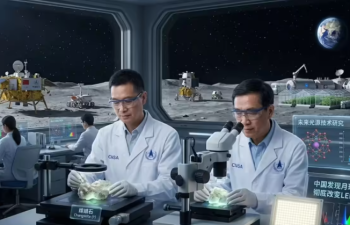
On 23 April 2026, researchers in China announced the discovery of Cerium–Magnesium Changesite, the 11th new lunar mineral identified by Chinese scientists. The mineral was found in a 44-gram solid lunar meteorite with a dark molten shell, which was the first Moon meteorite recovered in China.
Mineral Features
Cerium–Magnesium Changesite is colourless, transparent and brittle. Its microscopic grain size is usually less than 10 micrometres, with particles ranging from about three to 25 micrometres. The mineral also has a distinct fluorescence effect.
Scientific Classification
The discovery was made by the China Geological Survey, which works on mineral identification and geological research in China. Lunar minerals are classified through laboratory analysis of meteorite samples, crystal structure and chemical composition.
Relevance to Materials Science
The mineral contains a rare-earth element ratio that has been linked to possible applications in high-efficiency LED technology. Rare-earth elements such as cerium are used in phosphors, display materials and lighting components.
Lunar Geology Context
Scientists have stated that the mineral formed under physical conditions of temperature and pressure, and chemical conditions, that are different from those on Earth. Lunar meteorites are fragments of the Moon that reach Earth after impact events on the lunar surface.
Name and Origin
The name Changesite is associated with China’s lunar exploration programme and Chang’e, the moon goddess in Chinese mythology. Lunar mineral names are approved through international mineral nomenclature procedures. Cerium–Magnesium Changesite is the 11th new lunar mineral identified by Chinese researchers. Lunar meteorites are important samples for studying the mineralogy and geochemistry of the Moon.
Last Modified: April 24, 2026