
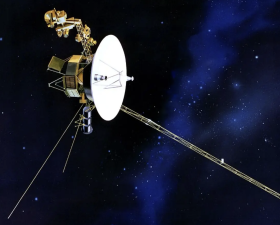
Voyager 1 is set to become the first human-made object to reach a distance of one light-day from Earth by November 2026. The milestone will mark another record for the spacecraft, which has been travelling through deep space for nearly five decades and remains the most distant object ever built by humans.
Historic Deep-Space Mission
Voyager 1 was launched in 1977 during a rare planetary alignment that occurs roughly once every 175 years. This alignment enabled gravity-assist manoeuvres past the outer planets. The probe flew by Jupiter and Saturn, where it discovered new moons, ring features and important atmospheric phenomena. It then continued on a trajectory out of the solar system.
First Spacecraft in Interstellar Space
In August 2012, Voyager 1 became the first spacecraft to cross the heliopause, the boundary where the Sun’s influence gives way to interstellar space. As of August 2024, it was about 164.7 astronomical units from Earth and travelling at around 38,000 miles per hour relative to the Sun. Four instruments remain active to study cosmic rays, magnetic fields and plasma waves.
Communication Challenges at Extreme Distance
At one light-day, radio signals will take 24 hours to reach Voyager 1 and another 24 hours for a reply to return. The spacecraft currently transmits data at only 160 bits per second. Its weak signals must be collected by multiple antenna arrays on Earth. This extreme delay makes real-time control impossible and limits the amount of data engineers can receive.
Autonomy and Mission Extension
Voyager 1 was built with onboard autonomy so it can enter a safe state if problems arise. To extend the mission, NASA has gradually shut down non-essential instruments and systems to conserve power. The spacecraft continues to provide rare scientific data from interstellar space, making it a unique asset in solar system exploration.
Last Modified: April 26, 2026