
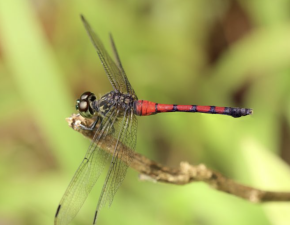
Researchers have confirmed a new dragonfly species, Lyriothemis keralensis, from the low-lying coastal regions of Kerala. Commonly called the Slender Bombardier, it was formally identified after more than a decade of study. The species was first noticed in 2013 in the Varappetty area of Kothamangalam and was initially mistaken for Lyriothemis acigastra, the Little Bloodtail. Later examination of specimens, including older museum material, established that it was a distinct species.
Discovery and Identification
The species was described by a research team led by Dr Dattaprasad Sawant, Dr A Vivek Chandran, Renjith Jacob Mathews and Dr Krushnamegh Kunte. Their findings were published in the International Journal of Odonatology. The identification process took over ten years and involved detailed comparison of body structure, genital features and behaviour.
Distinct Physical Features
- The species has a slimmer abdomen than the Little Bloodtail.
- It has a distinct tail and genital structure.
- Males show a deep blood-red abdomen with black markings.
- Females are broader and have yellow and black colouring.
- The dragonfly is about three centimetres long.
Habitat and Seasonal Behaviour
Unlike many dragonflies linked to forest ecosystems, Lyriothemis keralensis thrives in human-modified agricultural landscapes. It has been found in pineapple and rubber plantations, especially in shaded canals and seasonal pools. The species appears during the monsoon and disappears after the rains, suggesting a strong dependence on temporary microhabitats.
Conservation Significance
The discovery marks the ecological value of farmlands and other non-forest habitats. Researchers have stressed that biodiversity protection must extend beyond protected forests. Since the species depends on fragile local water bodies within plantations, its survival may be affected by land-use changes, drainage and habitat loss. The finding also adds to India’s growing record of odonate diversity and underlines the importance of field surveys and museum collections in species discovery.
Last Modified: April 28, 2026