
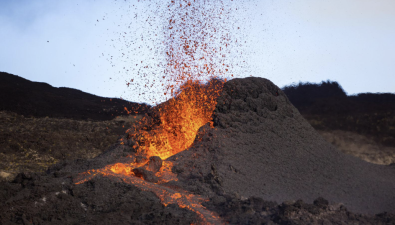
Piton de la Fournaise, one of the world’s most active shield volcanoes, has entered a new effusive phase on the island of La Réunion in the Indian Ocean. The latest eruption began after renewed seismic activity beneath the summit and is confined to the Enclos Fouqué caldera on the south-south-east flank. Lava continues to flow within the uninhabited volcanic enclosure, while authorities have restricted access as a precaution.
Latest Eruption and Lava Movement
The eruption started at 10:06 local time on 13 February after a seismic crisis beneath the summit. Fissures opened inside the Enclos Fouqué, and lava flows moved down the Grandes Pentes. By the afternoon, the lava front had descended to around 1,500 metres elevation. Later, it approached National Road 2 in the Route des Laves sector, though the road remained open.
Safety Measures and Access Restrictions
Authorities activated ORSEC Alert 2–1, which applies to eruptions inside the Enclos without direct threat to people, property, or the environment. The Enclos Fouqué was fully closed from all access points, including Pas de Bellecombe-Jacob. Gendarmerie units evacuated hikers present within the caldera. Drivers on RN2 were told not to stop in order to prevent congestion and accidents.
Monitoring and Volcanic Activity
On 13 February, monitoring networks recorded 551 summit volcano-tectonic earthquakes, along with two deeper events. GNSS data showed inflation at summit stations and at more distant stations, indicating pressurisation of both shallow and deeper magmatic sources. No ash emissions were reported, and no populated areas are currently threatened.
January Eruption and Renewed Unrest
The 2026 activity began on 18 January with an eruption following a seismic crisis beneath the summit. Four fissures opened inside the caldera, but lava fountains remained modest and flows stayed confined within the enclosure. Surface effusion ended on 20 January. In the following days, shallow earthquakes, long-period events, and renewed summit inflation indicated continuing pressure in the magmatic system. A further swarm of 343 very small earthquakes on 6 February suggested a small magma intrusion before the latest eruption.
Last Modified: April 28, 2026