
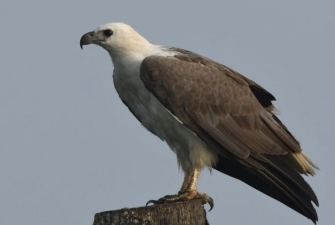
The annual nest monitoring survey of the White-bellied Sea Eagle has recorded 17 active nesting sites in Kannur and Kasaragod districts this season. This is a modest rise from 13 sites in 2024, but the number remains below historical levels. The survey marks both a partial recovery and the continuing need for habitat protection in Kerala’s coastal belt.
Survey Findings
The survey was jointly conducted by the Malabar Awareness and Rescue Centre for Wildlife and the Social Forestry Divisions of Kannur and Kasaragod. It identified 10 active nests in Kasaragod and seven in Kannur. In Kasaragod, all nests were old. In Kannur, four were newly recorded and three were old. Records from 1996 had shown 25 active nesting sites, indicating that the species has not yet returned to earlier levels.
Habitat and Nesting Pattern
The species showed a strong preference for large, mature trees. Nests were found on Ficus religiosa, Mangifera indica, Alstonia scholaris and Casuarina species. Around 70% of the nests in Kasaragod were located inside temple compounds. In Kannur, nests were spread across public lands, private properties and coastal stretches. For the first time, one nest was found on a telephone tower at Kattampally, showing adaptability to changing landscapes.
Conservation Significance
The White-bellied Sea Eagle breeds mainly between January and March. It often returns to the same nest each year and renovates it before breeding. The species is an apex predator in coastal ecosystems and is regarded as an indicator of marine and coastal environmental health. In Kerala, it is known to nest only in Kannur and Kasaragod. The survey underlines the importance of protecting tall trees in inhabited and coastal areas, since tree loss remains a major threat.
Protection Measures Needed
Officials have stressed that conservation depends on safeguarding nesting trees and reducing disturbance near active sites. The public has been asked to report additional nesting locations to the Forest department or MARC to support continued monitoring and protection.
Last Modified: April 28, 2026